By Melinda Jo Ray | March 26, 2026
Hood County was formed in November 1866 by an act of the Eleventh Texas Legislature. The area had been within the Mexican Municipality of San Felipe de Austin as early as 1823 and became part of the Municipality of Viesca in 1834. After Texas became a republic, the area now known as Hood County was, at one time or another, been part of Robertson, Navarro, McLennan, Erath, and Johnson counties. The formation of a new county mostly comprised of the western half of Johnson county was discussed as early as the late 1850’s, but the tumult of the U. S. Civil War delayed a decision for several years. Indeed, the formation of the county in 1866 was the occasion of a little-known battle between the state legislature and the governor because of the political chaos that followed the war. We were, in fact, the county that almost WASN’T.
When President Abraham Lincoln was killed in April 1865, his death opened the door for a huge political battle between the new president, Andrew Johnson, and the Congress of the United States over the process by which the southern rebel states would be readmitted to the Union. Johnson put forth a fairly lenient plan, while Congress mostly advocated a much more stringent set of requirements that included several provisions southern lawmakers found very unpalatable. This controversy between the president and the Congress lasted for over a year. During that time the southern states were left basically in limbo, defeated, conquered, and not yet fully reinstated as part of the Union. For that reason, the state legislatures of those states did not have official permission to operate. Finally, President Johnson gave some permission under his more lenient terms, but Congress’ terms were still different. So, when the Texas Legislature met in its Eleventh Session in 1866, it had permission from the president but not from Congress.
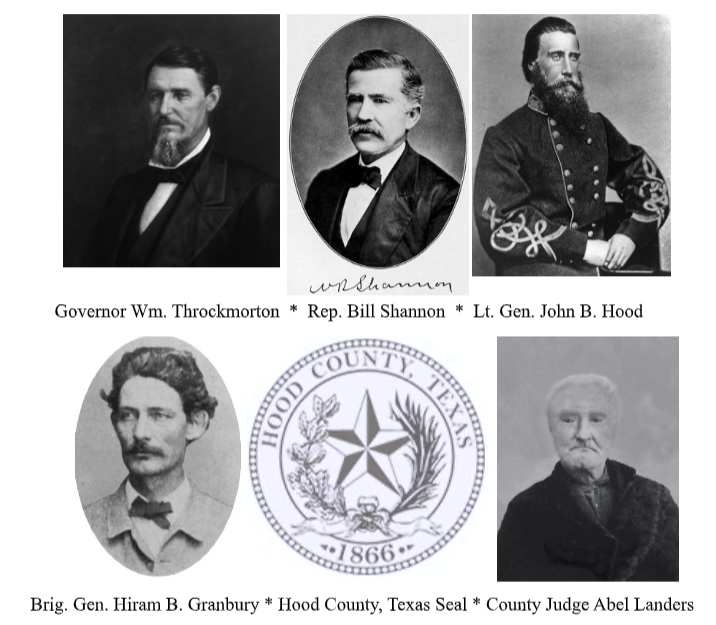
The governor at the time, William Throckmorton, was a moderate, and kept trying to pressure the legislature to meet the additional requirements from Congress so the state’s government could legally operate unimpeded. Through the spring and summer of 1866, the Texas Legislature met, in spite of the concerns of the governor. During that time they took a series of actions (or refusals to action) that were “In your face” defiance of the rules being put out by Congress. Among those acts was the bill for formation of just one new county in the state. The bill, sponsored by the representative from Johnson County, William Shannon, stipulated that the legislative committee had decided to name that one new county and its county seat after two of the Confederate officers Shannon had served under during the war. The county was to be named after Lt. General John Bell Hood, and the county seat was to be named in honor of General Hiram Bronson Granbury. The governor, who was fighting to prevent a Federal Declaration of Martial Law and takeover of government in Texas, was horrified. Convinced that the formation of a county with names so associated with the Confederacy could be the straw that broke the camel’s back with Congress, Throckmorton vetoed the bill and sent it back to committee with instructions to change the names.
Defiant, Shannon and the committee members refused and once again sent the bill to floor where it was passed once again. For a second time, Throckmorton angrily vetoed it, sending a letter saying, basically, you guys can keep doing this but I’m gonna veto this thing every time. Get over it and fix the names. By this time, it was well into October, and the legislative session was nearing its end. For a third time the committee sent the Hood County formation legislation to the floor. Again, it passed. Again, it was sent to the governor. By this time the governor was livid. He vetoed the legislation a third time. Being told that Shannon had finally gotten enough votes to override his veto, Throckmorton sent the committee a letter along with his veto reiterating vehemently his fears of the consequences of their actions. The letter was ignored and the bill for the formation of Hood County passed the legislature with one vote more than the number necessary to override the governor’s veto. The proclamation was signed into law and the eleventh session of the Texas Legislature adjourned. This was their final act. Three months later, in early 1867, federal troops marched into Austin, the legislature and all government offices were declared vacant, and martial law was declared.
Further turmoil ensued when the new carpetbagger legislature tried to rescind the names of the new county and county seat. One representative from Galveston pushed hard to rename the county seat Rubyville, after his daughter. But, the list of other deviances by the Texas Legislature was so long that the reconstruction government decided to let the formation and names of Hood County and Granbury stand. Abel Landers, a popular local man who was a known moderate in politics, was appointed county judge and given authority to hold local elections to fill the seats of local government. The results of those elections were subject to the approval of the reconstruction government in Austin.
A series of meetings was held in Acton, Stockton, Thorp Springs, and GlenRose Mills, in lieu of a formal countywide election since voter eligibility was a question still very much up in the air. The inclination of the men to elect to leadership positions the men who had so recently led them in battle was understandable, but Abel Landers over and over reminded them of the looming constraints most likely coming from afar. He welcomed participation and leadership of former soldiers in the process but preached the wisdom of allowing the older generation of non-combatants to serve as the elected community leaders – county commissioners and such – for a while longer. He pointed out this the allowed the younger men to focus on rebuilding lives and livelihoods so disrupted by the recent years of war.
Judge Landers consulted with leaders in each community and chose four older men of strong leadership reputation as commissioners for his police court. C.C. Alexander and Wilson Barker from the area near Glen Rose Mills and Barnard’s Trading Post, John Meek from over along the Paluxy, and Joe Robertson, the fiery preacher from Acton, were all eager to serve to promote the interests of the folks in their various parts of the county. C.C. had been county judge over the entirety of Johnson County for a time a few years back and so was a good source of information and comradery to Judge Landers in the daunting task at hand.
When the dust settled, in January of 1867, and the police court met at Abel’s cabin in Stockton for the first ever meeting of the Hood County Commissioners or Police Court, thirty or so observers gathered to watch. After discussing the consensus built at each of the far-flung county meetings, Abel Landers announced the election of Peter Garland, who had been a leader in protecting all from the Indians during the war years, as county treasurer, Gideon Mills a literate Scots-Irish farmer from over Paluxy way as tax assessor and collector, and John Morris a miller from over near Walnut Creek in Acton as clerk for the district court.
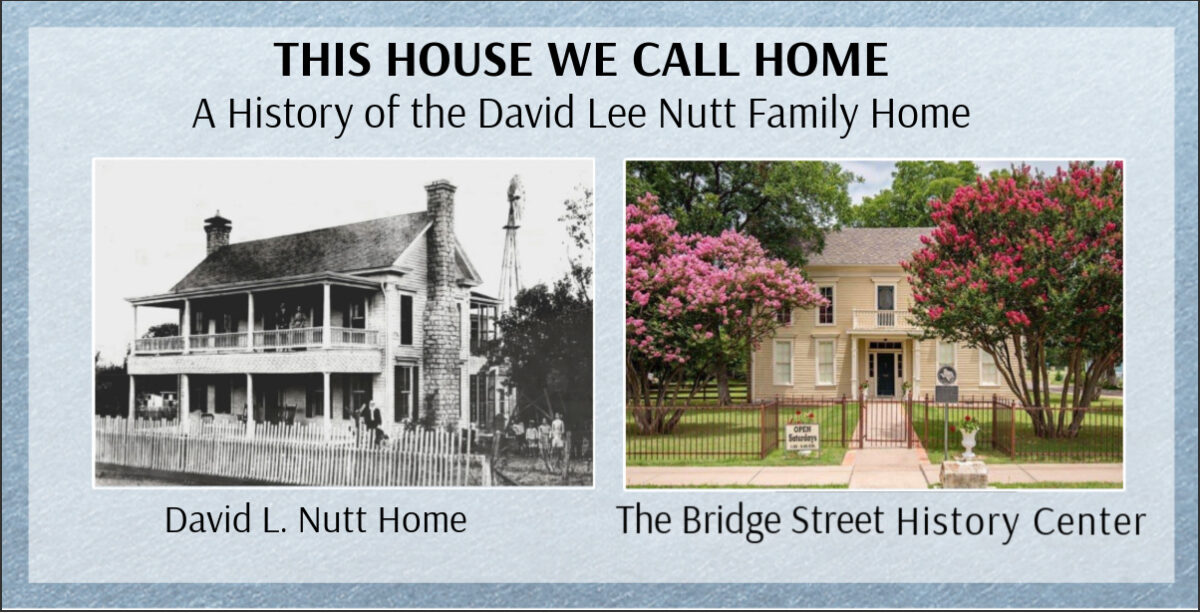
In spite of Abel’s advice to the contrary, the other two persons elected were former Confederate officers. A.J. Wright, husband to one of the Nutt’s daughters was elected as county sheriff. Relative newcomer, Alex McCamant, who had fought with one of the Indian protection regiments out in West Texas with some of the local men, was the new county clerk. He was a surveyor by trade, so many figured that made sense for him to have the office that dealt so much with the affairs of land ownership. These two elections did indeed end up being overturned by the military government amid much turmoil. Eventually, two local non-combatants in the war were chosen as replacements: John Hightower as Sheriff, with Wright hired as his deputy and blind businessman, Jesse F. Nutt as County Clerk with Alex McCammant working as his assistant and scribe.