PLEASANT THORP: PIONEER AND VISIONARY

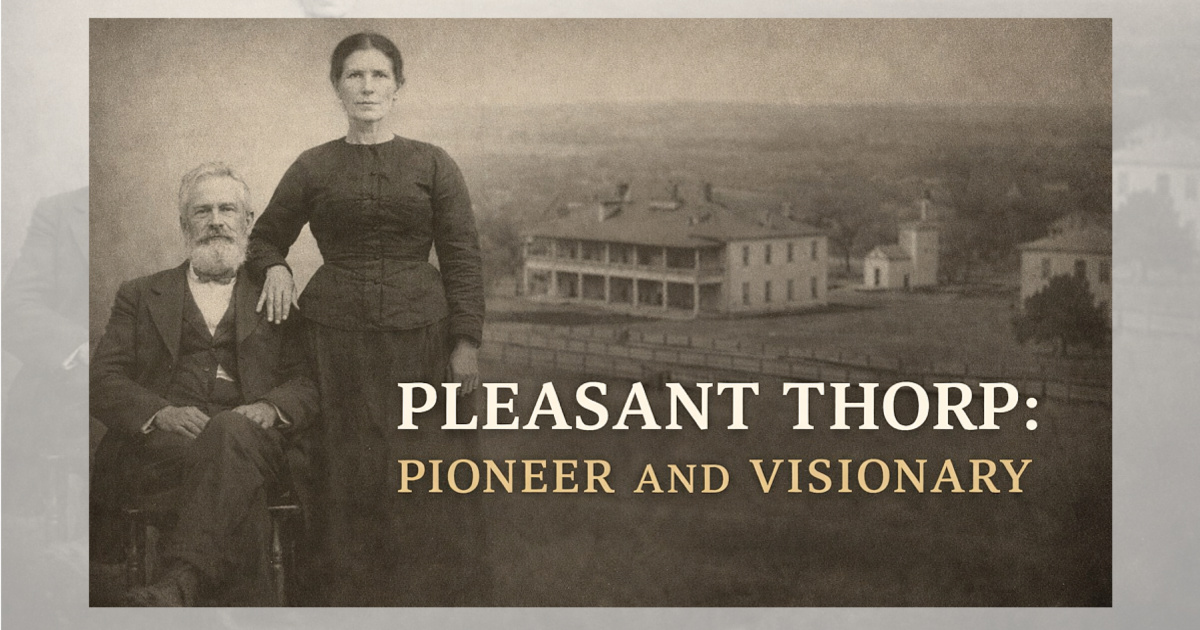
Pleasant Thorp and wife Nancy, pioneers of Thorp Spring in Hood County Texas

A hardy pioneer from Virginia, Pleasant Earl Thorp settled on the west banks of the Brazos River in 1854.  Naming the spot for himself and nearby springs in a branch of Stroud’s Creek, Thorp envisioned not just another settlement but an important town, and he spent almost the next forty years making the dream come true.  At his death in 1890, the eighty-one-year-old pioneer had lived to see his vision become reality. In that year the town’s population was over 1,000, and it was known statewide. Many later, lesser settlements are now familiar names. But Thorp’s dream blossomed only for a short, glorious season, then withered.  By 1980, the population of the once-vibrant town was estimated at 184.  Pleasant Thorp could not have been pleased. 

The young blacksmith wandered to the wild place called Tejas while it was still under Mexico’s oppressive rule.  He fought in the 1836 revolution for the Republic of Texas, married a young widow named Nancy Hicks Oldham McEwen, and started raising a family in Burleson County of the lower Brazos Valley, beginning a lifelong love affair with the country along the banks and bluffs of the Brazos River. But he was not yet content to settle down.  He dreamed of more and better land, for running cattle, horses, with some set aside for farming…perhaps a great rock house on a gentle slope…maybe even a settlement, with his name on it.  Thorp’s vision was northwest, upriver, in the heart of Comanche country. Pleasant knew the spot – he had seen it. In January of 1841, he rode with Brig. Gen. Edwin Morehouse’s Indian hunting expedition, penetrating far up the Brazos.  The expedition proved futile, but Thorp wouldn’t forget what he saw upriver around a majestic double-mesa, the river weaving a pattern around it.  He saw the land he wanted a certain spot, beside a stream with a natural spring nearby. Pleasant knew that someday he would be back to get it.

Someday came in the early 1850s. At last, Thorp made his move.  Over the years, he grew his stack of land certificates – trading, buying–adding to his 340-acre land grant in what would become Hood County.  In 1853, he made the long ride upriver to survey his more than 18,000 acres as well as Nancy’s father’s claim of 1,280 nearby. It was a very different place “where the Cross Timbers seemed to struggle between mountain and valley for room.”  It was a land to test even hardy pioneers. Treeless for miles, then thickly wooded. Rising above it all was the ancient double-mesa companion to the Brazos, Comanche Peak, which loomed just a few miles from Pleasant’s land.

In 1854, the family became the first settlers on the west banks of the Brazos in that area.  Shortly after the move, another girl was born – Nancy Elizabeth, “Lizzie,” was the first white child born in a brand-new frontier outpost called Thorp Spring – Pleasant’s town. Setting aside land for the townsite, Thorp feverishly pursued his plans.  Streets were laid out forty feet wide; and work was started on the big stone house, with Thorp’s few slaves providing most of the labor.  But after five years, there were only a few families settled at the village.  But there were still other settlers nearby and Thorp was not discouraged. 

The year 1860 was hard for the area that would become Hood County.  Storm clouds of the Civil War were gathering. Pleasant didn’t suffer financially, for he was frugal.  In that “bad” year, his real estate was valued at $56,000 and personal assets at $18,000, a fortune at that time.  And even more land came to the family when Nancy’s father died, leaving her an adjoining 640 acres. But with secession came realities of war and frontier conditions deteriorated.  Most young men joined the Confederate army.  Federal troops left the area, inviting Indian attacks. Many frightened settlers deserted the area.  But Pleasant was not about to abandon his dream or his land – the Thorps were there to stay.  

After the war, a semblance of “normalcy” came. More settlers pushed into and past Hood County, and relative peace settled into the area. More people soon settled in and around Thorp Spring; and, to Pleasant’s delight, the town began to flourish.  He came to be known as “Col. Thorp,” an honorary title often given to flamboyant or powerful figures.  And the spacious house, begun before the war, was finally completed. It was “a showplace of rock and boards brought from New Orleans by ox-cart,” — a real mansion for its time.   Shaded by a towering live oak, it boasted a panoramic view of the town, Comanche Peak, and Pleasant’s beloved Brazos River.

In the 1870s, a colorful character appeared. Capt. Sam Milliken, a Kentuckian who had plied the Ohio and Mississippi rivers as owner of several steamboats, was lured to Thorp Spring by its location and excellent water.  Milliken invested heavily, buying a large portion of Thorp’s acreage.  Some of Milliken’s land was on Sulphur Spring Branch, and his vision was to promote the springs as a summer resort.  The place was already known, having been a rendezvous for frontier soldiers.  Families vacationed there, and it was not unusual to see up to 100 campsites in the area. Milliken opened a feedlot and livery stable in anticipation of stage coach teams, and travelers’ stock.  He built a comfortable house to welcome tourists, a springhouse and bathhouses to accommodate the visitors he hoped to draw for bathing, swimming and boating. His wife welcomed overnight guests with appetizing meals and clean beds.  The venture became a great success in the 1870s, attracting a large share of the traveling public.

The town square boasted a variety of enterprises and, of course, the post office.  Local religious sentiment did prohibit the saloons found in nearby towns. Nonetheless, the village became a relay point for mail coaches on the Texas – Fort Yuma stage route, longest in the world in 1879.  Originating in Fort Worth, with the Concord coach and six-horse team to Thorp Spring often loaded with tourists as well as mail, it switched to a two-horse surrey going on westward. Pleasant’s vision was becoming a busy, well-known place, and not just as a resort.  In 1872, Pleasant decided on a bold move – to build a school – not just a cabin for one teacher, but a college, with one fine building at first.  He chose a six-acre site west of his house, on the highest point of the townsite, built a two-and-a-half story white limestone building. and began a search for staff.  The story of the college which prospered for many years in Thorp Spring is told later in this volume. But suffice it to say that for a time both the college and the town prospered, the population peaking by 1890. In that year, Col. Thorp died, with most of his dream intact.

There were many other contributors to the town – farmers, ranchers, doctors, lawyers, shopkeepers, teachers, and preachers.  However, the leaders in the early days had been two men of different, though complementing, styles – the stoic Thorp, with land and capital, and the flamboyant Milliken, affable promoter-speculator.  What this partnership lacked was the personality or inclination for “playing politics.” There were two bad omens of things to come and both events were largely the result of a lack of political influence.  After Hood County’s boundaries were defined in 1866, Thorp Spring came in second in a hot political war that ended up locating the county seat in Granbury, then called Lambert Branch.  Later, aggressive politics again came into play when the all-important Fort Worth & Rio Grande Railroad route was also set through Granbury. Those two defeats didn’t seem to matter for a time, though there were lingering bitter feelings. But they eventually emerged as the first two strikes against the stability of Thorp Spring.  The third strike came as a series of other events just prior to the turn of the century.

Capt. Milliken was killed trying to stop a team of runaway horses. Larger and finer vacation spots were developed, tourism dropped off sharply at the resort on Sulphur Spring Branch, and it was closed.  The cotton gin burned and, with the coming of the railroad through Granbury, stagecoaches were phased out.  The loss of Milliken and Thorp, the prime movers, was a blow.  But, in 1895, the decision was made to relocate AddRan Christian University to Waco and that was the final blow from which the town would not recover. There was a gradual withering.  Some businesses closed or moved away.  After AddRan left, Thorp Spring kept a college for years, but never so large, and the school was closed for the last time in 1930. Pleasant and Nancy Thorp’s “showplace” home was occupied for years by their son Jim’s family. Jim’s son, John, died there alone in 1935. In disrepair, the house partially collapsed and was finally razed.  

What remains of a pioneer’s vision sleeps by the swollen Brazos near where it becomes a full lake and water backs up to cover the springs that bubbled up cold sulfur water.  There’s no downtown, just a smattering of churches, a grocery store, and a couple of service stations along the highway.  The hilltop where Thorp’s first college stood is bare; the nearby university campus a lonely sight. A few ancient structures and foundations barely suggest the grandeur of a bygone day. The stop on the major stage route no longer has a post office.  Acreage Thorp gave to the county for a park at the spring sits untended by backed-up water. Pleasant and Nancy Thorp are buried with many descendants and other pioneer settlers in the old cemetery right outside of “town” on a hill above Blue Branch of Stroud’s Creek, under the ever-watchful eye of Comanche Peak, and just a stone’s throw from the Brazos River — always the river…

Written By Melinda Jo Ray
Setting the Record Straight: How We Got Those Names!

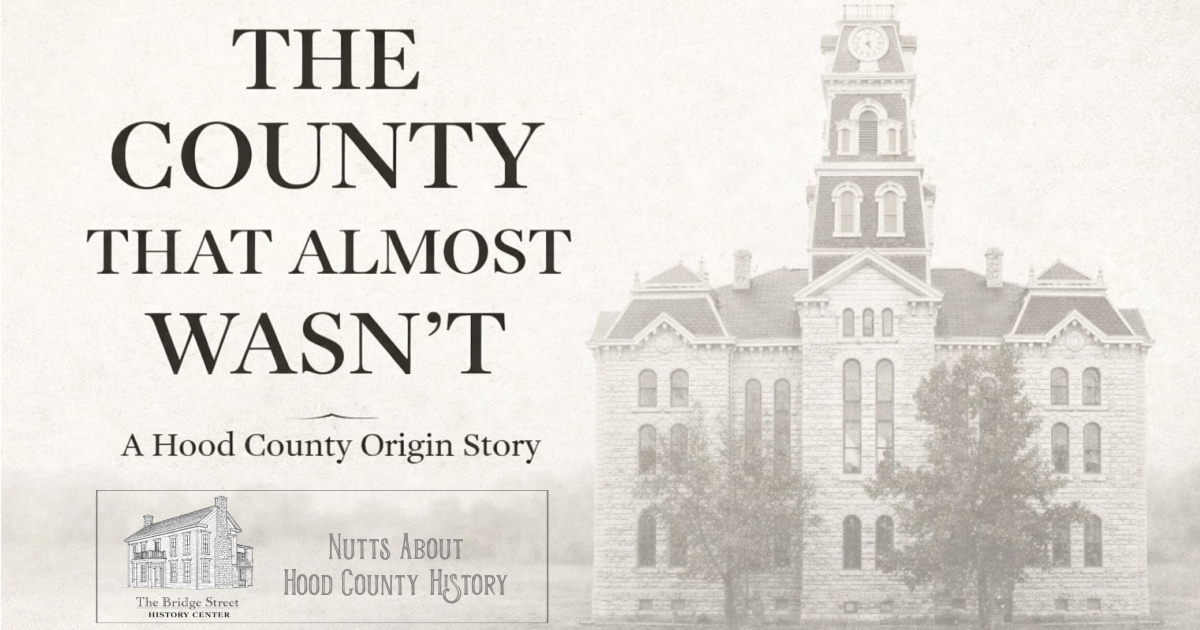
Historic Hood County Courthouse in Granbury Texas representing the county that almost wasn’t after Civil War political conflict

By Melinda Jo Ray | March 26, 2026

Hood County was formed in November 1866 by an act of the Eleventh Texas Legislature. The area had been within the Mexican Municipality of San Felipe de Austin as early as 1823 and became part of the Municipality of Viesca in 1834. After Texas became a republic, the area now known as Hood County was, at one time or another, been part of Robertson, Navarro, McLennan, Erath, and Johnson counties. The formation of a new county mostly comprised of the western half of Johnson county was discussed as early as the late 1850’s, but the tumult of the U. S. Civil War delayed a decision for several years. Indeed, the formation of the county in 1866 was the occasion of a little-known battle between the state legislature and the governor because of the political chaos that followed the war. We were, in fact, the county that almost WASN’T.

When President Abraham Lincoln was killed in April 1865, his death opened the door for a huge political battle between the new president, Andrew Johnson, and the Congress of the United States over the process by which the southern rebel states would be readmitted to the Union. Johnson put forth a fairly lenient plan, while Congress mostly advocated a much more stringent set of requirements that included several provisions southern lawmakers found very unpalatable. This controversy between the president and the Congress lasted for over a year. During that time the southern states were left basically in limbo, defeated, conquered, and not yet fully reinstated as part of the Union. For that reason, the state legislatures of those states did not have official permission to operate. Finally, President Johnson gave some permission under his more lenient terms, but Congress’ terms were still different. So, when the Texas Legislature met in its Eleventh Session in 1866, it had permission from the president but not from Congress.

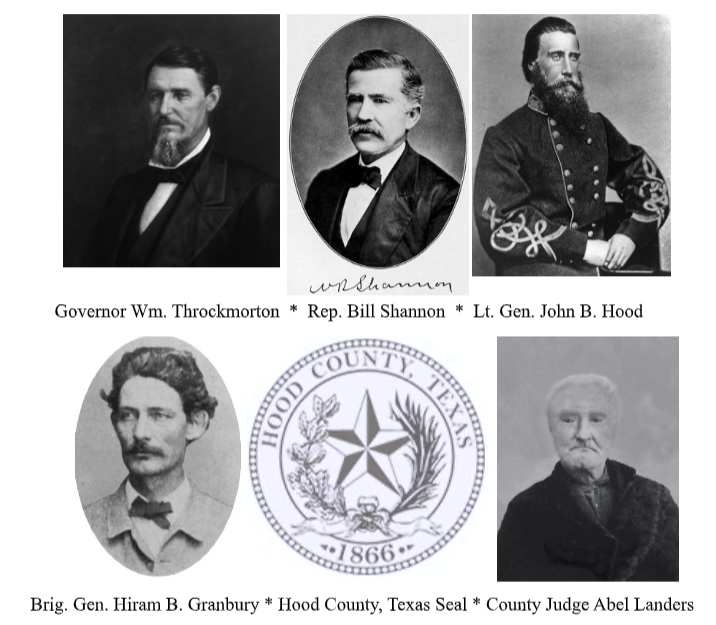
The governor at the time, William Throckmorton, was a moderate, and kept trying to pressure the legislature to meet the additional requirements from Congress so the state’s government could legally operate unimpeded. Through the spring and summer of 1866, the Texas Legislature met, in spite of the concerns of the governor. During that time they took a series of actions (or refusals to action) that were “In your face” defiance of the rules being put out by Congress. Among those acts was the bill for formation of just one new county in the state. The bill, sponsored by the representative from Johnson County, William Shannon, stipulated that the legislative committee had decided to name that one new county and its county seat after two of the Confederate officers Shannon had served under during the war. The county was to be named after Lt. General John Bell Hood, and the county seat was to be named in honor of General Hiram Bronson Granbury. The governor, who was fighting to prevent a Federal Declaration of Martial Law and takeover of government in Texas, was horrified. Convinced that the formation of a county with names so associated with the Confederacy could be the straw that broke the camel’s back with Congress, Throckmorton vetoed the bill and sent it back to committee with instructions to change the names.

Defiant, Shannon and the committee members refused and once again sent the bill to floor where it was passed once again. For a second time, Throckmorton angrily vetoed it, sending a letter saying, basically, you guys can keep doing this but I’m gonna veto this thing every time. Get over it and fix the names. By this time, it was well into October, and the legislative session was nearing its end. For a third time the committee sent the Hood County formation legislation to the floor. Again, it passed. Again, it was sent to the governor. By this time the governor was livid. He vetoed the legislation a third time. Being told that Shannon had finally gotten enough votes to override his veto, Throckmorton sent the committee a letter along with his veto reiterating vehemently his fears of the consequences of their actions. The letter was ignored and the bill for the formation of Hood County passed the legislature with one vote more than the number necessary to override the governor’s veto. The proclamation was signed into law and the eleventh session of the Texas Legislature adjourned. This was their final act. Three months later, in early 1867, federal troops marched into Austin, the legislature and all government offices were declared vacant, and martial law was declared.

Further turmoil ensued when the new carpetbagger legislature tried to rescind the names of the new county and county seat. One representative from Galveston pushed hard to rename the county seat Rubyville, after his daughter. But, the list of other deviances by the Texas Legislature was so long that the reconstruction government decided to let the formation and names of Hood County and Granbury stand. Abel Landers, a popular local man who was a known moderate in politics, was appointed county judge and given authority to hold local elections to fill the seats of local government. The results of those elections were subject to the approval of the reconstruction government in Austin.

A series of meetings was held in Acton, Stockton, Thorp Springs, and GlenRose Mills, in lieu of a formal countywide election since voter eligibility was a question still very much up in the air. The inclination of the men to elect to leadership positions the men who had so recently led them in battle was understandable, but Abel Landers over and over reminded them of the looming constraints most likely coming from afar. He welcomed participation and leadership of former soldiers in the process but preached the wisdom of allowing the older generation of non-combatants to serve as the elected community leaders – county commissioners and such – for a while longer. He pointed out this the allowed the younger men to focus on rebuilding lives and livelihoods so disrupted by the recent years of war.

Judge Landers consulted with leaders in each community and chose four older men of strong leadership reputation as commissioners for his police court. C.C. Alexander and Wilson Barker from the area near Glen Rose Mills and Barnard’s Trading Post, John Meek from over along the Paluxy, and Joe Robertson, the fiery preacher from Acton, were all eager to serve to promote the interests of the folks in their various parts of the county. C.C. had been county judge over the entirety of Johnson County for a time a few years back and so was a good source of information and comradery to Judge Landers in the daunting task at hand.

When the dust settled, in January of 1867, and the police court met at Abel’s cabin in Stockton for the first ever meeting of the Hood County Commissioners or Police Court, thirty or so observers gathered to watch. After discussing the consensus built at each of the far-flung county meetings, Abel Landers announced the election of Peter Garland, who had been a leader in protecting all from the Indians during the war years, as county treasurer, Gideon Mills a literate Scots-Irish farmer from over Paluxy way as tax assessor and collector, and John Morris a miller from over near Walnut Creek in Acton as clerk for the district court.

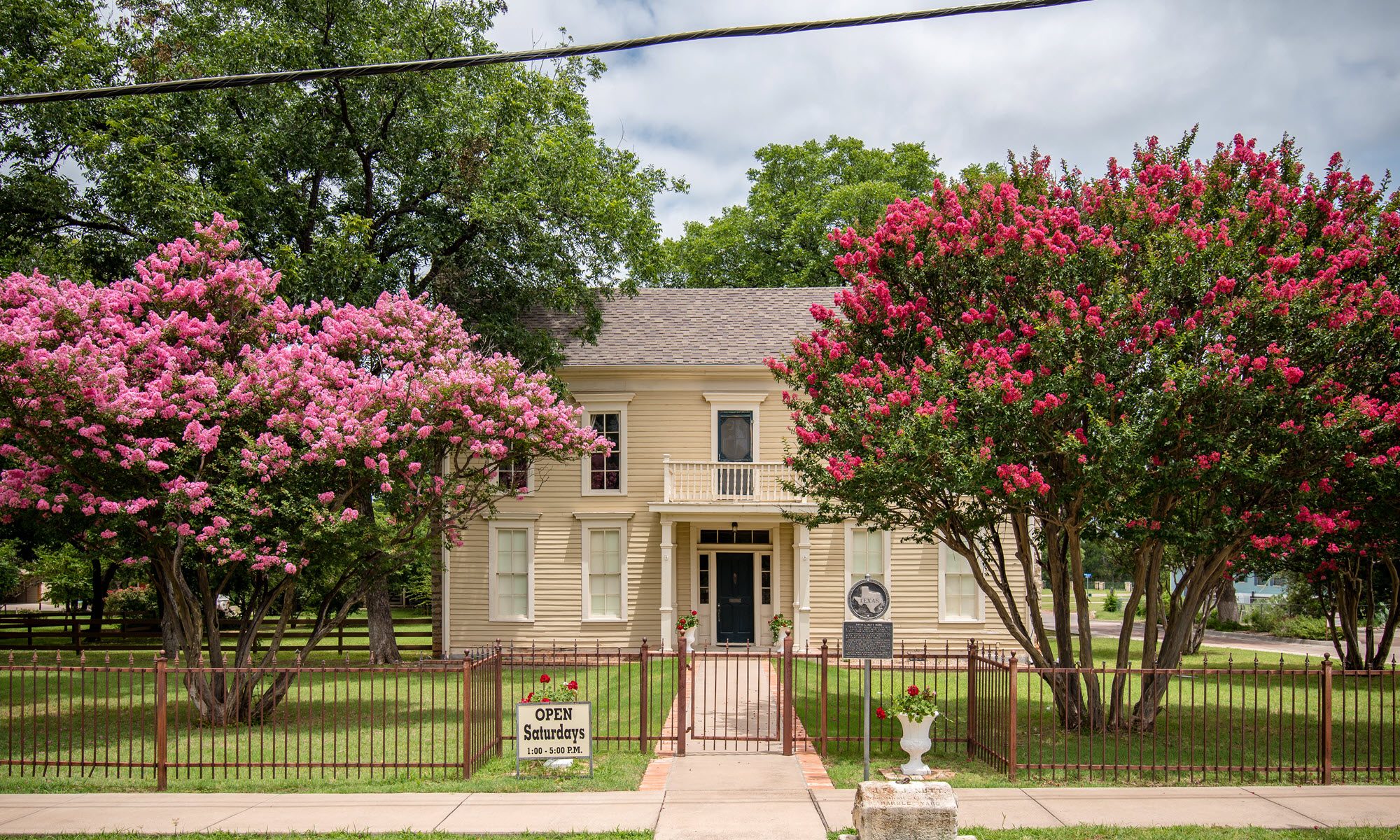
In spite of Abel’s advice to the contrary, the other two persons elected were former Confederate officers. A.J. Wright, husband to one of the Nutt’s daughters was elected as county sheriff. Relative newcomer, Alex McCamant, who had fought with one of the Indian protection regiments out in West Texas with some of the local men, was the new county clerk. He was a surveyor by trade, so many figured that made sense for him to have the office that dealt so much with the affairs of land ownership. These two elections did indeed end up being overturned by the military government amid much turmoil. Eventually, two local non-combatants in the war were chosen as replacements: John Hightower as Sheriff, with Wright hired as his deputy and blind businessman, Jesse F. Nutt as County Clerk with Alex McCammant working as his assistant and scribe.

Welcome to “Nutts About Hood County History” Blog

Nutts About Hood County History granbury history hood county history historical images and stories

March 4, 2026
Written By Melinda Jo Ray

An Introduction

Greetings Readers and Friends!

First off, thank you to the board members of The Bridge Street History Center for allowing me to contribute to this websites blog on a weekly basis.

Welcome to a blog dedicated to doing the very thing our mission statement describes – sharing the stories of the people, places and events of our local past. As the writer of five books on this subject, I combined my love of history and of this place where I live with my passion for education and storytelling and the research skills acquired as a career teacher and librarian. Now this new project brings the opportunity to continue that journey. Now I look forward to sharing a delightfully wide variety of true stories about the people and events that made a difference here – from the early days of pioneer settlement through the nearly 175 years of change and growth since then. “Nutts about Hood County History” will strive to introduce you to some of the lesser- known people and aspects of our county’s quintessentially American story while not neglecting to share some of the little-known stories about some folks you’ve probably already heard of. There may even be a few tales featuring some really famous people with connections to our story that most people today have never heard about. Throw in a good mystery or two and I think we can all have a great time together!

So check back here each week and spend a little time with me poking around to see what went on around here in those “days gone by”. You just never know who we might meet up with – Wanderin’ round the Hood!

Melinda Jo Ray historian, author, and retired school teacher and librarian from Granbury Texas writing for the Nutts About Hood County History blog
Melinda Jo Ray, historian and author of five published books, writes the Nutts About Hood County History blog for the Bridge Street History Center in Granbury, Texas. Ray is a retired school teacher and librarian who has dedicated years to researching and preserving the history of Hood County.