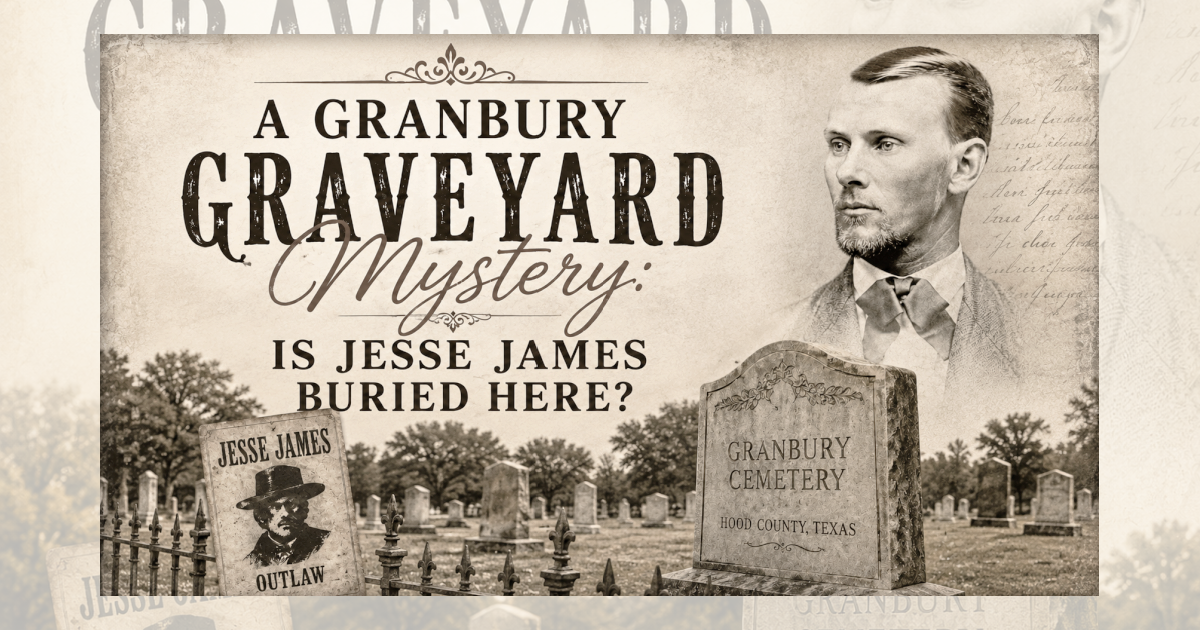
In 1951 a man died in Granbury who was known to some folks secretly as Jesse James. Publicly, through the years, the man had apparently used various aliases here and elsewhere. Like John St. Helen before him, this man whose life, whoever he may have been, was forever changed by his choices during the Civil War years, found a refuge of a sort here in Hood County. The people who kept his secrets apparently did so as a result of Christian convictions about forgiveness and the belief he was trying to make a fresh start. Here, my historian friend Karen Nace and I teamed up to put the pieces we found together to help us all understand the story and maybe help understand why people believed, and many still believe, that this man was actually Jesse James.
Let’s back up to where and when so many of the stories in our area begin – Missouri, just prior to the Civil War. The James family moved from Tennessee to Missouri before Jesse was born in 1847. His father was a farmer and Baptist minister. He died when Jesse was still a small boy. Jesse’s mother remarried twice. The middle husband was elderly and died. Her third husband was Robert Samuel, and he took over the farm. They had four children who were half-siblings to brothers Frank and Jesse James.
The James-Samuel family did own slaves and were settled in the area of northern Missouri that became known as “little Dixie” because of the strong pro-slavery, pro-secessionist sentiment there. Missouri was a border state, and its overall population was just about evenly split between Unionists and Confederate sympathizers. So much so that although a majority of the state legislature did vote to secede, a formal signing of articles never took place, and the secessionists never actually controlled the state. Few traditional battles were actually fought there, and many Missouri men never signed up to serve in the regular army on either side – but instead signed up for local militia aligned with one side or the other. These groups basically engaged in a bloodbath guerilla war on their home soil throughout the war, punctuated by occasional forays by the Union Army into the state to try to establish martial law and restore order. Jesse’s brother Frank was a member of one such militia which fought on behalf of the Confederacy. Eventually, Frank became known to Union troops in the area.
In 1863, a group of Union soldiers came to the farm looking for Frank. They tortured both Jesse and his stepfather in an attempt to learn Frank’s whereabouts. Reuben Samuel was hung, although not until dead, and fifteen-year-old Jesse’s torture was to have the bottoms of his feet set on fire. The scars and nerve damage from those burns followed him the rest of his life.
At age sixteen Jesse joined Frank and his militia-mates in their subversive activities. Toward the end of the war, unable to catch the brothers, Union troops forced the Samuels to remove themselves from Clay County. They were supposed to head south into Confederate territory but instead crossed the state line into the Nebraska territory, which became their base of operations. Once the war was officially over, many of these disillusioned, angry young men from the militias became the so-called outlaws of the “wild west” era. For the next decade and a half, the James-Younger gang robbed banks and trains and became notorious across the nation because of sensationalized accounts of their crimes in newspapers – the social media of the day.
In 1879, the James gang robbed two stores in far west Mississippi. The gang absconded with $2,000 cash in the second robbery and took shelter in abandoned cabins on the Kemp Plantation. A posse attacked and killed two of the outlaws but failed to capture the entire gang. By 1881 the brothers returned to Missouri, where they felt safer. James moved his family to St. Joseph, Missouri, in November 1881, not far from where he had been born and reared. Frank, however, decided to move to safer territory and headed east to settle in Virginia. They intended to give up crime. The James gang had been reduced to just the two of them.
With his gang nearly annihilated, James trusted only the Ford brothers, Charley and Robert. Although Charley had been out on raids with James, Bob Ford was an eager new recruit. Or so Jesse thought. But by that time, Bob Ford had secretly negotiated with Missouri Governor Thomas T. Crittenden to bring in the famous outlaw. Crittenden had made capture of the James brothers his top priority but was barred by law from offering a large reward. Secretly he had turned to the railroad and express corporations to put up a $5,000 bounty for the delivery of each of them and an additional $5,000 for the conviction of either of them.
On April 3, 1882, after eating breakfast, the Fords and Jesse went into the living room before traveling to Platte City for a robbery. From the newspaper, James had just learned that gang member Dick Liddil had confessed to participating in a murder. He was suspicious that the Fords had not told him about it. Robert Ford later said he believed that James had realized they were there to betray him. Instead of confronting them, James walked across the living room and laid his revolvers on a sofa. He turned around and noticed a dusty picture above the mantle and stood on a chair to clean it. Robert Ford drew his weapon and shot the unarmed Jesse James in the back of the head. The result was such that James’s two previous bullet wounds and partially missing middle finger served to positively identify the body.
The death of Jesse James became a national sensation. The Fords made no attempt to hide their role. Robert Ford wired the governor to claim his reward. Crowds pressed into the little house in St. Joseph to see the dead bandit. The Ford brothers surrendered to the authorities and were dismayed to be charged with first-degree murder. The governor’s quick pardon suggested he knew the brothers intended to kill James rather than capture him. The implication that the chief executive of Missouri conspired to kill a private citizen startled the public and added to James’s notoriety.
James’s original grave was on his family property, but he was later moved to a cemetery in Kearney. The original footstone is still there, although the family has replaced the headstone. James’s mother, Zerelda Samuel, wrote the following epitaph for him: “In Loving Memory of my Beloved Son, Murdered by a Traitor and Coward Whose Name is not Worthy to Appear Here.” James’ widow and cousin, Zerelda Mimms James, died alone and in poverty.
It appears at that time no one came forward and disclaimed the killing; however, since then there have been some complications. In recent years, the Missouri burial was uncovered and DNA testing was preformed, but the results were inconclusive! So, is that Jesse or was it not his relative that was tested? We may never know, but it adds to the possibility that the real Jesse is in the Granbury Cemetery.
According to Sam Rash, a Granbury resident whose land was impacted by the coming of the railroad “dump” or lake, he first met the former outlaw as one of the workers on the building of the new railroad line in the mid-1880s. The two men became friends. After a time, the man revealed his true identity to Sam and his family, and because they believed his intent to live a reformed life, they kept his secret. Rash’s daughter, Golda, grew up knowing this man, who was a guest in the Rash home from time to time. Later, after she was married and had children, they also knew him. Her son, David Burks, was quoted as believing the man he knew to be Jesse James.
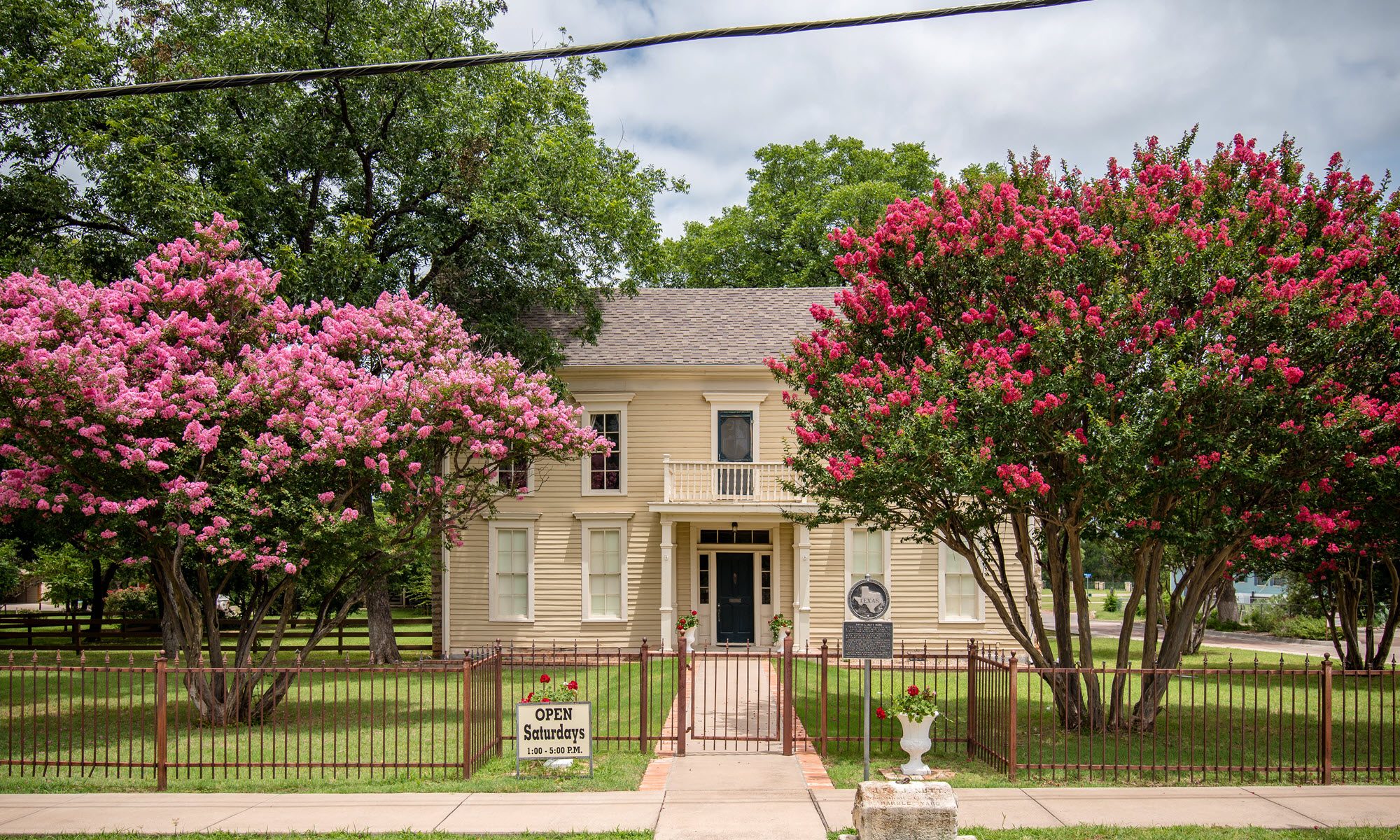
Golda married William Henry Holland in 1911, a Granbury man who had lost his arm as a child. Proof of that is that the arm is buried in the Holland plot in the Granbury Cemetery, “amputated Nov. 16, 1895.” Holland would have been thirteen at that time. Holland died relatively young, in 1927. Golda buried him in her father’s plot, but times were hard and no headstone was placed there. In 1928 she married William Henry Burks and moved to Texas City, and had a son, David. There are accounts from old-timers who remember Sam Rash’s friend who used to work for the railroad visiting him from time to time. According to contemporary accounts, Golda’s son David also got to know him, and even knew his “real” name. Over the years they kept in touch. Eventually, in 1951, Golda heard again from her father’s old friend, now a very elderly and frail gentleman who is about to be released from a hospital there after having a broken hip. According to the newspapers at that time, (1951) Golda made travel arrangements, and went to accompany James as he came by train to Granbury. She had Ben Estes, a local mortician who owned an ambulance, transport him from the depot to her father’s house to recover. She arranged for James to be cared for there, as the house was not in use. (Both her parents had passed away in the 1940’s.)
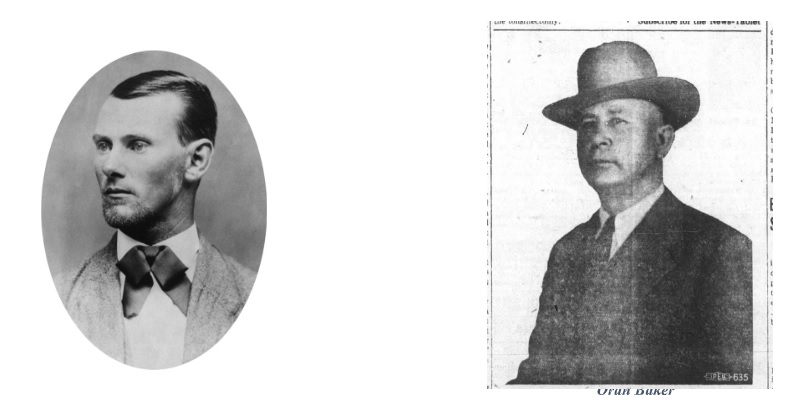
Hood County sheriff Oran Baker, a good friend of Rash’s, apparently knew of the man’s existence and identity, but had never met him. He went to visit the day of his arrival, and the two struck up an immediate comradery. For the next nine days Oran Baker went daily to visit. Listening avidly to the old man tell tales that later proved to match what is known of Jesse James life and all the years since. Also, during this time the old man shared with both Golda and Baker his desire to be buried in Granbury. He told them that there was a woman that he had known here years ago, who was the finest woman he had ever known. Because of her, he wanted to be buried here. He never mentioned her name. – Another mystery!
Alas, their friendship was short-lived. Ten days later the old man died of natural causes – extreme old age. While alive, James is said to have given some unique gifts to individuals in Granbury. Oran Baker received a pair of silver spurs from the man he believed to be Jesse James, eventually giving them to his son, Boots.
On August 17, 1951, a day after his death, the body of this man, who was believed by some to be Jesse Woodson James, was the subject of a postmortem exam. Those present were Oran Baker, Sheriff; Harley Cherry, local druggist, representing Estes Funeral Home; Mack Tidwell; Joe L Deering; Dewitt Travis; and Lee Howk. Baker, Cherry, Tidwell, and Deering signed the affidavit swearing under oath that the following wounds existed on the body:
“Bullet wound through left shoulder; bullet wound through left side of belly; evidence of rope burns on neck; bullet wound on right side of neck; bullet wound between shoulders at base of neck; bullet wound along hairline above both eyes; bullet wound under right eye, causing right eye to droop slightly; small scar under right eyelid, perhaps due to removal of mole; scar of some undetermined kind of the lower lip; powder burns across chin hidden by Buffalo Bill type goatee; two bullet wounds on right shoulder; three of four bullet wounds indicated above elbow on left arm; three or four bullet wounds along left arm from wrist to elbow; tip end of left index finger sort of “chewed off”; two bullet wounds in right chest near nipple; bullet wound along right side near second lower right rib; evidence of several bullet wounds up and down right arm, probably 8 to 10 wounds; both feet showing evidence of having been severely burned, scars on both knees; a tattoo on inner side of right forearm “Tex. Y’s”; bad wound on back between hips.” This document was notarized and filed of record August 28, 1951. Jesse would have been one month shy of 104.
The most curious injury could be the burns on his feet. This is consistent with the torture Jesse experienced at the hands of Union soldiers almost eighty-six years before. Also, it is worth noting that those same burns were NOT a part of the detailed reports describing the body of the man killed by Rob Ford in St. Joseph.
When Jesse died, Golda buried him without a headstone in her father’s plot. It is said that 2 nieces of Jesse finally put a headstone in the cemetery in the 1982, when they also corrected details on the original death certificate. After over 30 years, the location of the exact grave was probably questionable with no head stone for either Holland or James. Indeed, they may not have even known about the Holland burial that had taken place previously. In 2000 when there was an attempt to dig up “our” Jesse James for DNA testing, it is assumed no one realized Holland was buried so close to James or even that he was there at all. When the gravesite was opened, apparently they found a concrete vault and spied a wooden coffin nearby. Since the vault was under the headstone, that was removed and opened, only to find a one-armed man. At that point, it seems the quest was abandoned, and to date has not been re-tried.
What does all this prove? Perhaps some legends should remain just that. There are those who firmly believe Jesse James is here, others who believe him to be in Missouri, and some who believe the jury is still out. These are the pieces we have, there are a few more that might add weight, and others that might not. Let the legend live on!