Today I am hightlighting the founders.
Even in the Victorian era, when arranged marriages were not all that uncommon, it appears that most of the founding couples of our Granbury community had the happy circumstance of marrying for love. Several local couples’ stories also tell of self-sacrifice and courage that speak across the centuries of what men and women alike can and will do for and with the person they love. Their stories shaped the life of our community as well. Their fidelity and strength are the foundation upon which our community was built. In their stories we find not only a sense of kinship, but also an inspiration for our own lives, for the virtues of love and devotion and fidelity are a blessing, no matter what year the calendar says.
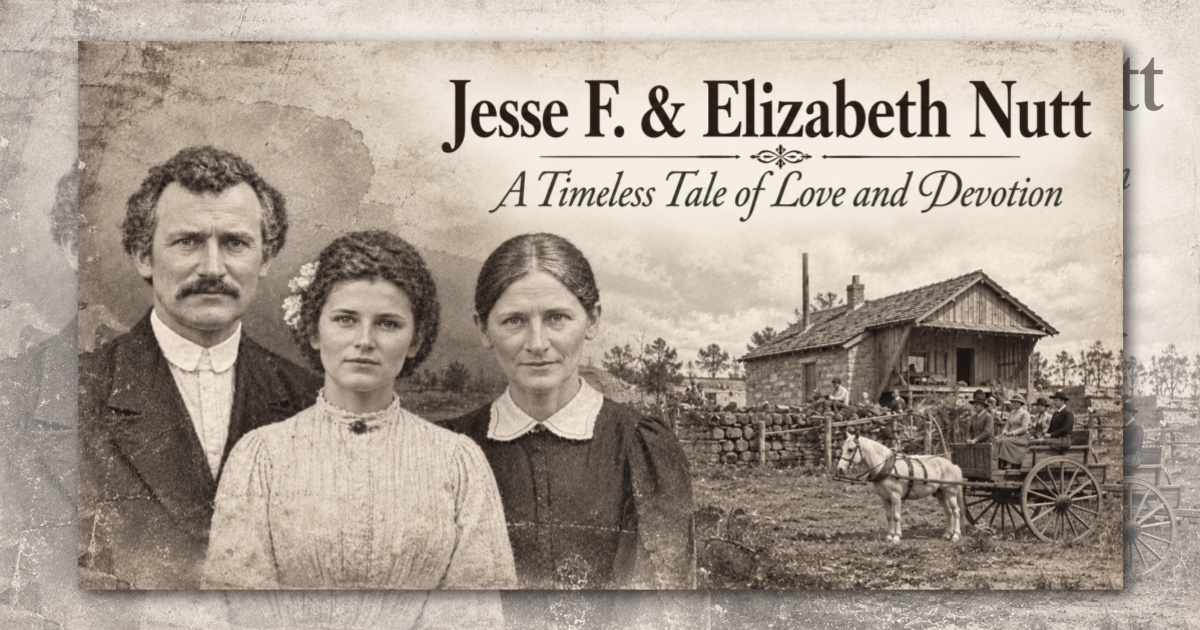
Always, the first of these stories that comes to my mind is the one I have come to know most intimately: the story of Jesse and Elizabeth Nutt. Their fathers, David G. Nutt and Abel Landers, were boyhood friends in the Tennessee of the early 1800s. When David married Abel’s younger sister Sarah, it set the stage for a decades long blending of families that literally made Hood County history. Cousins and friends since childhood, Jesse Franklin Nutt and Elizabeth E. Landers made a love match between a promising young man studying law and the independent-minded daughter of a prominent Missouri politician. She was an “older woman,” being an old maid of 23, and he almost two years younger and still 21 when they married in 1854. Everything pointed to a prosperous and perhaps political future for them as they started their life together. Eight months later, tragedy struck when both Jesse and his brother Jacob were permanently blinded in horrific circumstances during the lead up to the American Civil War. Less than two years later, Jesse and Elizabeth Nutt and their five-month-old daughter, Abigail, left the home of their childhood and civilization, to travel with family members by covered wagon to the wild banks of the Brazos River, here in Texas.
When I first began to study their story, I was struck by the enormity of the changes and challenges they faced in just the first three years of their lives together. What must that have been like, what must it have meant for their relationship? Did their apparent love and romance survive? The records showed a long marriage and two daughters. But in those days divorce was almost unheard of. For Elizabeth – did love become duty? Did she stay because she had to or because she wanted to? Did he become bitter over his loss? Did he just expect her to stay? Did whatever love was between them endure or wither away? Those many questions found a simple answer… carved in stone. An early trip to the Granbury Cemetery revealed that she had died first, a full fifteen years before he did, and according to records, both stones were carved to his instructions. On hers, there was the standard “beloved wife and mother” and a verse of scripture. But down below, almost worn away by time, and perhaps by the touch over many years of loving fingers, was another line… “Her self-sacrifice meant so much…” – six words full of love, gratitude, and acknowledgement… assurance that love had not only survived but thrived.
Jesse and Elizabeth and their newborn daughter, Abigail, were actually part of the first group of Nutt/Landers family members to travel by covered wagon from Missouri to Texas to settle in the valley of El Rio de los Brazos de Rios (The River of the Arms of God) in 1856. Their fathers were friends with one of the earliest settlers west of the Brazos, Amon Bond. It was his tales of a free and open and beautiful land with good soil and plentiful game, seemingly far from the boiling cauldron of pre-war chaos and conflict in Missouri that enticed the Nutt and Landers families to consider uprooting their lives to start something new. When business obligations delayed Jesse’s father-in-law, Abel Landers, from making an exploratory trek himself, Abel’s cousin, Logan, son Henry, and Jesse and Elizabeth made the journey in his stead. Devout Baptist Christians, the name given by the Spanish to the river that carved these Texas lands – El Rio de los Brazos de Dios (The River of the Arms of God), also beckoned, offering the tragedy afflicted young couple a chance for a new beginning.
Determined to work together to achieve success in business in the new land, Jesse and Elizabeth formed a formidable team. Jesse’s keen intelligence and way with people, along with Elizabeth’s business sense and kindness, combined to make the couple welcome additions to the tiny community of Stockton Bend, surrounded on three sides by the west banks of the Brazos River. Cabins were built, land was claimed, soil was tilled, and friendships were formed. Two years later, in the fall of 1858, a wagon train carrying over forty souls arrived to double the size of the settlement. Consisting mostly of Nutt/Landers relatives, including both Jesse and Elizbeth’s parents and several more of their siblings, it included Jesse’s brother Jacob, who shared his tragedy of blindness.
At first the group hoped they had come far enough west to avoid the war to come, but that dream ended with Texas’ choice to secede with the other southern slave states to form the Confederacy. Ill-equipped to move further west, the
families decided to stay put, knowing that hard times were ahead. Abel Landers became the de facto leader of the settlement, and Jesse, once his burgeoning partner in the lawyer business, served in many ways as his first lieutenant
as a guiding hand for the people on the home front during the war years. Times were lean and hard and tears came often as the community lost folk to the both the hardships of the frontier and the ravages of war. A source of comfort
for many was the small Baptist Meeting group that met most Sundays under the trees near a couple of the Nutt family cabins. Jesse and Jacob were among the group of men who often recited scripture for the group, sometimes making a few remarks or leading the group in a hymn.
Once the war was over, it wasn’t long before Jesse and Elizabeth joined with brothers Jacob and young David Lee Nutt in what became a partnership that would last a lifetime. Using their collective cash of a whole $32.00, the group bought the tiny grocery store of a Stockton Bend citizen named Borden and the rest, as they say, was history. The grocery and dry goods business known as the Nutt Bros. Mercantile became a mainstay of the Granbury business scene for over forty years and the Nutt House Hotel, which began operations in the 1890’s in David Lee Nutt’s home and moved to the Granbury Square after the turn of century, still operates today, over 100 years later on the same corner lot the brothers purchased together.
For decades, while David and Jacob pursued added interests of ranching and real estate, “Uncle Jesse” and “Aunt Lizzie” Nutt became the faces of the Nutt Bros. Mercantile business. Lizzie worked with David in the ordering and bookkeeping realms, and assisted Jesse with knowing the exact location, price, and inventory of every item stocked. She also took lively interest in the growing up years of their two daughters, Abby and Josie, born fourteen years apart. She and her friend Nettie Hannaford took great joy in making back yard “socials” for the young folks to attend. Somehow, she also found time to help her sister-in-law, Sudie Nutt, begin the fledgling hotel – which became known for its gracious hospitality.
Jesse, meanwhile, was active in both community and church affairs. Not only did he run the mercantile almost daily, he also gained a reputation among his neighbors as a kind man of great integrity, wisdom, and peace. It was said that many a squabble between neighbors was resolved by the peacemaker, Uncle Jesse Nutt. He also apparently had a knack for predicting the weather and his forecasts were often mentioned in the local newspapers. Even though blind, he was so trusted that he served as treasurer for the Paluxy Baptist Association for eighteen years and his passion for the Gospel of Jesus Christ and sharing it led him to become a much sought after lay-preacher and to serve for over twenty years as Sunday School Superintendent for all the area Baptist churches. He was on the founding board of directors of the First National Bank of Granbury and was a staunch supporter of public, co-educational education. He was on the founding boards of almost every school established in Hood County during his lifetime.
Jesse and Elizabeth’s life together came to a sudden and tragic end in 1898, when she passed away after a fall down a flight of stairs. The whole community mourned. Widowed and sixty-five years old, Jesse retired from the daily running of the mercantile a couple of years later but hardly slowed down. As a lay preacher, he spoke and taught regularly in area churches, and, at age seventy, in 1902-04, he took a two-year missionary trip on horseback with a young minister friend to preach the Gospel to Native Americans in New Mexico. The result – 247 baptisms into the Faith. “Uncle Jesse” Nutt, a man who had embodied living one’s Faith to the end, passed into the Arms of his Lord at his home in Granbury on February 4, 1913, leaving behind a community forever blessed by his many years of love and service to the people of Granbury and Hood County.