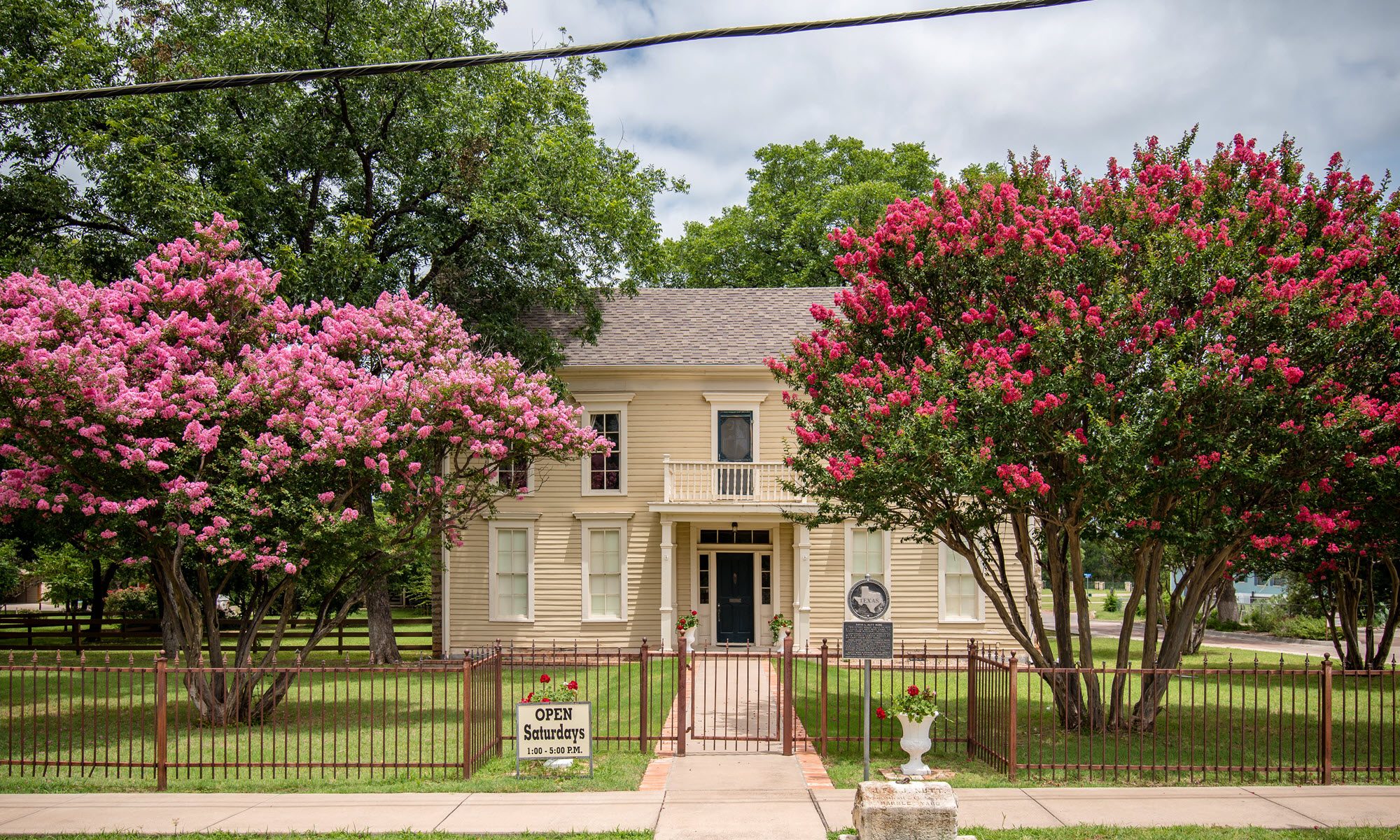
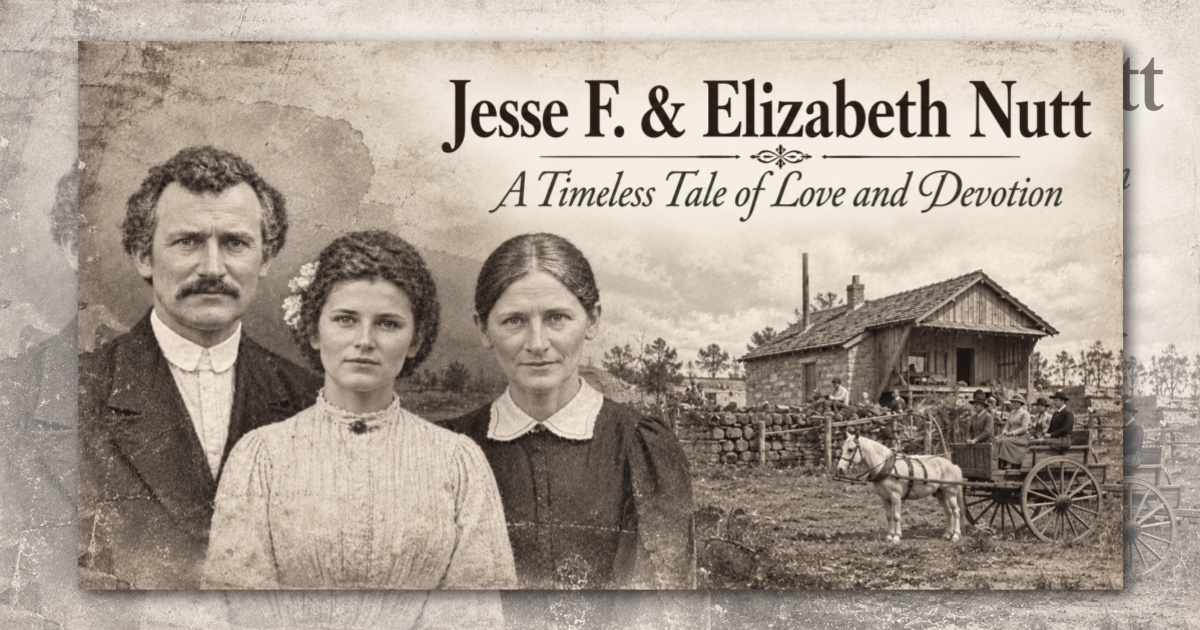
Jesse F. & Elizabeth Nutt: A Timeless Tale of Love and Devotion

“Jesse F. and Elizabeth Nutt featured in a sepia historical collage depicting their family and pioneer life in early Hood County, Texas.”

Today I am hightlighting the founders.

Even in the Victorian era, when arranged marriages were not all that uncommon, it appears that most of the founding couples of our Granbury community had the happy circumstance of marrying for love. Several local couples’ stories also tell of self-sacrifice and courage that speak across the centuries of what men and women alike can and will do for and with the person they love. Their stories shaped the life of our community as well. Their fidelity and strength are the foundation upon which our community was built. In their stories we find not only a sense of kinship, but also an inspiration for our own lives, for the virtues of love and devotion and fidelity are a blessing, no matter what year the calendar says.

Always, the first of these stories that comes to my mind is the one I have come to know most intimately: the story of Jesse and Elizabeth Nutt. Their fathers, David G. Nutt and Abel Landers, were boyhood friends in the Tennessee of the early 1800s. When David married Abel’s younger sister Sarah, it set the stage for a decades long blending of families that literally made Hood County history. Cousins and friends since childhood, Jesse Franklin Nutt and Elizabeth E. Landers made a love match between a promising young man studying law and the independent-minded daughter of a prominent Missouri politician. She was an “older woman,” being an old maid of 23, and he almost two years younger and still 21 when they married in 1854. Everything pointed to a prosperous and perhaps political future for them as they started their life together. Eight months later, tragedy struck when both Jesse and his brother Jacob were permanently blinded in horrific circumstances during the lead up to the American Civil War. Less than two years later, Jesse and Elizabeth Nutt and their five-month-old daughter, Abigail, left the home of their childhood and civilization, to travel with family members by covered wagon to the wild banks of the Brazos River, here in Texas.

When I first began to study their story, I was struck by the enormity of the changes and challenges they faced in just the first three years of their lives together. What must that have been like, what must it have meant for their relationship? Did their apparent love and romance survive? The records showed a long marriage and two daughters. But in those days divorce was almost unheard of. For Elizabeth – did love become duty? Did she stay because she had to or because she wanted to? Did he become bitter over his loss? Did he just expect her to stay? Did whatever love was between them endure or wither away? Those many questions found a simple answer… carved in stone. An early trip to the Granbury Cemetery revealed that she had died first, a full fifteen years before he did, and according to records, both stones were carved to his instructions. On hers, there was the standard “beloved wife and mother” and a verse of scripture. But down below, almost worn away by time, and perhaps by the touch over many years of loving fingers, was another line… “Her self-sacrifice meant so much…” – six words full of love, gratitude, and acknowledgement… assurance that love had not only survived but thrived.

Jesse and Elizabeth and their newborn daughter, Abigail, were actually part of the first group of Nutt/Landers family members to travel by covered wagon from Missouri to Texas to settle in the valley of El Rio de los Brazos de Rios (The River of the Arms of God) in 1856. Their fathers were friends with one of the earliest settlers west of the Brazos, Amon Bond. It was his tales of a free and open and beautiful land with good soil and plentiful game, seemingly far from the boiling cauldron of pre-war chaos and conflict in Missouri that enticed the Nutt and Landers families to consider uprooting their lives to start something new. When business obligations delayed Jesse’s father-in-law, Abel Landers, from making an exploratory trek himself, Abel’s cousin, Logan, son Henry, and Jesse and Elizabeth made the journey in his stead. Devout Baptist Christians, the name given by the Spanish to the river that carved these Texas lands – El Rio de los Brazos de Dios (The River of the Arms of God), also beckoned, offering the tragedy afflicted young couple a chance for a new beginning.

Determined to work together to achieve success in business in the new land, Jesse and Elizabeth formed a formidable team. Jesse’s keen intelligence and way with people, along with Elizabeth’s business sense and kindness, combined to make the couple welcome additions to the tiny community of Stockton Bend, surrounded on three sides by the west banks of the Brazos River. Cabins were built, land was claimed, soil was tilled, and friendships were formed. Two years later, in the fall of 1858, a wagon train carrying over forty souls arrived to double the size of the settlement. Consisting mostly of Nutt/Landers relatives, including both Jesse and Elizbeth’s parents and several more of their siblings, it included Jesse’s brother Jacob, who shared his tragedy of blindness.

At first the group hoped they had come far enough west to avoid the war to come, but that dream ended with Texas’ choice to secede with the other southern slave states to form the Confederacy. Ill-equipped to move further west, the

families decided to stay put, knowing that hard times were ahead. Abel Landers became the de facto leader of the settlement, and Jesse, once his burgeoning partner in the lawyer business, served in many ways as his first lieutenant

as a guiding hand for the people on the home front during the war years. Times were lean and hard and tears came often as the community lost folk to the both the hardships of the frontier and the ravages of war. A source of comfort

for many was the small Baptist Meeting group that met most Sundays under the trees near a couple of the Nutt family cabins. Jesse and Jacob were among the group of men who often recited scripture for the group, sometimes making a few remarks or leading the group in a hymn.

Once the war was over, it wasn’t long before Jesse and Elizabeth joined with brothers Jacob and young David Lee Nutt in what became a partnership that would last a lifetime. Using their collective cash of a whole $32.00, the group bought the tiny grocery store of a Stockton Bend citizen named Borden and the rest, as they say, was history. The grocery and dry goods business known as the Nutt Bros. Mercantile became a mainstay of the Granbury business scene for over forty years and the Nutt House Hotel, which began operations in the 1890’s in David Lee Nutt’s home and moved to the Granbury Square after the turn of century, still operates today, over 100 years later on the same corner lot the brothers purchased together.

For decades, while David and Jacob pursued added interests of ranching and real estate, “Uncle Jesse” and “Aunt Lizzie” Nutt became the faces of the Nutt Bros. Mercantile business. Lizzie worked with David in the ordering and bookkeeping realms, and assisted Jesse with knowing the exact location, price, and inventory of every item stocked. She also took lively interest in the growing up years of their two daughters, Abby and Josie, born fourteen years apart. She and her friend Nettie Hannaford took great joy in making back yard “socials” for the young folks to attend. Somehow, she also found time to help her sister-in-law, Sudie Nutt, begin the fledgling hotel – which became known for its gracious hospitality.

Jesse, meanwhile, was active in both community and church affairs. Not only did he run the mercantile almost daily, he also gained a reputation among his neighbors as a kind man of great integrity, wisdom, and peace. It was said that many a squabble between neighbors was resolved by the peacemaker, Uncle Jesse Nutt. He also apparently had a knack for predicting the weather and his forecasts were often mentioned in the local newspapers. Even though blind, he was so trusted that he served as treasurer for the Paluxy Baptist Association for eighteen years and his passion for the Gospel of Jesus Christ and sharing it led him to become a much sought after lay-preacher and to serve for over twenty years as Sunday School Superintendent for all the area Baptist churches. He was on the founding board of directors of the First National Bank of Granbury and was a staunch supporter of public, co-educational education. He was on the founding boards of almost every school established in Hood County during his lifetime.

Jesse and Elizabeth’s life together came to a sudden and tragic end in 1898, when she passed away after a fall down a flight of stairs. The whole community mourned. Widowed and sixty-five years old, Jesse retired from the daily running of the mercantile a couple of years later but hardly slowed down. As a lay preacher, he spoke and taught regularly in area churches, and, at age seventy, in 1902-04, he took a two-year missionary trip on horseback with a young minister friend to preach the Gospel to Native Americans in New Mexico. The result – 247 baptisms into the Faith. “Uncle Jesse” Nutt, a man who had embodied living one’s Faith to the end, passed into the Arms of his Lord at his home in Granbury on February 4, 1913, leaving behind a community forever blessed by his many years of love and service to the people of Granbury and Hood County.
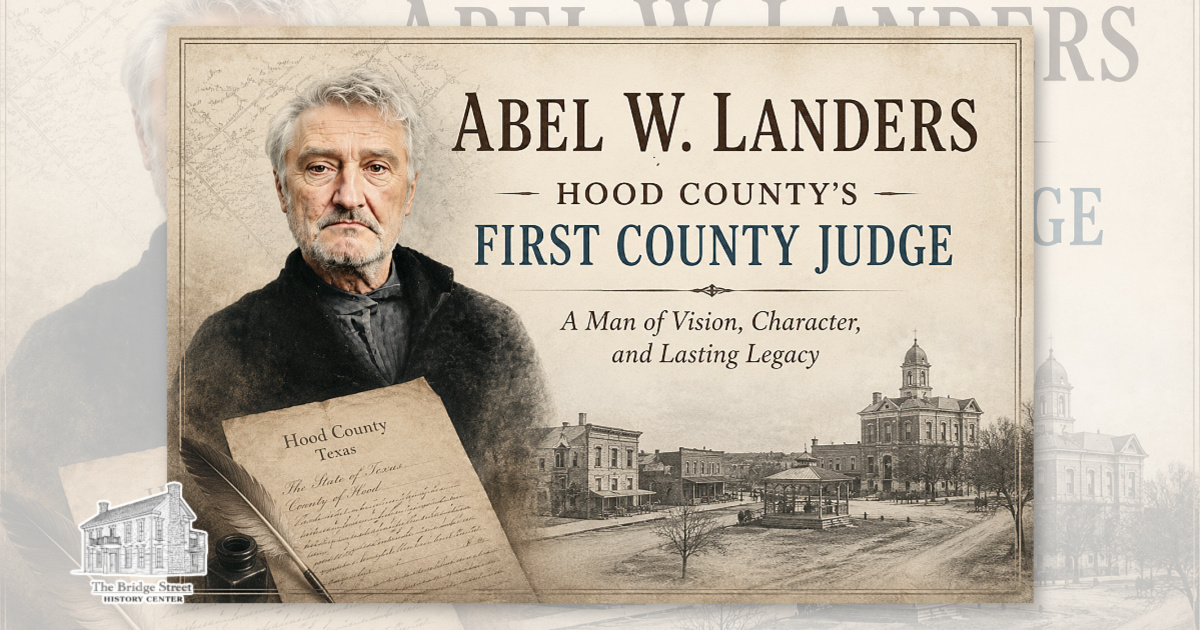
Hood County‘s First County Judge : Abel W. Landers

Portrait of Abel W. Landers, Hood County's first county judge and one of the founders of Granbury, Texas.

Editor’s Note: Abel W. Landers is often remembered simply as Hood County’s first county judge. Yet his influence reached far beyond the courtroom. Drawing upon years of research, this article explores the remarkable life of a pioneer whose leadership helped shape the founding of Granbury and the future of Hood County.

I want to tell you about Abel W. Landers. I mean, I really, really do. For me, it’s almost personal. Twenty years ago, when I set out to write a novel about the Nutt brothers and the beginnings of Granbury, I had in my mind this older uncle, who was getting on in years, who came with them Texas and kind of hung around like some honorary grandfather on the periphery of events. Then, I read an article by one of his descendants and amended that to cantankerous honorary grandfather. Then I read T. H. Ewells “account” and amended it to ornery, eccentric and cantankerous…but still basically a “minor” character. Then, I got into serious research about the background and span of this man’s life, and he reached across and through the mists of time and grabbed me by the collar, got in my face, and said “Missy, I may be a lot of things, and you can be right up front about all of’em. But I am not, nor will I ever be ‘a MINOR character’!”

Twenty plus years, five books, and hundreds of hours of research later I am absolutely convinced that the people of Granbury and Hood County owe more of who we have been and who we are to this one man than to any other single human who ever walked the tops of these limestone bluffs or gazed across the majesty of valley of the “River of the Arms of God.” Abel Landers got that eccentric, cantankerous caricature label from a single paragraph mention in T. H. Ewell’s 1895 History of Hood County. Writing twenty plus years after Landers’ death, Ewell basically dismisses Landers’ almost twenty years of leadership during the formation of the community that became Granbury, and portrays his tenure as our first county judge as that of a legal hack. One has to wonder what axe Ewell had to grind – or if he even bothered to research the background and actual history of this man whose career and contributions he made such light of for the sake of an entertaining story.

This is not to say that Abel Landers was of docile character, or that he didn’t have a forceful personality, or even that he was above pushing hard and engaging in political hard ball in pursuing a course he believed to be right. But he was an honorable man, an educated and astute man, and was well-thought-of by those who truly knew him, and also- surprisingly- by those who only knew him by reputation. So how did this happen? And who was Abel Landers, really? What can we know about someone who lived so long ago, from what records remain of the sum of his life? I’ve read those records, everything I can find. My journey has taken me from Kentucky and Tennessee westward to Missouri and finally onward here to Texas. And what I have found is the story of a man of remarkable character, who still – across all these years – comes to us as a REAL human being.

Abel Landers was born in 1796 in Warren County, Kentucky, where his father Christopher had received a land grant. Both of his parents were descended from very successful, landed colonial families, his father from a Norman British family whose name was originally spelled Landis, and his mother Phoebe from the famed Lee’s of Virginia. His parents had met and married in North Carolina, in 1793 and moved to Kentucky sometime prior to his birth. Born only 4 years after their marriage, he was nonetheless their third child, being proceeded by two older brothers. Sometime after the turn of the century, Abel’s father acquired by grant a larger amount of land in Bedford County, Tennessee, and the family moved there to what would be his parent’s permanent home. It was there that destiny began its work. Young Abel met and forged friendships with two other boys there, David G. Nutt – another son of a family with deep North Carolina roots, and Amon Bond – son of a young Quaker couple from Baltimore, Maryland. These three lads were of an age, all born within eighteen months of each other, and all of their fathers owned and farmed the land. They all grew up with a growing appreciation of the prosperity that the land, properly nurtured could bring. They watched and listened as young teens to the men around them plan and dream as they built the nearby county seat town of Shelbyville – the place that became one of the first in the new nation to build a prosperous business district on a plan that became known as “the Shelbyville model” – a central town square with the courthouse and seat of government at the center, surrounded on four sides by a block of retail and service businesses facing inward, surrounded by blocks of residences, parks, churches, and schools – the model that became the blueprint for a nation.

These three young men listened well, and observed much, including the differences between their families. While they shared much in common, one large difference was the Quaker faith practiced by Amon Bond’s family. While all three sprung from devout, church-going folk, the Quakers stood out in that Tennessee of so long ago, not just in their language and their dress, but in another very important way- they didn’t believe in slavery. And the records show that example apparently spoke not only to the conscience of young Amon Bond, but to his friends Abel Landers and David Nutt as well. Upon reaching adulthood, the three young men worked as laborers for their fathers, apparently earning a stake- a startup of land for themselves. Each one shows no record at any point in their lives, from that beginning forward, of ever owning slaves for labor.

Amon shows no record of ever owning slaves in his lifetime. Abel and David both inherited a small number of slaves from their fathers as part of their inheritance. Both were young married men at the time, with land and families. Abel had apparently also done some study of the law, and had begun to do some legal work, mostly for family members, dealing with estate matters. But he was keenly aware of the legal ramifications of his and David’s situations. It would do no good for them to free their slaves in Tennessee, since Tennessee law did not recognize emancipation. Even a former slave with signed and witnessed emancipation papers could be picked up at will by anyone and declared property by that person. Also, it was illegal for slaves in Tennessee to be taught to read, write or cypher. To release the people in their care under those circumstances would be tantamount a sentence of death, or imprisonment, or both.

Correspondence with his wife Sally’s Shipman relations in the new state of Missouri provided Abel and his now brother-in-law David Nutt the answer they needed. Emancipation was legal and honored by the law in Missouri. Quietly, Abel saw to it that the slave families he and David had inherited (plus another orphaned black child he purchased apparently on impulse to keep her from being sold into a lifetime of captivity) were educated and taught job skills to equip them for freedom. In 1837 emancipation papers were signed and the two men sold their land, gathered their families and worldly goods, and struck out via covered wagon almost 500 miles across the Ozark mountains to the newly forming settlement of Neosho Missouri. Their newly freed slaves traveled there as well. Abel gave each of them, his and David’s slaves alike, $35 (a sizable sum back then) in start-up money. Both white and black members of the party purchased land and set up farms in the area, worked by all of them and several of their now grown or teen-aged sons and daughters.

Abel also began doing legal work, and soon became active in community affairs. In the latter, it is apparent that he quickly brought insights and information from his Shelbyville observations that impressed his fellow citizens. In 1838, his new hometown of Neosho, situated on Hickory Creek, was named county seat of the new county of Newton, and Abel’s input was apparently valued. In 1839, he was appointed to the independent commission that selected the site for and made the initial plans for the county seat of the newly forming Barry County, Missouri. The city of Carthage was established on the banks of the Spring River in the new Barry County, and remains the county seat today. In 1841, another county, Jasper, was forming, and once again Abel Landers was chosen as one of the commissioners who would choose a site and do the initial planning. The town of Cassville was placed on the banks of a small spring fed creek known as the Roaring River whose origins have only recently been traced to deep within an Ozark mountain cave system, miles away.

In addition to serving on these planning commissions, Abel also served during these early Missouri years as a tax assessor and Justice of the Peace. Then in 1842 he ran for state office and won. He was elected to three terms as a member of the Missouri State House of Representatives and served one term in the Missouri State Senate. In a total of 8 years out of the next ten he worked as a moderate in the Missouri Legislature. A supporter of an end to the expansion of slavery and a gradual end to slavery nationwide, he worked with Senator Benton and others to rally support to that end, often treading a fine line with some of the slaveholders in his home district. Seeing the tide turning toward war with the passing by Congress of the Missouri compromise in 1854, he chose not to seek another term in the Missouri Senate.

About this time, Amon Bond and his family, also seeing the tides of war rising, decided to head for the frontier lands of far-removed Texas. Amon invited his old friends to join the adventure. There was land for the taking, and Amon’s son Ed had already procured a start, a grant on the west bank of a river known as “El Rio de los Brazos de Dios” – The River of the Arms of God. The free land beckoned, and the fact that Abel knew of a certainty of Texas governor Sam Houston’s staunch opposition to secession gave hope of a war to be avoided. Over the next few years the majority of the Nutt and Landers family members came to agree that removal to Texas was the right thing to do. A quick mass exodus was delayed by illnesses, tragedies, marriages, births, and business concerns. But in the spring of 1856 Amon came back to Neosho to lead the first small group to Texas. Abel’s relative Logan Landers and his family, Abel’s daughter Elizabeth and her husband, Jesse Nutt- one of the blind brothers, and Abel’s middle son Henry went with this small group. Their plan – to get land claimed and cabins built for a much larger party to follow in a couple of years.

The advance party arrived in Texas and wrote back to Abel with glowing reports. But he was getting on in years and his wife, Sally was in fragile health. The unsettled times made the selling off of property a challenge for both him and David. But finally, in the spring of 1858, a long line of wagons rolled through the Neosho square. The Landers and Nutts and many kinfolk and friends were pulling up stakes one last time and were “gone to Texas”! Upon arrival, Abel, Amon, and Jesse Nutt quickly became leaders of the fledgling little community on the banks of the Brazos, known as Stockton Bend.

The first years were incredibly hard. The hardships of the frontier proved too much for Abel’s beloved Sally, who died in January 1859. 18 months later secession and war came in deadly earnest. The Confederacy instituted the first military draft ever invoked on American soil, and most of the young men, except for the blind Jesse and Jacob Nutt were caught up in it. All told, Amon, Abel, and David sent nine sons off to fight in a war for a cause they didn’t support. Only five of those sons came home.

During the war, Abel Landers worked tirelessly with Johnson county officials to be sure that war widows and orphans in the western areas of the county received the assistance they needed. Beginning with the hotly contested elections in 1860, he led local efforts to ensure universal voter registration of all eligible voters and free and open access to the polls for same. He had a reputation for finding common sense solutions to sticky problems and was already looking forward to the coming end of the conflict, when he knew that population increases, and distance would probably lead to the formation of a new western county. At an age when most men, including his friends David and Amon were content to retire and leave the hard work of governing to the younger generation, Abel brought a depth of experience and expertise to “growing a new place” that was badly needed during those early years, when so many of the young and middle-aged men had been lost too soon. To illustrate – the sparsely populated Johnson county had sent over 600 men off to war. Almost 300 of those men did not return.

The post-war shenanigans involved in the formation of Hood county are described in several local history books. Nowhere were the political maneuverings of various factions more complex than those regarding location of the county seat. Citing his experience and reputation for honorable and moderate politics, Abel – a local man – was elected county judge and head official in the new county in 1866 and this was approved by the reconstruction government. That approval was not always readily given in those times and the people of Hood county knew it and breathed a sigh of relief. But there were no less than five locations vying to be the site of the new county seat. Even today, resentments and might have beens pop up in conversation. There was and is talk that Abel blocked due process, and refused to validate elections etc. The pure unvarnished truth when one looks at the situation objectively is this – First, this was not Abel’s first rodeo, it was his fourth – fifth if you count his original observations in Shelbyville. He knew better than anyone the requirements, both by law and logistics, for a new county seat.

The contenders were Glen Rose Mills, Acton, Thorp Spring, Lambert Branch, and a foothill at the base of Comanche Peak known as “the Center” (as it was literally the geographic center of the county). State law required only two things, that the county seat be named Granbury, and that it be located within 6 miles of the geographic center of the county. Two of the contenders, the two oldest settlements- Acton and Glen Rose did not fall into that 6-mile requirement. Other logistical requirements included an adequate and readily available and easily defended water source, and adequate space for expansion over decades. The “Center” was too far from the river for it to be a viable water source, and todays residents of the area can testify to the inadequacies of its ground water situation. That brought realistic consideration down to Thorp Spring and Lambert Branch.

At this point Thorp Spring had the larger population and a town already started. Lambert Branch had more open land and was located admittedly on Nutt, Landers and Bond family land holdings. But this writer believes that there were other factors that Abel’s experienced eye could see. One was that Lambert Branch would be a fresh start, and an open community. The other was its location on the high point above the river with a ferry crossing and potential bridge location at each end. When election failed to resolve the issue in a manner he felt was satisfactory (they kept choosing the Center (that hill where Lakeside Baptist Church stands today), with its inadequate water situation. Abel did the same thing his predecessors in Missouri had done – he persuaded the county commissioners to appoint an independent commission of men from outside the county and those gentlemen looked at all the factors and chose Lambert Branch. And the rest as they say, is history.

Abel was also instrumental in guiding the young county and its property owners through the beginnings of an almost twenty-year long legal battle with Milam County over ownership of School Lands located in Hood County. Abel was instrumental in retaining the respected and highly qualified A. J. Hood of Parker County as legal counsel for both individual defendants and the county in the matter. In the years from 1868 to 1872, his personal dialogue with Representative William Henry Sinclair, who became Speaker of the Texas House in 1871, obtained much needed State intervention in the matter to provide, at least for a time, the stability the new county needed to grow.

Abel was now past 70 years old, a long life in those times. Although he resigned as judge in mid-1869 in protest over a disqualification of duly elected commissioners by the Reconstruction Government, in his final years he oversaw the layout of the plats and lots, working with men he had raised up to understand and share his vision. Prior to his death in May, 1873 he witnessed the beginnings- those first wooden buildings going up, that first stone courthouse being built, all on lots in a quadrangle atop bluffs of limestone, overlooking the River of the Arms of the God he loved so well – his final gift and legacy to us and to the ages – our town, Granbury, on the Brazos.

“The towns that Abel built….”

Carthage, Barry County, Missouri

Cassville, Jasper County, Missouri

Neosho, Newton County, Missouri

Granbury, Hood County, Texas

Until next week,

Melinda Ray