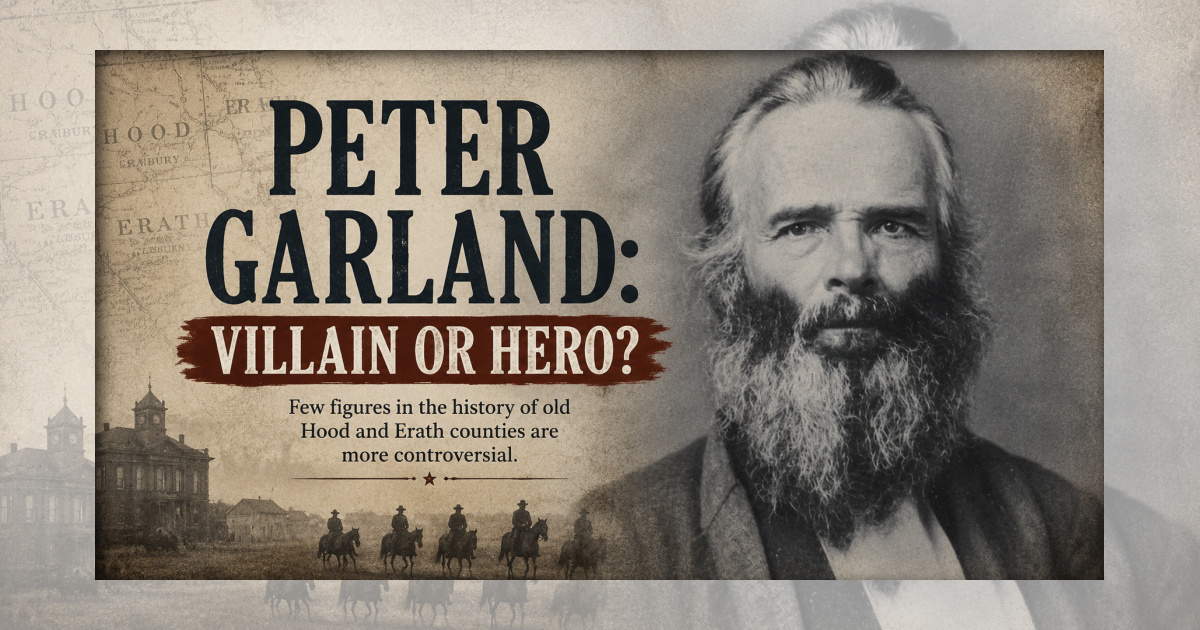
Few figures in the history of old Hood and Erath counties are more controversial that Captain Peter Garland. To some a vile, violent, hate-filled man, – to others a hero. Garland’s story is still capable of sparking strong emotions in the descendants of some who knew him, even 150+ years after his death.
Capt. Peter Garland of Texas was born in 1805 in Henry County, Virginia, the grandson of Col. David Garland of the Revolution and son of Maj. Peter Garland of the Virginia 64th Regiment in the War of 1812. A family written biography describes Peter’s connection to this heritage by saying, “His grandfather and father had wars to fight. Capt. Peter Garland, some say, created his own war against the Indians of the Texas frontier.
After leaving Virginia, young Garland was first married to Lucinda Goff in Tennessee and second to Louisa Phillips in Mississippi as he moved westward to Texas. Over the years he fathered a total of at least 12 children. Before coming to Anderson County, Texas, in 1850, Garland was a Deputy Sheriff, Circuit Court Clerk, and saloonkeeper in Tishomingo County, Mississippi. In 1857, the Garlands braved the raw frontier of Erath County along with several other families, including the Thorntons, Hightowers, and Wylies. Ten years later, in Hood County, Peter and Louisa 16-year-old daughter, Melissa Virginia, was married to James Goodhope Thorp, eldest son of Pleasant and Nancy Thorp, founders of Thorp Spring.
The reasons for Peter’s zeal regarding total removal of the Native Americans from the area is unclear. There is some tradition that he had family and close friends who had been killed by the natives during his early years in Erath County. Certainly, as the Civil War loomed, bloody Comanche raids on the settlers of the frontier area continued and would for another decade, despite removal of all Indian tribes from northern Texas to the reservations of what is now Oklahoma.
Peter and Louisa (Phillips) Garland moved from near Stephenville in Erath County to Hood County in 1860, settling on Stroud’s Creek near Thorp Spring. Controversy followed the volatile Garland to Hood County, and some historical writers still debate the part he played in the early history of this part of Texas. As a captain in the Frontier Guard, Garland has alternately been condemned as an Indian hater of the first order and murderer and hailed as a fearless Indian fighter, defender of the frontier, leading citizen, and hero. In retrospect, out of the context of the times, it is doubtful that controversy will ever be resolved.
Much of the controversy stems from an incident that occurred in August of 1859, when Garland and a group of men responded to news that a white woman had been kidnapped by a roving band of Indians. This was later proven to be a mistake – the woman was safe and sound at a friend’s house – but not before a tragedy of epic proportions occurred. Garland and a band of men set out to find and rescue the woman and punish (some said, annihilate) her kidnappers. Imagining the poor woman and her probable treatment at the hands of the Comanche, Garland and his men were already in a frenzy when they received a tip from a young man that he had seen some Indians camped with a white woman in their camp on the banks of a nearby creek. Garland and his men found and attacked the encampment. It was only after most of the camp had been leveled, no white woman found, and all its inhabitants but a few young children killed, that their bloodlust cleared enough to realize to their horror that possibly a mistake had been made. Most of the dead were squaws, old men, and children.
Confronted by the rancher who had given the small band of peaceful natives permission to camp on his property while their men hunted, Garland and company were accused of a senseless massacre. Feelings ran high and they departed the area in haste. News of the “massacre” spread and Indian troubles increased. According to family accounts, Garland was distraught over the incident but insisted he and his men had acted in defense of a neighbor on the basis of the information they had to hand. A descendent of the rancher quite recently described him as a mean recalling the story as told by his great-grandmother during his childhood.
In the fall of 1869, Peter Garland was one of the men from Thorp Spring involved in The Point of Timbers Fight, an incident which involved the killing of eight natives and one white man in what became known as the last Indian fight in Hood County. And so, the controversy lives on. In his History of Hood County, Thomas Ewell commented that Garland was honored and trusted by the people who knew him best and were personally cognizant of all the events. This must have reflected the views of many of Garland’s contemporaries, as he was elected Hood County Treasurer in 1872 and was serving in that post at the time of his death. He certainly had a profound influence on later history of the area, as several of his children married into prominent Hood County families.
Children of Peter Garland and his wives Lucinda and Louisa:
Thomas (m: Martha Wylie)
William
Mary Anna (m: Daniel L. Thornton)
Lucinda (m: Joshua L. Hightower)
Jefferson
Joseph
Melissa Virginia (m: James G. Thorp)
Susan Avarilla (m: David L. Nutt)
A. A.
Allison Nelson (m: Mollie Wright) Daniel T.
Martha Olive (m: J.C. Brown)
Capt. Peter Garland died in 1873 in Thorp Spring at age 69. He is buried there in the old Thorp Spring Cemetery.