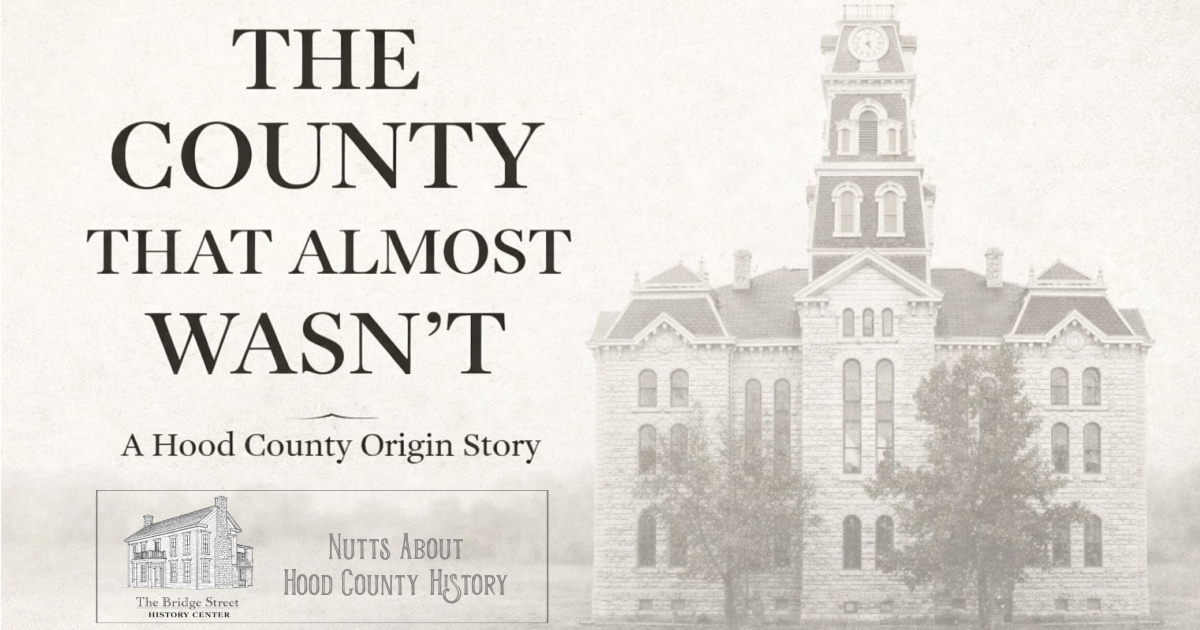
Dust, Mud, and Plywood: Back in the Day on the Granbury Square!

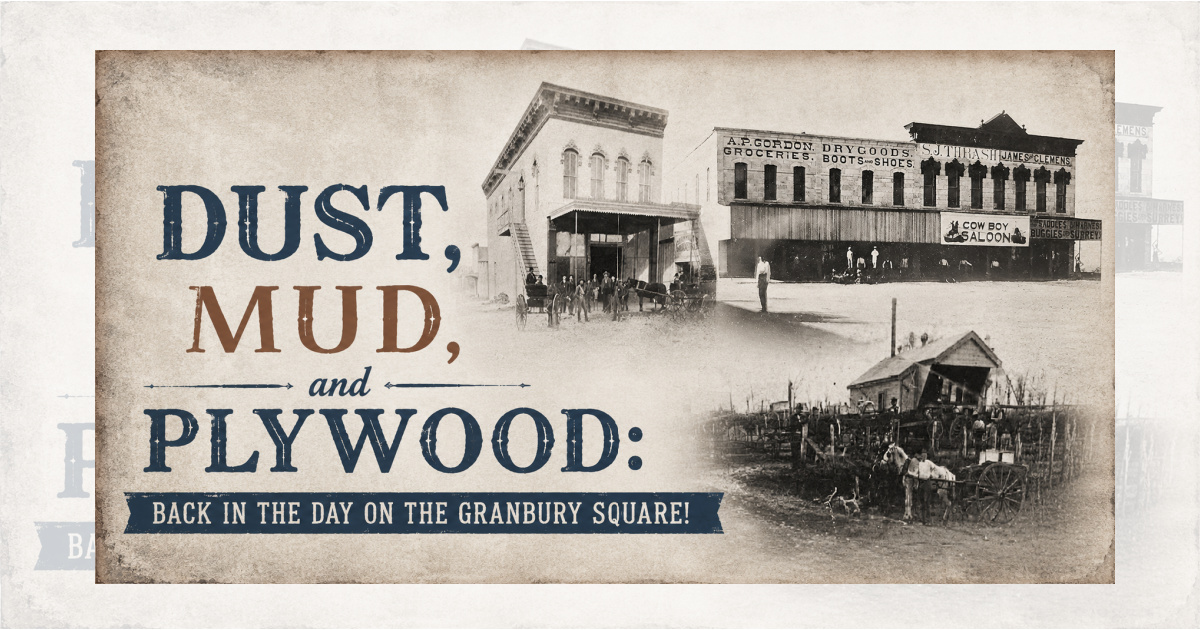
Historic photographs showing early Granbury Square with dirt streets, original storefronts, and the Nutt Brothers mercantile in Granbury, Texas.

About twenty years back the city of Granbury undertook a massive street and sidewalk renovation project to keep our Historic Square a living and vital part of our community. During the project some “fun” things happened that were reminders of the square that once was and that “historic” Granbury was not always exactly as we sometimes picture it.

Visitors and locals alike, spoiled to relatively level and clean asphalt roadways and concrete sidewalks, had to be reminded that “construction zone” Granbury Square, with its dust, unlevel dirt, and sometimes muddy streets, makeshift pedestrian crossings, temporary signage, and plywood or gravel temporary egress from some buildings was MUCH more like the actual reality of the REAL Granbury Square of the late 1800s than the pristine jewel we have long created here in our historic district. In the REAL historic Granbury, the streets were hardpacked dirt that turned to and churned as mud during the spring rains. Sidewalks were sporadic or non-existent and made of every available variation of material from wood planks to limestone.

And signage — oh my goodness the signage! This author must admit to a hardy laugh from time to time over the vehemence which characterizes the enforcement of the “SIGNAGE” regulations on today’s storefronts around the square! Photographs provide the proof: signage on the real square of the late 1800s was LARGE and mostly made of simply lettered sheets of wood. Outside those storefronts, under equally crude wooden awnings, were porches, mostly cluttered with displays of merchandise. TRAFFIC was a morass of parked and moving wagons and carriages pulled by live animals that answered nature’s call as it occurred and intermingled with lots of pedestrian traffic, made up of folks who sloshed through it all to sell and buy their goods. There was no air-conditioning in the summer and no relief outside from the messy consequences of inclement weather. In the fall and winter the air was filled with the smell of nearby cotton gins and smoke from the wood and coal fires that heated the interior of the shops and businesses. Yet still, the people came; commerce, entertainment, eating, and worship all took place; and our town grew and prospered.

While we are talking realities – another misconception is that the current relatively pristine assortment of late Victorian era buildings is “how it has always been.” Another hearty laugh pops out upon hearing folks talk of events that happened in the 1870s or even the early 1880s as having taken place in this building or that one, when the reality is that there is not a single structure on the square that existed prior to 1883 although the town began in 1870-71. That means for twelve or more years, the citizens of Granbury were living and working out their stories in structures that no longer exist.

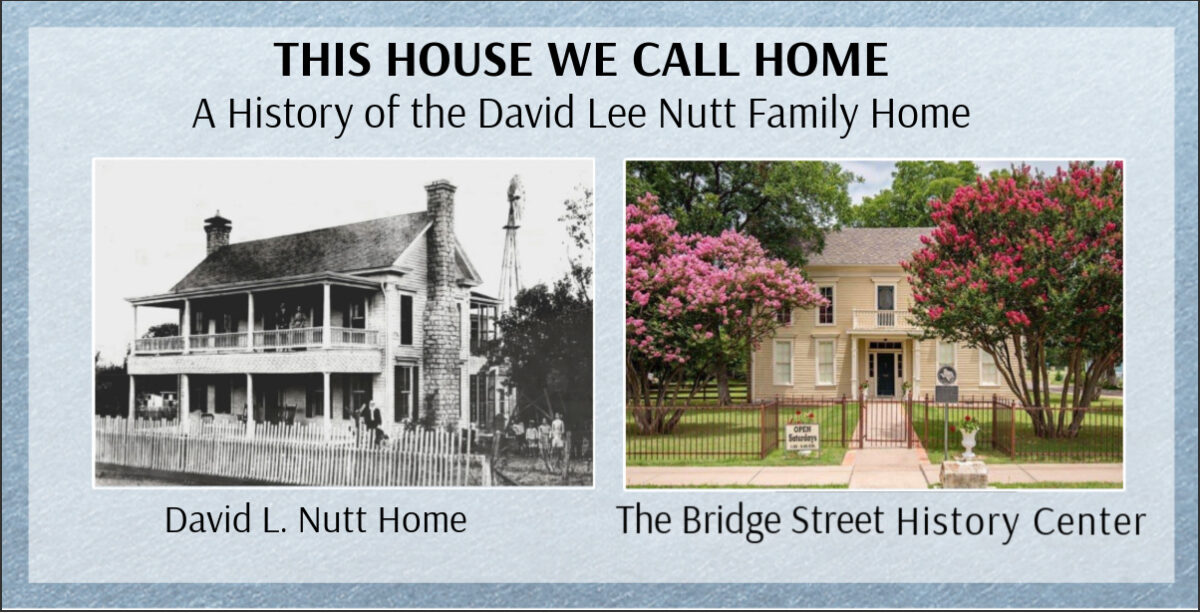
One of those old wooden structures, was preserved for a long time – Frank Gaston’s newspaper office, was moved many years ago to a site adjacent to the Old Granbury Light Plant behind the current post office. For decades you could drive by and take a look and imagine thirty or so such buildings on the lots surrounding the Courthouse Square! Unfortunately, it finally deteriorated and is no longer there. There is a photo that still exists from sometime in the 1870’s that shows the Nutt Brothers’ original frame mercantile building and a part of the stone barn that housed the original livery stable/wagon yard they ran behind it. They were located where the east side of the current Nutt House Hotel and north side of the current Wagon Yard Antiques businesses are located today.

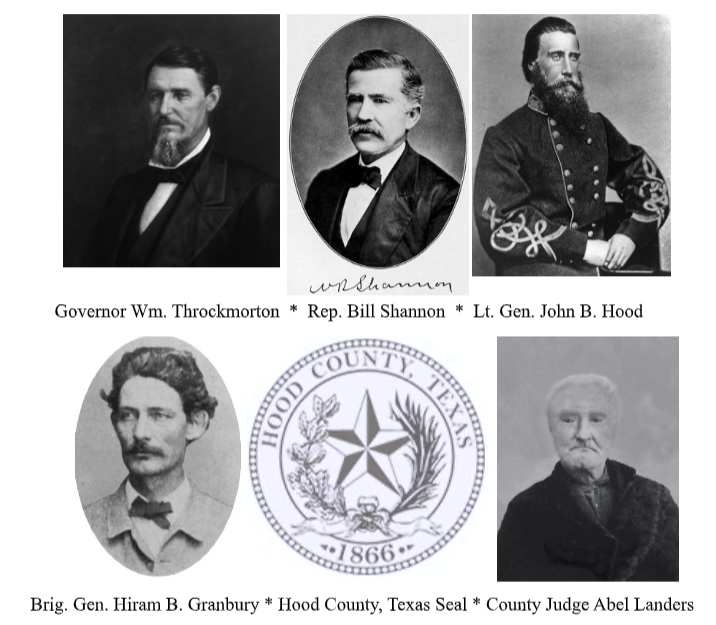
And then, of course, there’s the Courthouse! The 1890 Hood County Courthouse has become the iconic symbol of all things Granbury and Hood County. Yet, note that date….1890! That means that for 20 years the centerpiece of our town was much different in appearance! For the first few years a tiny log structure occupied the site. Then, in the years between 1872 and 1889, smaller, 50’ x 50’ two story limestone courthouse stood on that site. It is this writer’s belief that the oldest buildings in Granbury are that north wing of the Wagon Yard building shown in the picture behind the Nutt’s original mercantile and the Yeats-Duke cabin that sits just across from it on Crockett street, just north of the square, which dates to the mid-1850s. The oldest buildings facing the square, standing on their original site, are the Hannaford-Baker Building (once called the ”Arch-block” building) and the first section of the First National Bank that stand diagonally across from each other on the northwest corner of the square. They were built between 1881 and 1883.

In every photo, look at those DIRT streets!

Peter Garland: Villain or Hero?

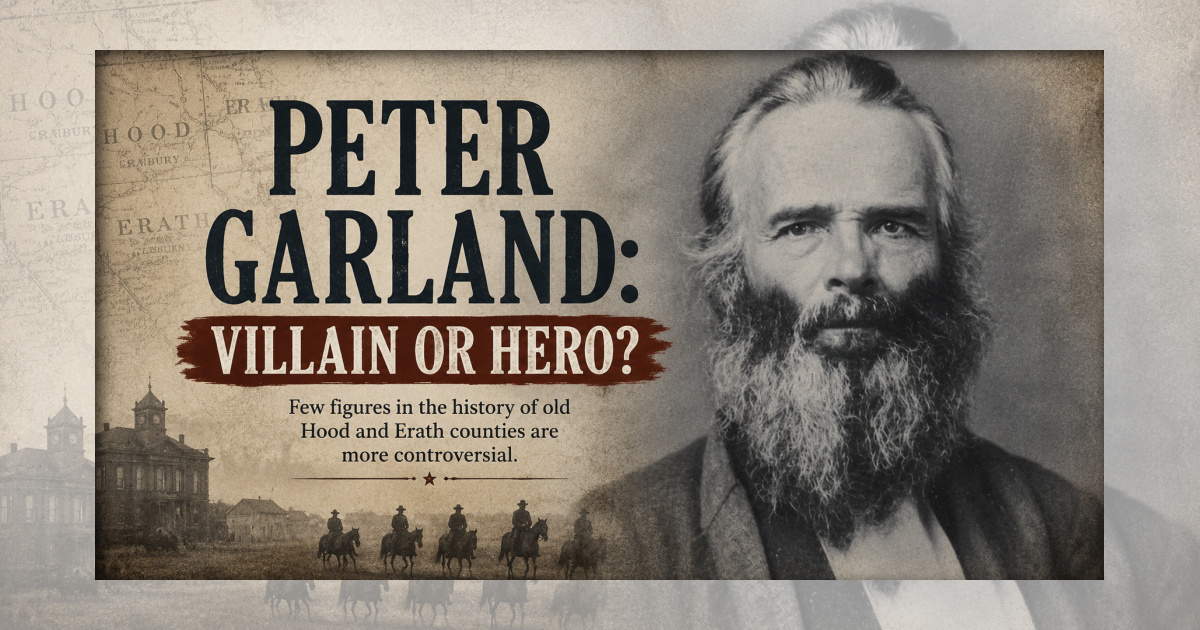
Historic portrait of Peter Garland with vintage Western design and the title “Peter Garland: Villain or Hero?” exploring controversial Hood and Erath County history.

Few figures in the history of old Hood and Erath counties are more controversial that Captain Peter Garland. To some a vile, violent, hate-filled man, – to others a hero. Garland’s story is still capable of sparking strong emotions in the descendants of some who knew him, even 150+ years after his death.

Capt. Peter Garland of Texas was born in 1805 in Henry County, Virginia, the grandson of Col. David Garland of the Revolution and son of Maj. Peter Garland of the Virginia 64th Regiment in the War of 1812. A family written biography describes Peter’s connection to this heritage by saying, “His grandfather and father had wars to fight. Capt. Peter Garland, some say, created his own war against the Indians of the Texas frontier.

After leaving Virginia, young Garland was first married to Lucinda Goff in Tennessee and second to Louisa Phillips in Mississippi as he moved westward to Texas. Over the years he fathered a total of at least 12 children. Before coming to Anderson County, Texas, in 1850, Garland was a Deputy Sheriff, Circuit Court Clerk, and saloonkeeper in Tishomingo County, Mississippi. In 1857, the Garlands braved the raw frontier of Erath County along with several other families, including the Thorntons, Hightowers, and Wylies. Ten years later, in Hood County, Peter and Louisa 16-year-old daughter, Melissa Virginia, was married to James Goodhope Thorp, eldest son of Pleasant and Nancy Thorp, founders of Thorp Spring.

The reasons for Peter’s zeal regarding total removal of the Native Americans from the area is unclear. There is some tradition that he had family and close friends who had been killed by the natives during his early years in Erath County. Certainly, as the Civil War loomed, bloody Comanche raids on the settlers of the frontier area continued and would for another decade, despite removal of all Indian tribes from northern Texas to the reservations of what is now Oklahoma.

Peter and Louisa (Phillips) Garland moved from near Stephenville in Erath County to Hood County in 1860, settling on Stroud’s Creek near Thorp Spring. Controversy followed the volatile Garland to Hood County, and some historical writers still debate the part he played in the early history of this  part of Texas. As a captain in the Frontier Guard, Garland has alternately been condemned as an Indian hater of the first order and murderer and hailed as a fearless Indian fighter, defender of the frontier, leading citizen, and hero. In retrospect, out of the context of the times, it is doubtful that controversy will ever be resolved.

Much of the controversy stems from an incident that occurred in August of 1859, when Garland and a group of men responded to news that a white woman had been kidnapped by a roving band of Indians. This was later proven to be a mistake – the woman was safe and sound at a friend’s house – but not before a tragedy of epic proportions occurred. Garland and a band of men set out to find and rescue the woman and punish (some said, annihilate) her kidnappers. Imagining the poor woman and her probable treatment at the hands of the Comanche, Garland and his men were already in a frenzy when they received a tip from a young man that he had seen some Indians camped with a white woman in their camp on the banks of a nearby creek. Garland and his men found and attacked the encampment. It was only after most of the camp had been leveled, no white woman found, and all its inhabitants but a few young children killed, that their bloodlust cleared enough to realize to their horror that possibly a mistake had been made. Most of the dead were squaws, old men, and children.

Confronted by the rancher who had given the small band of peaceful natives permission to camp on his property while their men hunted, Garland and company were accused of a senseless massacre. Feelings ran high and they departed the area in haste. News of the “massacre” spread and Indian troubles increased. According to family accounts, Garland was distraught over the incident but insisted he and his men had acted in defense of a neighbor on the basis of the information they had to hand. A descendent of the rancher quite recently described him as a mean recalling the story as told by his great-grandmother during his childhood.

In the fall of 1869, Peter Garland was one of the men from Thorp Spring involved in The Point of Timbers Fight, an incident which involved the killing of eight natives and one white man in what became known as the last Indian fight in Hood County. And so, the controversy lives on. In his History of Hood County, Thomas Ewell commented that Garland was honored and trusted by the people who knew him best and were personally cognizant of all the events. This must have reflected the views of many of Garland’s contemporaries, as he was elected Hood County Treasurer in 1872 and was serving in that post at the time of his death. He certainly had a profound influence on later history of the area, as several of his children married into prominent Hood County families.

Children of Peter Garland and his wives Lucinda and Louisa:
Thomas (m: Martha Wylie)
William
Mary Anna (m: Daniel L. Thornton)
Lucinda (m: Joshua L. Hightower)
Jefferson
Joseph
Melissa Virginia (m: James G. Thorp)
Susan Avarilla (m: David L. Nutt)
A. A.
Allison Nelson (m: Mollie Wright) Daniel T.
Martha Olive (m: J.C. Brown)

Capt. Peter Garland died in 1873 in Thorp Spring at age 69. He is buried there in the old Thorp Spring Cemetery.

John St. Helen – The Myth and the Mummy – The Final Chapter

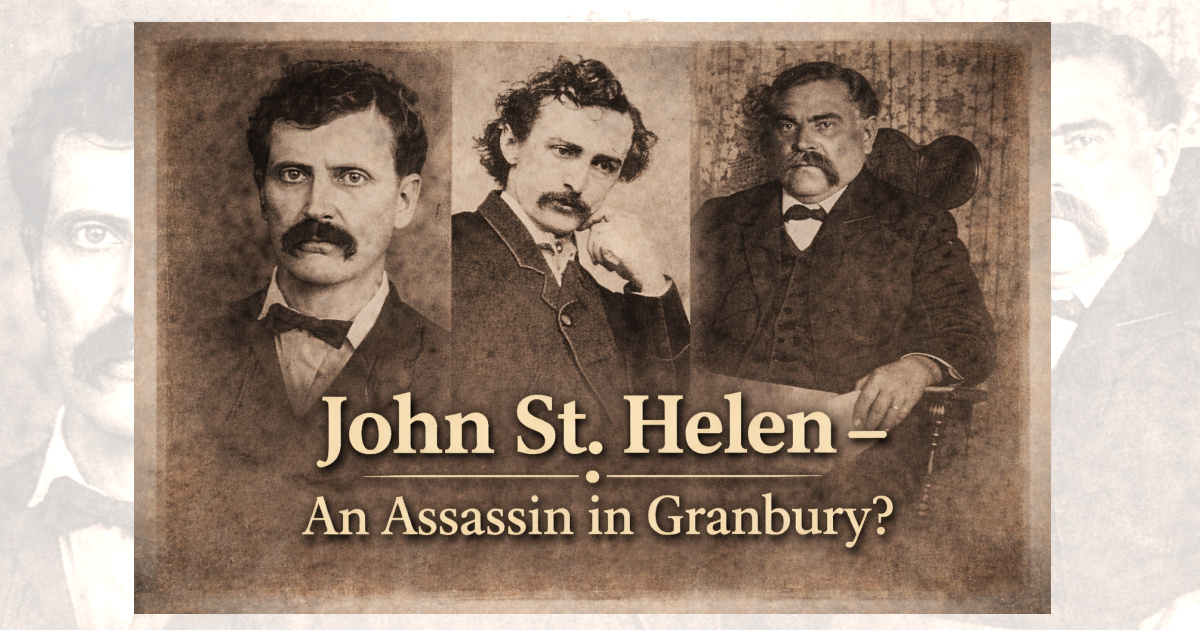
Historic images of John St. Helen connected to the question of whether an assassin lived in Granbury, Texas

If you are just joining us please find part 1 & 2 here.

John St. Helen – An Assassin in Granbury? Part One

John St. Helen – An Assassin in Granbury? Part Two

THE FINAL CHAPTER

Now is where this story crosses the line from mysterious to bizarre. In 1903, in Enid, Oklahoma, a local house painter with a fondness for drink and for reciting Shakespeare, going by the name of David E. George, had committed suicide by ingesting a large quantity of arsenic. Shortly after George’s death, Rev. Enoch Harper came to view the body and relayed a story to the undertaker who was embalming the body. In April 1900, George had reportedly confessed to Mrs. Jessie Kuhn, the reverend’s fiancé, that he was John Wilkes Booth. Mrs. Kuhn had then dismissed the confessions as the product of drug-induced delirium. George was also quoted as saying, “I killed the best man that ever lived.”

The undertaker, William Penniman, hesitated to have George buried until the body could be claimed. On December 31, 1902, George had drawn up a will with local lawyer Niles Houston, and it was filed with the local probate court on January 16, 1903. However, the property listed in the will proved to be non-existent, and the body remained unclaimed and unburied at Penniman’s. The arsenic embalmed body sat for eight years on display in Enid at Penniman’s establishment. Penniman had tied the body to a chair, opened its eyes, and placed a newspaper in its lap, creating a spectacle for passersby in the Enid downtown. A local boy led dime tours into the funeral home to view the mummified body where it lay on a shelf. According to Penniman, 10,000 people viewed George’s body in Enid, including a few who clipped hair, buttons, and one even attempted to remove his ear.

Other papers found on George requested Finis Bates to be summoned. On January 23, 1903, Bates identified the body as that of his old acquaintance John St. Helen. Ultimately, with no one else to claim it, and after years on “display”, the body ended up in Bates’ care. Bates stored it in the garage of his home in Memphis, Tennessee, and toured the alleged mummy of Booth in circus sideshows for years. The body was shown at the 1904 St. Louis World’s Fair but was rejected by the 1933 Chicago World’s Fair. In 1920, Bates tried to sell it to automaker Henry Ford for $1,000, but Ford declined. A carnival barker named William B. Evans rented the mummy in 1920, paying Bates $1,000 every five months. That year, while traveling to San Diego, the mummy came out unscathed in a tragic train wreck that claimed eight lives.  Before Evans could restart his tour, the mummy was stolen. Evans ran ads offering a $1,000 reward for its return. Eventually, the kidnapper himself turned in the mummy for its reward.

Evans wanted to return it to Finis Bates, but Bates had died in 1923. Bates’ widow sold the mummy to Evans for the usual sum of $1,000. Evans displayed the mummy at his farm for several more years. Kansas City lawyer, James Wilkerson, an expert on John Wilkes Booth, examined the mummy in 1928, comparing its scars to those of Booth, and began touring the Southwest with it.  Enraged by its presence, Veterans of the Grand Army of the Republic threatened to lynch the mummy. Wilkerson and Evans were often run out of town by health officials and policemen and, ultimately, the two disbanded.

In 1931, the Chicago Press Club hired six doctors led by Dr. Orlando Franke Scott (1885–1950) to examine the mummy. Part of their description described, “a scarred right eyebrow that arched upwards, a thickening on the knuckle joint of the right thumb, and a piece of skin missing from the back of the neck” and “X-rays of the head, hands, and legs showed a thickening of the tissues over the right eyebrow, a thickening in the bones of the right thumb, and a marked thickening of the left fibula at its lower end, indicating an earlier fracture.” The results were not conclusive nor widely accepted. The event was viewed as a publicity stunt, and the doctors did not examine other elements such as height and facial features.  X-rays from this examination were later displayed with the body, which now had a large opening in its backside as a result. Somehow, the concept that this had once been a living, breathing human being had been lost long before.

In 1932, the maudlin journey continued as Joseph Harkin bought the mummy, then named “John,” for $5,000. Joseph and his wife, Agnes, shared the back of a truck with “John” by night and displayed him by day. After some years the mummy was seized as collateral for debt repayment. It next surfaced in the 1950s, when “John” was stored in a Philadelphia basement. A man purchased “John” from a female landlord who had held it as collateral for $15.00 and went to Philadelphia to claim it, but when he arrived, the entire neighborhood had been razed, and “John” was gone. It was last seen in a midwestern carnival in the late 1970s. Though rumors surface from time to time, the final or current resting place of the remains of this man who may have changed the course of history remains a sad question for the ages.

But even more questions remain. Back in 1865, when government doctors did the autopsy on the body from Garrett’s barn, before sending it off for burial they removed two vertebrae to keep as “evidence” for posterity that Booth had indeed been captured and killed. Those vertebrae are still “on file” at Bethesda Naval Hospital in Maryland. Over the years, four different times the Booth family descendants have petitioned to exhume the body of Edwin Booth, John’s brother, to obtain DNA for comparison with DNA from the vertebrae. Every time (most recently in 2011) a local judge approved the exhumation, but a federal court overruled, refusing access to the vertebrae “on the grounds of national security.”

Many people take this repeated denial as proof that the federal government has always known that the body at Garrett’s barn was not Booth. The last living descendant of Ida Booth, Booth/St. Helen’s alleged daughter, died in 2011, before DNA science advanced enough to prove descent from so many generations removed. So again, unless the mummy can be found, any provable answers are lost to the mists of time. Some suggest that John St. Helen, the man who confessed to being “John Wilkes Booth” to attorney Finis Bates, is a different man from the person who married Louisa Payne. My research suggests they are the same man. This man, Jack Booth/John St. Helen/David E. George, was either a deluded and deceptive man who pretended to be John Wilkes Booth for over four decades or, as many descendants of the Booth family and countless others have believed, this man who shouted Shakespeare from a tabletop in Granbury, Texas, was actually the man who shot Abraham Lincoln, John Wilkes Booth himself.

Melinda Jo Ray historian, author, and retired school teacher and librarian from Granbury Texas writing for the Nutts About Hood County History blog
Melinda Jo Ray, historian and author of five published books, writes the Nutts About Hood County History blog for the Bridge Street History Center in Granbury, Texas. Ray is a retired school teacher and librarian who has dedicated years to researching and preserving the history of Hood County.

John St. Helen – An Assassin in Granbury? Part Two

Historic images of John St. Helen connected to the question of whether an assassin lived in Granbury, Texas

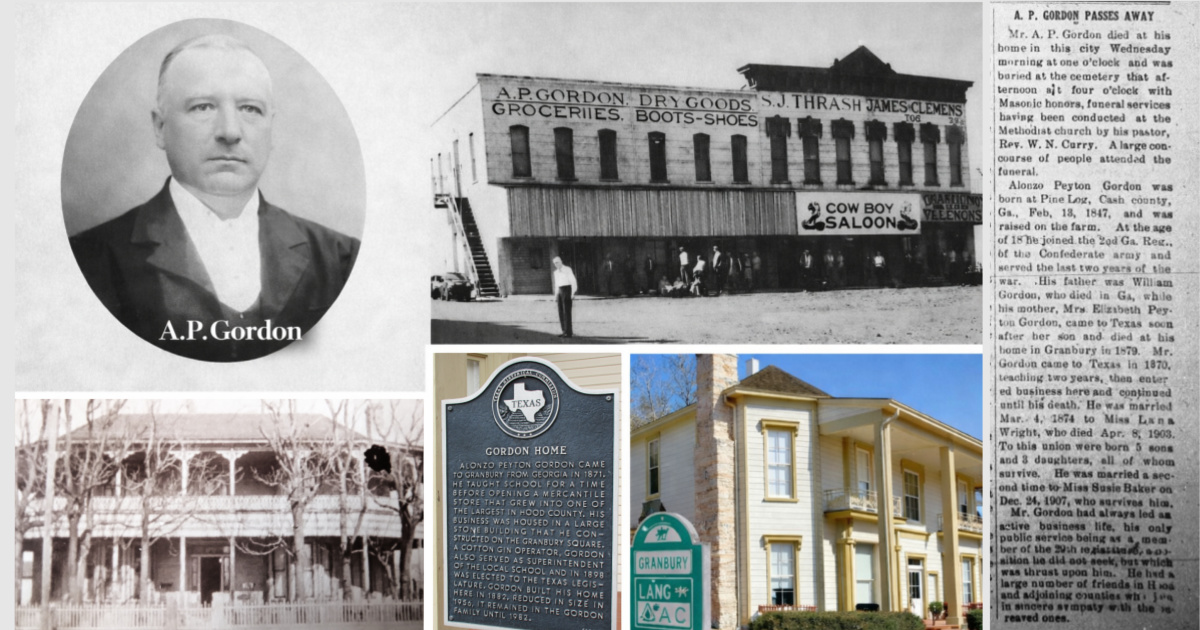
During his time at the McDonald farm near Glenrose Mills in 1873, John St. Helen would travel with his landlord on occasion to Dallas, hauling crops by wagon. It was noticed that he made himself scarce if serious law-enforcement, like the Texas Rangers, came around. In late 1873, a local young lady announced her engagement and imminent marriage to a Texas Ranger. Learning that the couple planned to make their home in Glenrose Mils, St. Helen left overnight just prior to the wedding in the spring of 1874, even leaving some of his belongings behind. He had met and befriended a young lawyer from the nearby town of Granbury at a picnic, so he headed north up the Brazos. He appeared in Granbury, was hired as a bartender and lived forover a year in a log cabin located near the town square and owned by merchant A. P. Gordon.

Now to take a moment to dispel some misconceptions. The Granbury that John St. Helen came to in 1873 bore very little resemblance to the town we know today. First of all, there were NO massive stone buildings on theso-called town square, except for the two-story limestone courthouse built in 1871– the first really substantial building to be built on this land whose title was at the time under dispute. There MAY have been six to ten log/frame/partial stone one-story buildings scattered on the lots that had just been laid out a couple of years before. Granbury was only recently incorporated, and most if not all governmental power rested with the County Police Court headed by J. B. Spears and the County Sheriff A.J. Wright. A. P. Gordon, St. Helen’s new landlord, had a small grocery store on what was designated as the lot on the southeast corner of the infant town square, at the intersection of the almost imaginary Pearl and Crockett streets. Over on the southwest corner, where Pearl intersected the equally imaginary Houston St., stood the beginnings of the Stringfellow Hotel and diagonally across from it was the log house known as the Black Hawk saloon – most likely St. Helen’s original employer, in an equally small, primitive structure. There was no “opera house” at that time. While the popular myth goes that St. Helen’s drunken diatribe of memorized Shakespeare on April 14, 1874, and possibly again in 1875, took place on the Opera House stage, the early recorded recollections of people who were actually here at the time describe him standing on a tabletop in the saloon.

The strange thing about St. Helen’s assassination anniversary monologue, and what apparently made it so memorable, was that it apparently broke his usual pattern of behavior. He was described a quiet sort, almost to the point of being taciturn, and, unusual in a bartender, he was an avowed teetotaler. During his almost two years in Granbury, St. Helen apparently presented the same cultured persona he showed when living with the McDonalds. As the tenth anniversary of the Lincoln assassination approached, he would have been thirty-six years old.

St. Helen apparently knew many of the men of the town due to his bartending job, but befriended few, and confided in none. The exception to this appears to have been his young lawyer friend who was also from Tennessee, Finis Bates. Bates was by his own admission a grass green, ambitious young attorney, who had come west to make his mark on the world. He saw in St. Helen a fellow Tennessean, an educated and cultured well-read man, and St. Helen apparently saw the same thing in kind. The two hit it off and became close friends. But Bates could tell his friend was a man with secrets. Following the code of a society full of people seeking a fresh start, he respected his new friend’s privacy and didn’t press for his secrets.
“Saint,” as he was apparently called, for all his cultured teetotaling ways, did have one notable vice, foreshadowed by his threat to his young stepson a few years before. He had a formidable temper and was apparently fully capable of violence. There is a stunning and dramatic story documented in a sworn affidavit given to federal investigators in the 1920s by an elderly David Lee Nutt. The Nutt brothers’ first mercantile store on the Granbury Square was a smallish one-story wood structure backed by a livery stable on the
northeast corner of the square one-block directly north of A. P. Gordon’s grocery store.

Apparently young David Lee, then aged 26 or so, was on duty with his blind brother Jesse Nutt at their store sometime in early 1875 when a man ran in the front door of the building with “Saint” in pursuit – wielding a knife. There was a skirmish at the back of the shop, and then as the sheriff approached, “Saint” fled, leaving the man bloody but with only minor injuries. In the way of things in those days, since the man’s injuries were minor, St. Helen got off with a warning. What the outcome might have been had the sheriff’s imminent arrival not intervened no one knows. But certainly, again, here is a man obviously capable of deadly violence.

After the stabbing incident, “Saint” was apparently on thin ice with his landlord and now, employer and, according to Gordon’s own statement, he was seriously considering firing and evicting the man. But cold weather arrived, and fate intervened. Sometime toward the end of the winter of 1874-1875, St. Helen became seriously ill with what was probably pneumonia. Convinced death was near, St. Helen sent for his
friend, Finis Bates. In the late afternoon, as the sun headed down and the light grew dim, John St. Helen made his confession to his friend, telling his identity, and revealing details of the assassination, including where he had hidden the “second derringer” that he had planned to use on Lincoln’s bodyguard, but the man was passed out drunk — which apparently saved his life. Additionally, St. Helen begged Bates to find a priest come and hear his confession and give him absolution. No priest being available in the vicinity, Bate and others found a “local man of the Godly persuasion” to do the deed.

Oddly enough, Finis Bates’ account of St. Helen’s story does not have any mention of the woman St. Helen presumably married and left behind. Bates departed late that evening, knowing he had to leave for an out-of- town court date and would be gone for several days. He found St. Helen’s landlord, A. P. Gordon, and gave him money to pay for St. Helen’s burial, vowing to return and settle up any further expenses required for his friend’s care. He left, never expecting to see his friend alive again. He was right, just not in the way he expected.

As promised, he showed up to inquire after his friend a few days later. Told that St. Helen was gone, he nodded and inquired as to the place of burial. At this point, Gordon replied, “No, you don’t understand. His fever broke the night you were here, and the next morning, even though he was weak as water, he rode out of here before sunup, with just some saddlebags and the clothes on his back.” The note St. Helen left, some other personal items, and a derringer that matches the other of the pair from the same set, that was used to
shoot Lincoln, is still owned by the Gordon family.

For the next twenty-plus years, St. Helen wandered the far western areas of the United States, the name popping up occasionally in the public or anecdotal record. He actually met in California on at least two known occasions with members of the Booth family who had known John Wilkes Booth well, and they became convinced that he was indeed the man they had known. But he was always elusive, secretive, still conscious of the very real threat of the gallows should he be captured and his identity proven.

Stay tuned to PART 3 next week.

NOTE FROM THE AUTHOR MELINDA RAY
Some may question the veracity of the information mentioned in this tale of the man those in the Granbury and Glenrose area knew as John St. Helen between 1873 and 1875. I have spent almost twenty years exploring the tales of early Granbury and Hood County and their inhabitants.  I began my investigations into the St. Helen tale as an avowed skeptic. After reading Finis L. Bates recounting of the tale, published in 1908 as the book The Escape and Suicide of John Wilkes Booth, I was intrigued. Bates had spent the thirty years between 1875 and 1905 working as a reputable attorney, who dealt on a daily basis with issues of truth and the law. For someone who had spent his life that way to put their reputation on the line by going public with what was sure to be dismissed by many and even by the government as at best a tall tale…got my attention. So, I proceeded to follow in the steps of those who had searched before me, and what I found blew me away.
I found the record of and photos of Booth and Louisa Payne’s marriage certificate from February of 1872 in the courthouse in Franklin County, Tennessee. I also found the tale of their marriage as told by both Louisa’s son, McCager Payne and his half-sister, who lived her entire life as Laura Ida Elizabeth Booth. And then I learned that the federal government of the United States sent 2 Secret Service agents to Hood and Somervell counties in the 1920’s to interview anyone who was still alive who had known St. Helen. There are 25 sworn affadavits from those folks were taken, all signed by a Texas notary. Here are just a few of the names on the list – Ashley Crockett, B. M. Estes, D. C. Cogdell, David Lee Nutt, Katherine Doyle and Sadie McDonald Rylee. The affadavit transcripts and other documentation can be found in two places- the originals are housed in the archives at Georgetown University, and certified copies are held here in Texas, in the collection of the library at San Angelo State University, alma mater of the attorney daughters of Texas native and Federal Judge E.H. Swaim who was involved in the investigation into the case.

John St. Helen – An Assassin in Granbury? Part One

Historic images of John St. Helen connected to the question of whether an assassin lived in Granbury, Texas

Next Tuesday night, April 14, 2026, at about 9:15 in the evening, Granbury citizens might want to pause to
remember that it was at that hour 161 years ago that the man many consider to be one of America’s greatest presidents, Abraham Lincoln, was shot and killed by the stage actor, John Wilkes Booth. Many believe that man became one of Granbury’s most notorious residents – John St. Helen. Many believe he was the stage actor, John Wilkes Booth, and was the principal player of a story that before, during and after that tragic event is still, 161 years later, shrouded in mystery, conspiracy, inuendo, and enough plot twists to make it one of history’s most convoluted and tragic whodunits.
John St. Helen – An Assassin in Granbury?

Part One

A shot fired. The President dead as a nation mourns.
The manhunt begins, and ends, in a smoky blaze of fire. In Tennessee, a wife with infant child wait – abandoned.
In far-away Texas, a young girl stores memories – of the well-dressed stranger who lives with her family briefly on a farm near tiny Glenrose Mills. In frontier Granbury, a young lawyer befriends that stranger – who becomes the cultured teacher in whose temporary courthouse classroom Granbury College began and whose pupils performed a costumed, Shakespearean drama. Come summer, the stranger becomes the volatile, Shakespeare quoting bartender and saloonkeeper who drank only once a year, on the eve of the ides of April.

Decades pass, and relatives tell of the assassin believed dead – met on San Francisco’s streets, seen in a western mining camp… And finally, news of the death by suicide of an elderly Oklahoma man in in 1903, and a final call to that former Granbury lawyer, Finis Bates. Then – a human body – identified, mummified, displayed, disappeared. Bones held in secret, unopened graves shielded by federal courts. Fifty years on, federal agents are deployed – taking the sworn affidavits from 25 of Granbury’s most prominent citizens, collecting tales of a stabbing in his family’s shop…, of a deathbed confession…, of an empty bed – found after the sound of hoof-beats in the night.

And still today, a Nation wonders, awaiting the final act in the crime that shaped its fate – the play’s ending, perhaps forever – unknown. These are the elements, the bare bones – if you will – of a story that has spanned over 161 years, and still has no ending – no certain reality to finally close the book on the story of that greatest of American tragedies: the Civil War. For that is what this is. The assassination of Abraham Lincoln was the final ambush of one brother citizen against another in the nineteenth century war whose divisions our nation still grapples with today. The fact that the true fate of the assassin that waged that last attack is still shrouded in mystery is surely one of the great question marks of the American story.

At the center of this tale is the less than three-year glimpse of a man, that mysterious stranger, John St. Helen.

In the spring of 1873 he appeared, arriving from the deep South, to linger here in the valley of the Brazos River on the frontier of Texas. He was alone, yet not alone – one of many immigrants to the area from what had once been the heart of the Confederate States of America. As such he should have felt himself among friends, and perhaps he was, as he soon made a deal for room and board with the family of farmer William McDonald, whose land was on the west side of the river near what is now Glen Rose in Somervell county. Or perhaps it was the cash he always paid with that made him welcome since, by all accounts, St. Helen was – at best – what my grandmother would have called “an odd duck.”

To say he did not blend in with the majority of the locals would have been an understatement. His ready cash was an anomaly in a culture where seasonal crops and or livestock were the primary sources of income. William McDonald’s daughter, Sadie McDonald Rylee, described him in recollections made almost seventy years later: “He was well-educated, and had fine manners, and he always wore the finest kind of clothes,
broadcloth and linen and silk. We would get mail only about every two or three weeks, and he would get lots of mail each time, and some of it would be fine clothing, and we were sure, though we didn’t know, that he got money through the mail. When we and other people of the community would have parties and entertainments, we would get St. Helen to read for us, which he did wonderfully. He was always poised, and he seemed to know Shakespeare by heart. Unless he were hiding out, it would seem strange for a man like him to be in a rough frontier country.”

Who was this cultured, dark-haired stranger; so suddenly appeared, so silent about his origins? Over the last sixteen or so decades a partial answer, most of it supported by some form of actual evidence, has been found. But the final answer, the one that matters, still eludes us. To put flesh on the bones of that story described in the summary above is to give substance to ghostly mystery, for the man called St. Helen appears then disappears again from history like a paranormal wraith in the night. Our only certainty is in the beginning — we know the event from which this man himself claimed John St. Helen sprang.

On April 14, 1865, several years before St. Helen’s arrival in northeast Texas, U.S. President Abraham Lincoln was shot and killed by a derringer wielding assassin as he attended a performance in Ford’s Theater in Washington, D.C. The assassin was a Shakespearean stage actor named John Wilkes Booth. Booth was a member of the then famous Booth family acting dynasty and was one of the most prominent and famous actors of the day. He was also a known Confederate sympathizer.

Once Booth leaps from the Presidential box to the stage, and flees into the night, the mystery begins. We know he had accomplices; we know other murders were planned and attempted that night. We know Booth had a well-planned escape route. We know he had knowledge of a people across the Potomac in Southern territory ready to help him vanish. We know he had his broken leg tended by Dr. Samuel Mudd, and we think we know that, at least for a time, he hid in a barn owned by a farmer named Garrett. We know federal troops surrounded the barn. We know they fired multiple shots into the barn. We know the barn caught fire, either set or from a broken lantern, and partially burned. We know there was a body found in the barn afterward.

From there forward are myths and mystery. The myriad versions of the story of how government troops knew of Booth’s supposed presence in the barn, how long he was there, and what exactly transpired that evening do little to assure history of the veracity of the official government version of the tale. Even more staggering are the wildly divergent descriptions from many supposedly reliable sources as to the description and identity of the man who died there that day. But for the purposes of our story, let it suffice to say that descriptions vary from sworn statements that the body
matched the detailed description of John Wilkes Booth who clearly had dark hair and olive skin, to descriptions from supposed eyewitnesses who later swore the body they saw had reddish hair and fair, freckled skin.

From the Virginia confines of the barn on the Garrett’s farm, Booth fled, according to our tale. Heading first south and later west. For the next five plus years he wandered in the shadows, from “safe house” to “safe house,” moving often, and avoiding places where law enforcement or federal troops gathered. Finally, around 1871, he appears in the area of Franklin County, Tennessee, using the name John St. Helen. At this point he apparently decided enough time had passed that he could risk staying put for a while.

Louisa J. Payne was a Confederate Civil War widow. Her first husband, Confederate soldier C. Z. Payne, died in 1865 toward the end of the war. Louisa was left to care for her young son McCager (or Cage). Louisa worked as a seamstress for the recently opened The University of the South in Sewanee, Tennessee. In 1871 Louisa met a man named Jack Booth who claimed he was a distant cousin to John Wilkes Booth. Louisa fell in love and she married Jack in February 1872. However, after the wedding, Jack told Louisa that he had a past, and his name was not really Jack. He confessed that he was actually John Wilkes Booth, the assassin of the Republican President. Louisa, a devout Christian and southern Democrat, could forgive her husband for his war actions and personal deceptions to her, but she insisted that he sign their marriage certificate with his God-given name. And so, on February 24, 1872, a new certificate was signed in the presence of Rev. C. C. Rose, listing the marriage of John Wilkes Booth and Louisa Payne.

The late historiographer for The University of the South, Dr. Arthur Ben Chitty, did extensive research into Louisa Payne and her marriage to the man claiming to be John Wilkes Booth. Dr. Chitty eventually discovered the marriage certificate itself, located in the Franklin County Courthouse in Winchester, Tennessee. Dr. Chitty archived at The University of the South several audio tape interviews of men who personally knew McCager Payne, who in 1872 became John Wilkes Booth’s stepson. Dr. Chitty discovered that McCager had intimate knowledge while a youth that his stepfather was actually John Wilkes Booth.

As a newly married couple Louisa and John Wilkes Booth moved to Memphis, Tennessee, because, as Louisa would later say, “my husband had been told he would be paid a large sum of money owed him for his official work on behalf of the Confederacy.” While in Memphis, Louisa overheard some men on the street discussing her husband and pointing out where the “skunk” was now living. Louisa informed John that the men knew who he was, and his life was in danger. John told Louisa that it would be better if they separated for a season. He would go to Texas, and she should go back to Winchester, Tennessee, until things cooled off. John promised Louisa that he would return to Tennessee after things settled down.

Louisa went back east to Payne’s Cove, Tennessee, and the man claiming to be John Wilkes Booth headed south. Unbeknown to the couple at the time, Louisa was pregnant with John’s child. Louisa Payne would give birth to Laura Ida Elizabeth Booth, named after one of John Wilkes Booth’s sisters, while living alone in Tennessee in early 1873. Her second husband, the man who claimed to be “John Wilkes Booth” had gone to Hood County, Texas, and would change his name to John St. Helen.

Back in Tennessee, during 1873 Louisa Booth received financial help from the family of her deceased first husband. She went to work caring for her son, McCager, and her newborn infant girl. Louisa kept hope that her husband would return to her from Texas, but she never heard from him again. In 1879, 36-year-old Louisa Payne was burning leaves in her front yard when her dress accidentally caught fire. Louisa ran to a nearby creek to douse the flames, but her burns proved fatal. Before she died, Louisa called her six-year-old daughter Laura Ida Booth, and her fourteen-year-old son, McCager Payne, to her bedside. The mother informed her children that Ida’s father was John Wilkes Booth.

McCager Payne would later tell friends that he already knew John Wilkes Booth was his stepfather because of conversations he had overheard between his mother and the man when he was a boy. Caught once listening by his stepfather, McCager recalled being threatened by the man. If he told anyone his stepfather was Booth, the man told the boy, “I will kill you”.

Stay tuned to PART 2 coming Tuesday April 14th. 

NOTE FROM THE AUTHOR MELINDA RAY
Some may question the veracity of the information mentioned in this tale of the man those in the Granbury and Glenrose area knew as John St. Helen between 1873 and 1875. I have spent almost twenty years exploring the tales of early Granbury and Hood County and their inhabitants.  I began my investigations into the St. Helen tale as an avowed skeptic. After reading Finis L. Bates recounting of the tale, published in 1908 as the book The Escape and Suicide of John Wilkes Booth, I was intrigued. Bates had spent the thirty years between 1875 and 1905 working as a reputable attorney, who dealt on a daily basis with issues of truth and the law. For someone who had spent his life that way to put their reputation on the line by going public with what was sure to be dismissed by many and even by the government as at best a tall tale…got my attention. So, I proceeded to follow in the steps of those who had searched before me, and what I found blew me away.
I found the record of and photos of Booth and Louisa Payne’s marriage certificate from February of 1872 in the courthouse in Franklin County, Tennessee. I also found the tale of their marriage as told by both Louisa’s son, McCager Payne and his half-sister, who lived her entire life as Laura Ida Elizabeth Booth. And then I learned that the federal government of the United States sent 2 Secret Service agents to Hood and Somervell counties in the 1920’s to interview anyone who was still alive who had known St. Helen. There are 25 sworn affadavits from those folks were taken, all signed by a Texas notary. Here are just a few of the names on the list – Ashley Crockett, B. M. Estes, D. C. Cogdell, David Lee Nutt, Katherine Doyle and Sadie McDonald Rylee. The affadavit transcripts and other documentation can be found in two places- the originals are housed in the archives at Georgetown University, and certified copies are held here in Texas, in the collection of the library at San Angelo State University, alma mater of the attorney daughters of Texas native and Federal Judge E.H. Swaim who was involved in the investigation into the case.