About twenty years back the city of Granbury undertook a massive street and sidewalk renovation project to keep our Historic Square a living and vital part of our community. During the project some “fun” things happened that were reminders of the square that once was and that “historic” Granbury was not always exactly as we sometimes picture it.
Visitors and locals alike, spoiled to relatively level and clean asphalt roadways and concrete sidewalks, had to be reminded that “construction zone” Granbury Square, with its dust, unlevel dirt, and sometimes muddy streets, makeshift pedestrian crossings, temporary signage, and plywood or gravel temporary egress from some buildings was MUCH more like the actual reality of the REAL Granbury Square of the late 1800s than the pristine jewel we have long created here in our historic district. In the REAL historic Granbury, the streets were hardpacked dirt that turned to and churned as mud during the spring rains. Sidewalks were sporadic or non-existent and made of every available variation of material from wood planks to limestone.
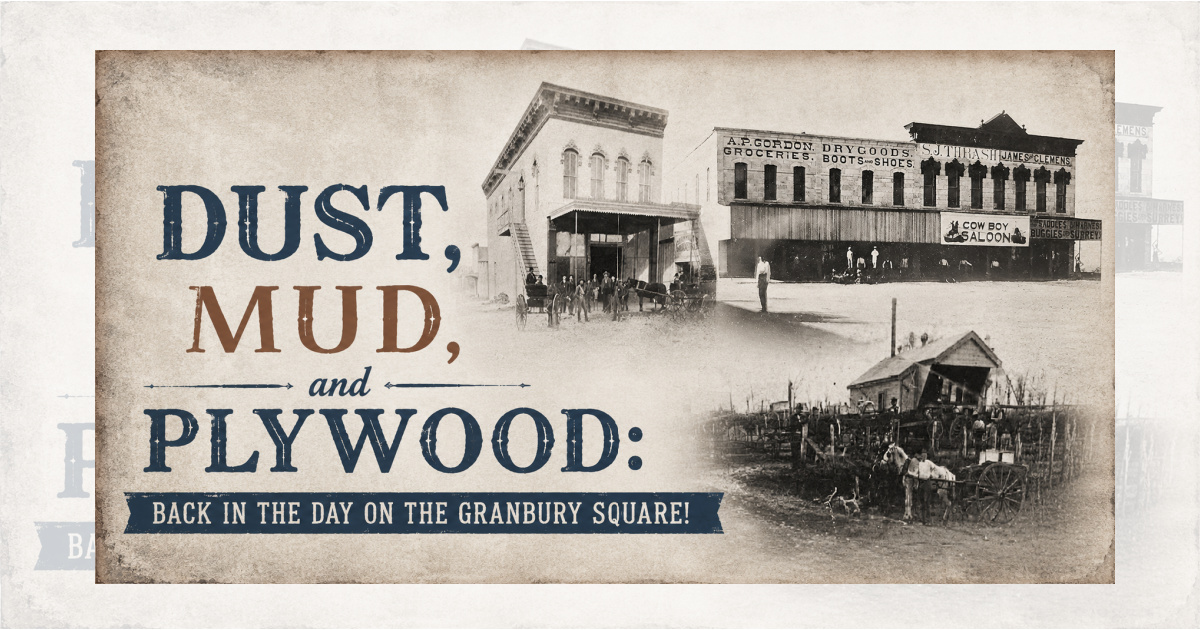
And signage — oh my goodness the signage! This author must admit to a hardy laugh from time to time over the vehemence which characterizes the enforcement of the “SIGNAGE” regulations on today’s storefronts around the square! Photographs provide the proof: signage on the real square of the late 1800s was LARGE and mostly made of simply lettered sheets of wood. Outside those storefronts, under equally crude wooden awnings, were porches, mostly cluttered with displays of merchandise. TRAFFIC was a morass of parked and moving wagons and carriages pulled by live animals that answered nature’s call as it occurred and intermingled with lots of pedestrian traffic, made up of folks who sloshed through it all to sell and buy their goods. There was no air-conditioning in the summer and no relief outside from the messy consequences of inclement weather. In the fall and winter the air was filled with the smell of nearby cotton gins and smoke from the wood and coal fires that heated the interior of the shops and businesses. Yet still, the people came; commerce, entertainment, eating, and worship all took place; and our town grew and prospered.
While we are talking realities – another misconception is that the current relatively pristine assortment of late Victorian era buildings is “how it has always been.” Another hearty laugh pops out upon hearing folks talk of events that happened in the 1870s or even the early 1880s as having taken place in this building or that one, when the reality is that there is not a single structure on the square that existed prior to 1883 although the town began in 1870-71. That means for twelve or more years, the citizens of Granbury were living and working out their stories in structures that no longer exist.
One of those old wooden structures, was preserved for a long time – Frank Gaston’s newspaper office, was moved many years ago to a site adjacent to the Old Granbury Light Plant behind the current post office. For decades you could drive by and take a look and imagine thirty or so such buildings on the lots surrounding the Courthouse Square! Unfortunately, it finally deteriorated and is no longer there. There is a photo that still exists from sometime in the 1870’s that shows the Nutt Brothers’ original frame mercantile building and a part of the stone barn that housed the original livery stable/wagon yard they ran behind it. They were located where the east side of the current Nutt House Hotel and north side of the current Wagon Yard Antiques businesses are located today.
And then, of course, there’s the Courthouse! The 1890 Hood County Courthouse has become the iconic symbol of all things Granbury and Hood County. Yet, note that date….1890! That means that for 20 years the centerpiece of our town was much different in appearance! For the first few years a tiny log structure occupied the site. Then, in the years between 1872 and 1889, smaller, 50’ x 50’ two story limestone courthouse stood on that site. It is this writer’s belief that the oldest buildings in Granbury are that north wing of the Wagon Yard building shown in the picture behind the Nutt’s original mercantile and the Yeats-Duke cabin that sits just across from it on Crockett street, just north of the square, which dates to the mid-1850s. The oldest buildings facing the square, standing on their original site, are the Hannaford-Baker Building (once called the ”Arch-block” building) and the first section of the First National Bank that stand diagonally across from each other on the northwest corner of the square. They were built between 1881 and 1883.
In every photo, look at those DIRT streets!