Festival Parades from Days Gone By: Granbury’s Texas Independence Day & San Jacinto Celebrations (1923–1924)

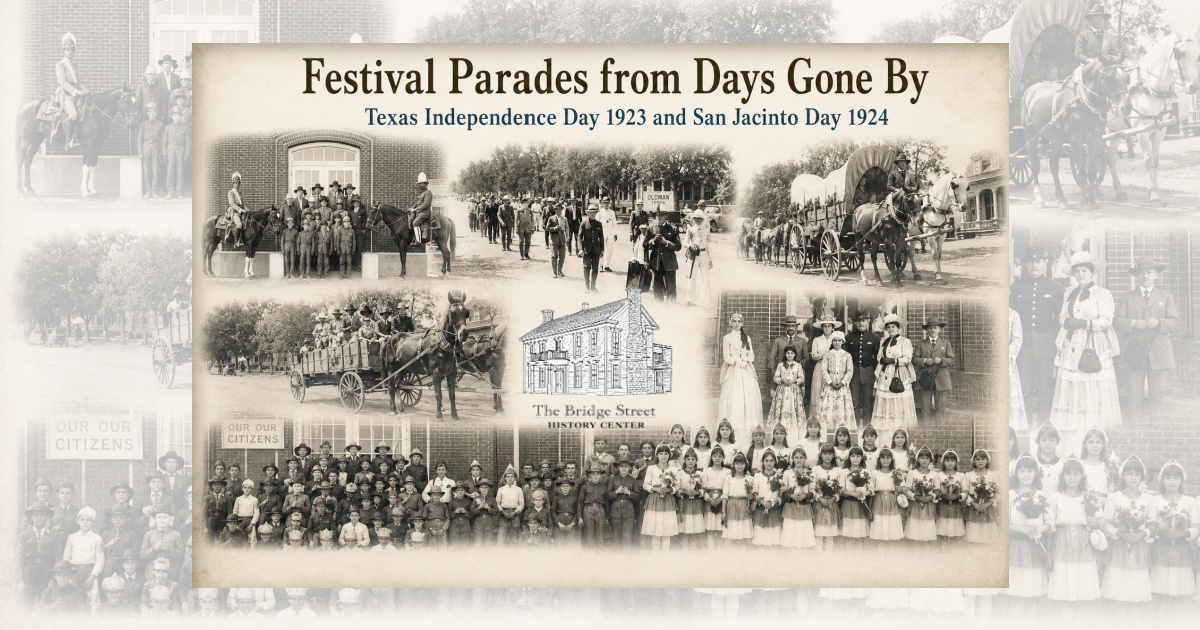
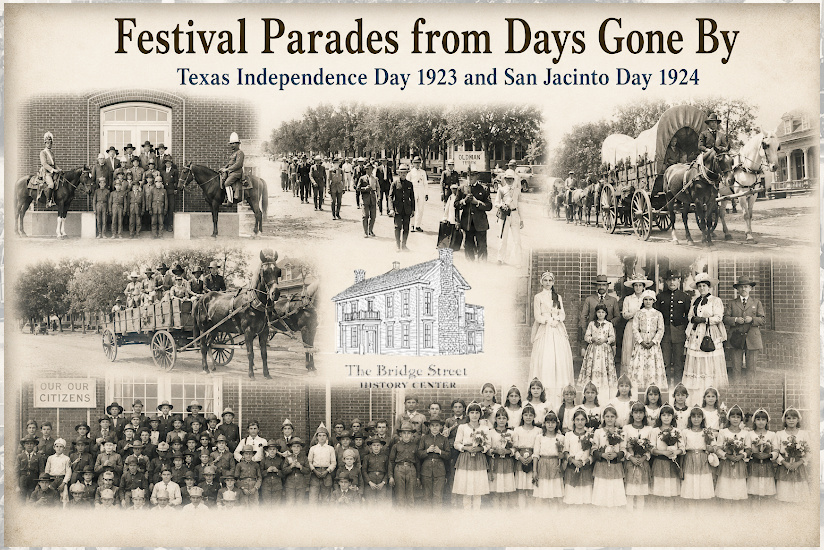
Historic collage of Granbury's 1923 Texas Independence Day and 1924 San Jacinto Day festival parades featuring schoolchildren, horse-drawn wagons, period costumes, and community celebrations around the Granbury Square.

Featuring Photos From:
Texas Independence Day 1923 and San Jacinto Day 1924

Well folks, if you didn’t know it already, let me share something with you! GRANBURY HAS ALWAYS KNOWN HOW TO THROW A PARADE!!! As we gather for the year’s July 4th Parade and festivities around the Granbury, it seems a good time to share these photos I collected of past festivities during my years of research and working with the good folks at the old Hood County Jail Museum. Join me in visualizing a couple of Granbury Festivals of years gone by! We’ll have a blast! Like most of our festivals today, these were duly reported in the local newspapers and the folks who were in charge took lots of pictures! So, come with me, as we go down to the Square to wander around 1923 and 1924 to catch some glimpse of the celebrations on TEXAS INDEPENDENCE DAY and SAN JACINTO DAY!

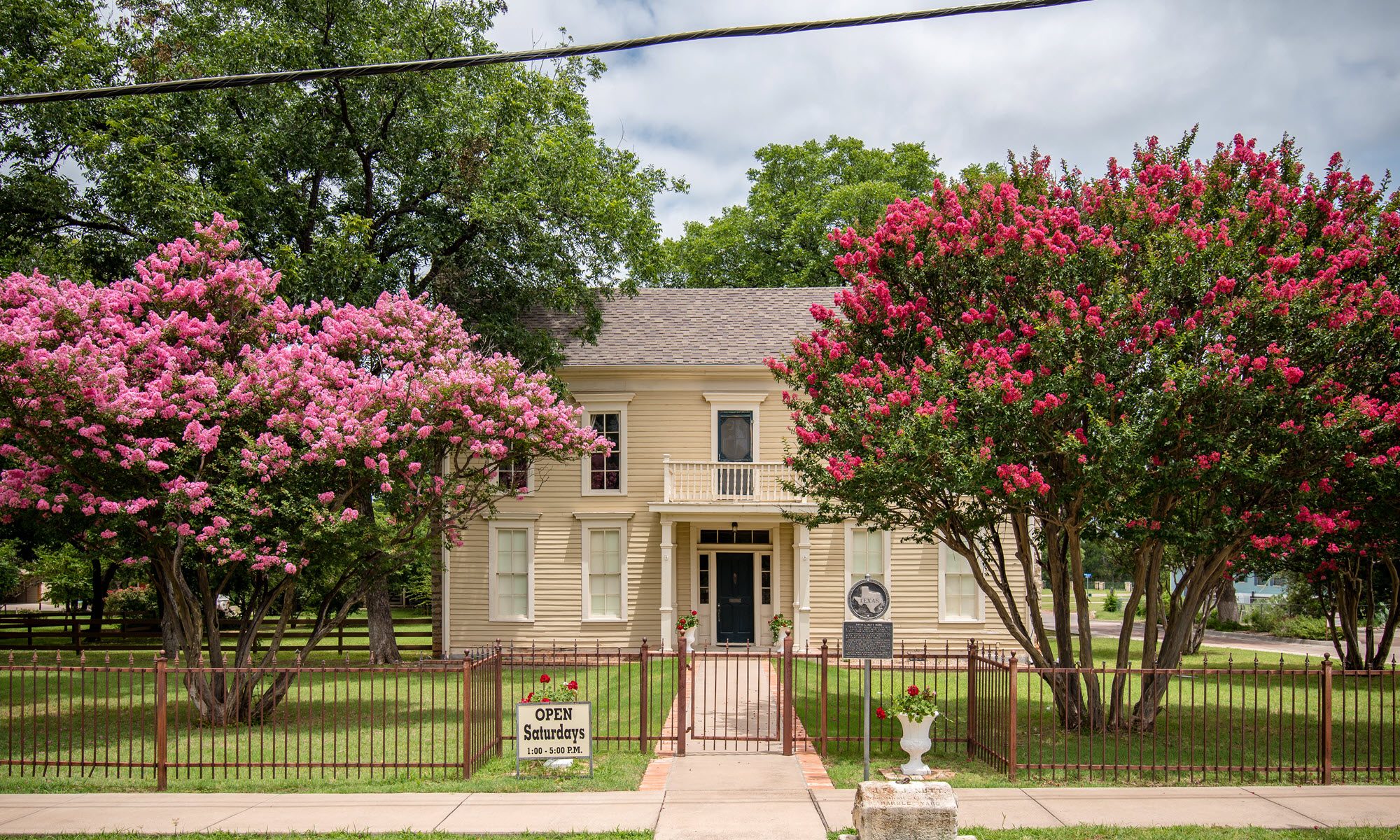
On both March 2, 1923, and April 21, 1924 – It is a fine spring day on one of the state public holiday when we celebrate Texas winning her War for Independence from Mexico! As always in Granbury, the parade is set to come right down Pearl Street from the school to the square, make that turn up Crockett, and then left on Bridge right back down to the schoolhouse! We’ve got the perfect seats right here in front of the Nutt Hotel! Uncle Henry Nutt and his wife, Aunt Euna, have made us welcome, as citizens from all over Hood County crowd the limestone sidewalks! Many are jostling to get a good view of their children and classmates!

All of the schools in Hood County have signed up to participate in the parade! Assisted by their teachers and the ladies of the Granbury Parent Teacher Organization, the children have constructed an extravaganza to honor 100 years of Texas History! This Pageant of Texas is designed to give the children and all of us a greater appreciation of the wonderful history of our state! If you look at your program you will see the names of the various children and adults involved in each part of the celebration.

“Oh, look here they come now!!!” The parade is led by three pupils portraying OLD MAN TEXAS, accompanied by the ladies PROSPERITY and OPTIMISM! And following them are the six wonderful floats! Oh, look, all the children are in costumes and so are the adults, all depicting a special part of Texas history. At each school, all the students helped with researching the proper costumes and the details that needed to be shown on each float! Oh, my goodness, there is Frank Gaston, that fellow who owns the Granbury News!! Let’s look over his shoulder and see what he has to say about this scene!

“Our teachers, pupils, and the ladies of the Parent-Teacher Association have reason to feel proud of the success of the historical pageant… celebrating San Jacinto Day. We are glad to say the program was carried out exactly as advertised and in every feature was far better than the public expected! In six episodes of Texas history the costuming was historically correct, older people in the audience recognizing the true representations of costumes and manner of life in some of the episodes, especially those of the Confederacy. In this latter was a unique feature, the slave section being represented by Barney Hightower and Aunt Judy Anderson, two ex-slaves, with a number of children from the negro school, in an old-fashioned wagon and riding on a bale of cotton.

Other features were also specially attractive, and none more so than the pioneers, with the old moving wagon, even with the cow being led behind, the young ladies representing the red, white and blue, those representing the colonies and the states of the union, the boy scouts, the future citizens, and especially the little tots representing the Texas state flower, ‘The Blue Bonnet’. The individual characters listed in the program were also well represented in their costumes and actions. The parade consumed nearly an hour, being well timed so as to give the best effect, and upon returning to the school building there was a program of splendid talks, with some music and readings, all in harmony with the great historical occasion. To carry out such a program required much study of detail and all connected therewith have reason to feel a just pride in its universally pronounced success!”

PRESENT DAY — Wow, that just about says it all! It was so much fun seeing all the pictures of the children and adults involved! So many of the children became leaders in our community in the years to come. But, the truly remarkable thing about this moment in Granbury history is the shining example of its inclusiveness. In a day when segregation, Jim Crow, and the KKK were tearing nearby communities apart, in Granbury the people, young and old alike, of all colors, joined together for a day-long celebration of our common history.

The newspaper account goes on to tell in detail about the program and how ALL of the people gathered to share a meal and see the program put on by students from ALL of the schools! A point was made to show the spirit of community and fun shared by all, with anecdotes of highlights of contributions from every part of the county! The mere fact, preserved in print, of this celebration reminds us of just what a remarkable community Granbury/Hood County has always been! “Where Texas History Lives” is our motto and, when we look to our past, we are blessed to have the example set by the folks from “around here” back in those days. It’s so remarkable that they were already celebrating that history, even in those bygone days of just over 100 years ago! The tradition lives on!

CLICK TO ENLARGE.

Collage Caption: A collage of pictures showing some of the time period groups from each year. Featured here are: Indian Era – 1924, Texas War for Independence – 1923, Pioneers 1923, Slavery – 1923, Civil War -1924, Citizens of the Future – Boys and Girls – 1924

The Bon Ton – Early Eatery Brings Twenty Years of Good Eats

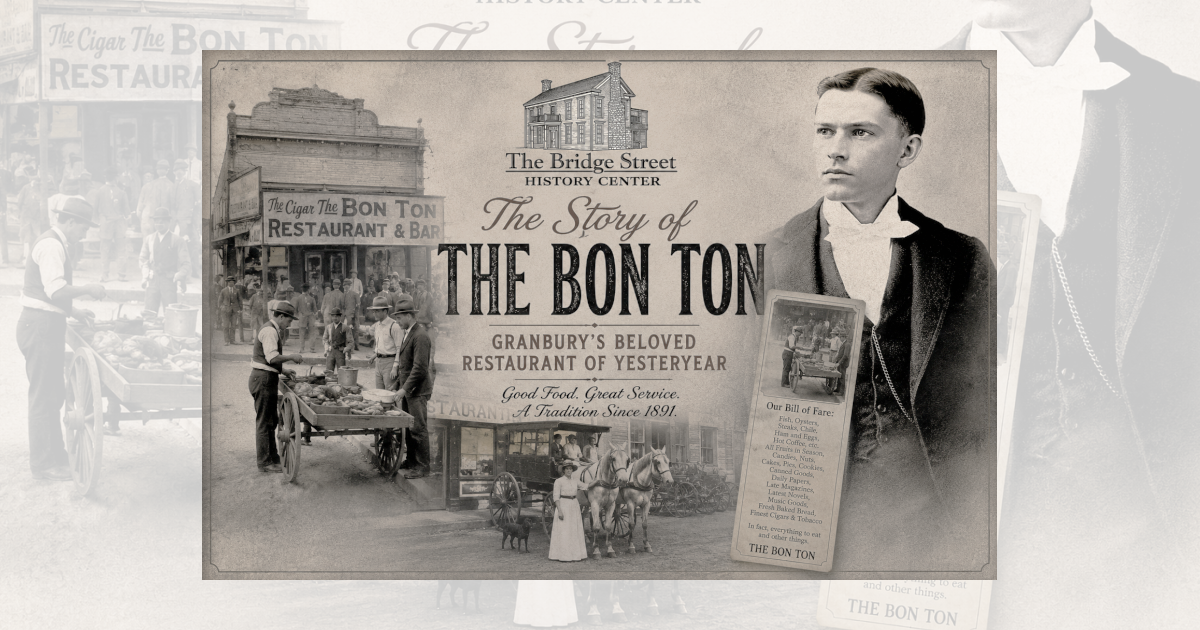
Historic collage featuring The Bon Ton Restaurant on the Granbury Square, founder Ralph Bowden, and vintage scenes from downtown Granbury, Texas.


In 1891 Granbury businessman Ralph Bowden decided to open an eatery on the Granbury Square. His new restaurant would not be the first on the Granbury Square, but it would become one of the longest lasting in those early days. The Bon Ton Eatery opened on the west side of the square in the building that now houses another business that offers great food and drink in a unique atmosphere — The Silver Saddle Saloon! The new eating establishment joined a hodgepodge of eating choices available to the early citizens of our community.

Several small establishments known as lunch stands were operating in the spices around the downtown area. Also, several of the saloons had opened lunch counters as well. But The Bon Ton set out to be a real full-service restaurant. The Granbury citizens took note and a twenty- plus year love affair began. The Bon Ton offered a wide variety of cuisine, including the apparent culinary obsession of the time, fresh fish and oysters! This was apparently a big deal – as almost every eating place in town boasted about their fish and oysters in their weekly newspaper ads. The Bon Ton also mentions steak, ham and eggs, sandwiches, fresh fruit in season, canned goods, and fresh bread as part of their daily offerings.

Also, on the menu are listed a wide variety of desserts- including cakes, pies, cookies, and a whole confectionery shop full of candy! Apparently, the desserts were a hit. In one local paper there is an ad soliciting 500 eggs. The restaurant offered cash payment in the ad to any local persons with eggs for sale! It should be noted that one could make a good living in those days selling eggs, milk, and butter to local restaurants and grocery stores.

Coffee, tea, and cigars rounded out the menu but that wasn’t all one could get at this very special eatery. In the offering of customer service, the Bon Ton apparently was the forerunner of the modern-day Starbucks! In addition to all the food they also sold newspapers, magazines, and the latest novels!

Mr. Bowden owned the Bon Ton for almost fifteen years, all the while running several other businesses on the side. Around 1895 he announced that the restaurant would begin serving evening meals as well as lunch. Even today, that is a lot of hours for a restaurant to be open each day, and one has to wonder how Mr. Bowden did it all.

In 1903 he purchased the local phone company and decided to sell his restaurant business in order to devote all his time to expanding local phone service. The Bon Ton was sold to two young men, Rochelle Daniel and Henry Williams. They continued to operate the restaurant for several more years. Apparently, Mr. Bowden kept his interest in the confectionery end of the business, as he and his wife were still running a candy store on the Square as late as the 1940’s.

Today, the Silver Saddle Saloon occupies the Bon Ton’s old home on the west side of the Granbury Square! It is part of a thriving Culinary District that continues the tradition of good food and beverages along with good service that began over a century ago with those tiny lunch stands and The Bon Ton. Through the years we’ve seen long time favorites like the Nutt House Dining Room and the Merry Heart Tearoom and Rinky Tinks become part of the fabric of the community in their day. We’ve even had a famous chef or two among us, such as Grady Spears. Be sure to go downtown and check out the menus! — You’ll be sure to find some great folks continuing those traditions of down-home good times, great beverages and wonderful food, right here – on the Granbury Square!

Captured But Never Defeated: The Incredible Story of Josephine Cavasos Barnard

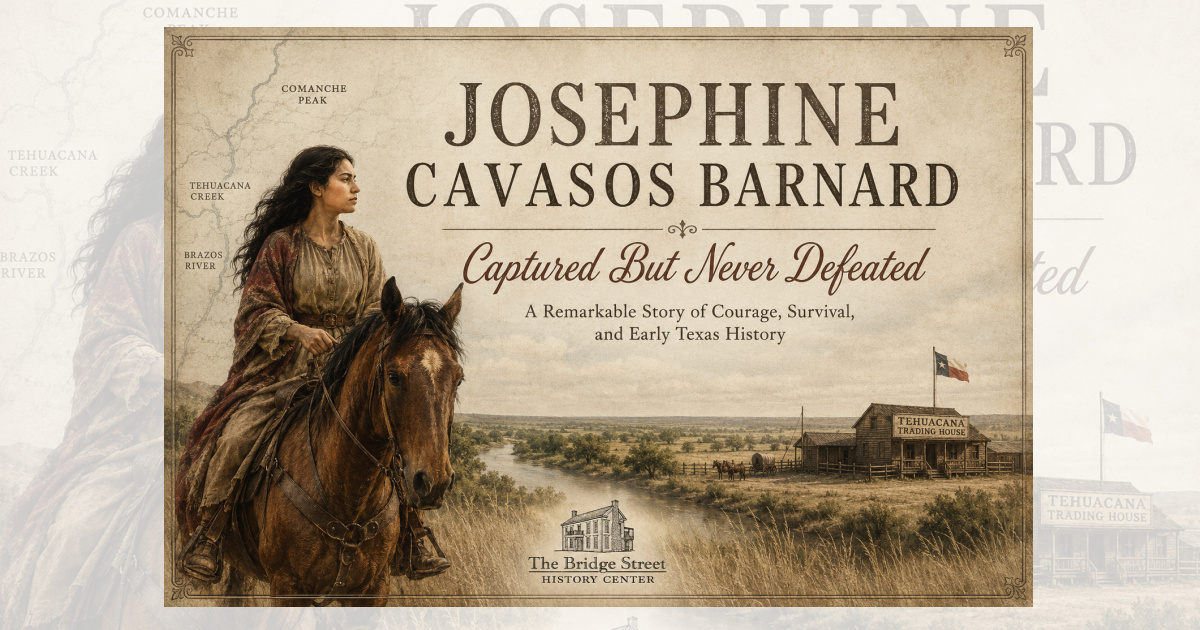
Josephine Cavasos Barnard on horseback, a survivor of Comanche captivity who became a pioneering settler in Hood County, Texas.


Josephine Cavasos Barnard – Captured But Never Defeated – PART ONE

This is the story of Josephine Cavasos Barnard, who was wrenched from all she knew and suffered abuse and great trauma, before being rescued – by the man she would go on to build a life with. Josephine (or Juana, as she was called by many) and her husband Charles Barnard were among the earliest settlers in the area that now straddles the line between Hood and Somervell Counties. .Many don’t know that area was within the original boundaries of Hood County when it was established in 1866. But Juana’s story begins many years before… in a time long before Texas was even a State.

Josephine Maria Cavasos was born June 24, 1824, in the Canary Islands of Spanish-Italian ancestry. Her parents, Juan Jose and his wife, migrated from there to Matamoros, Mexico because his father, Don Narciso Cavasos, had received l06 leagues of land or 601,657 acres from the King of Spain. This was the largest land grant ever made in the New World and later part of it became part of what is now northern Mexico and south Texas.

In August 1842 Josephine was 18 years old. Texas was still part of Mexico then and friends and relatives passed freely back and forth across the Rio Grande. Josephine was great friends with a girl named Mary Alice whose family lived on the north side of that great river. As was the custom in those days, visits lasted days or even weeks. So, Josephine went to spend a few days visiting with her friend. While she was there, a band of Comanche attacked the house. Chaos ensued. Josephine ran from the house as the thunder of hoof beats filled the air. She hid in the woods nearby, but was found by a young Indian brave, who grabbed her by the hair and slung her across the horse in front of him. Over the course of the next few hours she saw him kill a mother and baby with his tomahawk and endured many miles of travel over rough terrain. Every moment she feared a downswing of the tomahawk that would end her life. Finally, they stopped at a dry creek, where she was thrown to the ground and tied to a tree. As night fell, Josephine heard sobs and cries from nearby. She recognized the voice as that of her friend, Mary Alice. She struggled against her bonds and called out to her friend. She received a fist in the face for her trouble.

This was the beginning of a harrowing nightmare of years of captivity. The band of Comanche first stayed in the area of south Texas and tortured the girls, trying to get them to tell them the location of the largest horse ranches in the area. Fearing for their fellow settlers, the girls at first refused, but later, in desperation, concocted a story hoping to lead the Indians astray. The raiding party returned, empty handed and furious. The girls were badly beaten. Mary Alice cried and begged for mercy and Josephine was made to watch as she was brutally killed.

In defiance, Josephine glared through her tears as a brave approached her, knife at ready. “Go ahead, do it!” she hissed.

Startled by her courage, he stopped, placed his hand over her heart, and said, “Brave, like Comanche! No kill!”

Alone now, Josephine was determined to survive and escape. As the Indian band turned north, she was tied each day to the horse she rode but was allowed to swim when water was available. She had experienced and seen horrific brutality, yet she was never brutalized again. She was befriended by one of the old women of the tribe and from her learned to live as the Indians did. She learned to cook and eat their food and how to soften skins for clothing. Other women joined in to teach her about herbal medicine, how to speak Comanche, and how to wash with soapwort.

Winter that year was spent on the Guadalupe River. A family trying to pass through was captured. The family was killed, except for a small boy. The Indians entertained themselves by holding the child’s bare feet in the flames. Josephine, unable to stand it, burst past the laughing Indians and snatched the boy. The Old One who had befriended her motioned that she come and bring the boy to her teepee. She not only dressed the child’s feet but salvaged some food for them. She told Josephine that she had insulted the Indians and she and the child were to be abandoned to starve. The next morning all the other Indians were gone and Josephine and the child were alone. After some period of days, the Indians returned; but the child was dead and Josephine was near death. Again, the Old One adopted her and nursed her back to health.

For most of the next two years Josephine lived with the Comanche. She was expected to work hard, but was allowed freedom to swim, shoot, and ride wild mustangs. She became so skillful at breaking horses that some of the braves became jealous. Because she understood Comanche, she learned of a trading post on Tehuacana Creek that treated the white man and red man the same.

George Barnard had established trading posts near Marlin Falls and Tehuacana. His brother, Charles, had come from New York to join him in the venture in Texas. They had made friends with Sam Houston and were well known for their business and trade with both Indians and white settlers at all their establishments. It was said by 1845 that relations with the Indians were so bad that settlers hardly slept except in the areas where the Barnards and their associates, the Torreys, had established a relationship with the Comanche.

On February 7, 1846, at Comanche Peak, the federal agents had called for a powwow. The Indians accepted many gifts and exchanged some polite talk, but the treaty with the Indians did not materialize. Instead, another meeting in May at Tehuacana Trading House was set.

By April, Indians were gathering on Tehuacana and Trading House creeks. All the Indians, including the women and children, attended, but Josephine was left in a canyon 20 miles away to tend The Old One — the woman who had protected her. Despite Josephine’s best effort, she died. When this happened, Josephine was taken to join the others. One of the activities was a sort of rodeo with each tribe entering its best riders. The ponies were wild; but one in particular had never been ridden. On the second day, Josephine leaped past her watchers and ran to the wild one. Grabbing its hackamore, she leaped aboard and rode the wild mustang until it was exhausted.

Charles Barnard was watching. He realized that this was not an Indian. As she leaped from the tamed horse, the tribe circled round Josephine, preventing anyone from approaching her. But she had seen Charles. As she was led away she was able to send a look which was unmistakably a cry for help.

End of PART ONE.

Josephine Cavasos Barnard – Captured But Never Defeated – PART TWO

This is the story of Josephine Cavasos Barnard, who was wrenched from all she knew and suffered abuse and great trauma, before being rescued – by the man she would go on to build a life with. Josephine (or Juana, as she was called by many) and her husband Charles Barnard were among the earliest settlers in the area that now straddles the line between Hood and Somervell Counties. .Many don’t know that area was within the original boundaries of Hood County when it was established in 1866. But Juana’s story begins many years before… in a time long before Texas was even a State.

Charles and George Barnard quickly came up with a plan and tried to bargain for the girl they had seen with the Indians at their Trading Post, but at that time she was not for ransom. A treaty was signed May 16, 1846, for a definite line some distance west of the westernmost settlements. Indians were to stay west; settlers were to stay east. During these negotiations, Josephine was nowhere to be seen. Just as the Indians were preparing to leave, she was taken to the trading house. There Charles and George Barnard were behind the counter with the chief and tribal leaders on the other side. The counter was covered with piles of blankets, knives, beads, flour, and sugar. Negotiations began. George was the bargainer. The Indians were very demanding. Each time the Chief would shake his head, George would nod and Charles would add to the pile. At last the chief grunted and left with his men carrying the bounty, leaving Josephine free for the first time in over three years.

Josephine was placed under the care of an Irish lady named Katy. Charles Barnard became a regular visitor at Katy’s home, and romance quickly blossomed between Josephine and her rescuer. But the decision to marry him was made difficult because of the life he had planned. He wanted her to go with him to establish a new trading post far up the Brazos River to the north in the shadow of the mesa called Comanche Peak where the tribes had gathered the year before. She would be the only white woman in the remote area. In 1847, Charles left to go start building the new post, while Josephine pondered her decision.

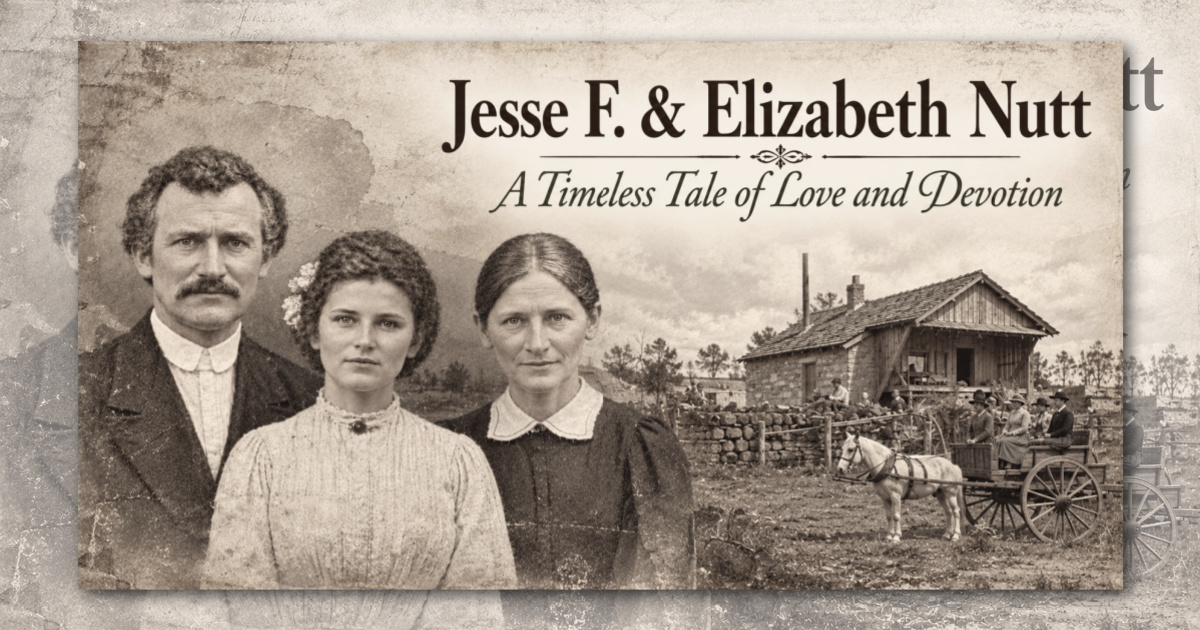
Love won out over fear and she and Charles were married in October of 1848. While the construction of the post continued, Josephine and Charles began married life with his traveling between his new post on the Brazos, and George’s post in central Texas. In August,1849, their daughter Maria was born. Shortly afterward, she and her mother joined her father on the Texas frontier. Josephine and Charles began their long life together in the log and limestone house on the banks of the Brazos in what is now southern Hood County. Their second child, John, was born the next year. He was the first child born to white settlers in the area. Throughout their marriage, Charles and Josephine were devoted to each other. He always allowed her the freedom to indulge her need for open spaces and ride fast horses. She bore him fourteen children, but in the way of those days – only four lived to adulthood.

In 1851, friendly Indians settled in a village across the creek from the trading post. They farmed, hunted, and were peaceful and enjoyed horse racing gatherings with Charles and Josephine and other folks passing through. There were no schools in the territory, so Charles (a Harvard graduate) tutored the Indian children right along with his own. Later they attended the Acton Institute and then Baylor College in Waco. The Acton Institute was housed on the ground floor of the 19 Acton Masonic Lodge, of which Charles was a charter member. That building also doubled as a church meeting house for the various denominations in the Acton community. After many years of neglect, it was restored in the 1970s and is now the chapel of Good Shepherd Anglican Church.

In 1854 the Indians were removed to the reservation at Fort Belknap. Prior to that time it was common for the Commanche to come to Josephine for medical help, as her skills in that realm were remembered by their people. At one point, three Comanche brought a sick child to Josephine. She recognized him as a Mexican child, deathly sick with pneumonia. After nursing him back to health, she and Charles raised Ambrosio Hernandez and treated him as their own for the rest of his life.

At the age of 37, with his work with the Indians finished, Charles built a mill on the Paluxy River. Known as Barnard’s Mill, it took four years to build and cost $30,000.00. One winter afternoon at the mill, Josephine recognized the voice of Capt. Sullivan Ross, a friend who was a Texas Ranger. He and his men had captured a white woman with a baby who was a captive of the Comanche. The only thing they could learn from her was that she was Peta Nacona’s widow. Cynthia Ann Parker finally allowed herself and the baby to be bathed and accepted some clean clothing. When she left, she told Josephine, speaking for the first time in English, “You are kind, and I thank you.”

The mill was sold some years later to T. C. Jordan who changed the name to Glen Rose.

Near the trading post there was a shallow, stone-paved crossing on the Brazos where thousands crossed on the Chisholm Trail. In 1870, a large herd came from South Texas on the way to Fort Dodge, Kansas. The trail boss learned that the Brazos was on the rise and did not want to lose even a day. After the river became fordable, he went across to the trading post to thank Charles for giving them permission to camp. When Charles went out to greet the trail boss, Josephine heard him speak and recognized the voice of her twin brother. She screamed, “That’s Juan! That’s my brother!” At that Juan leaped for the porch and a 28-year-long separation had ended. In 1872, he bought land from Charles and came to live nearby.

During her many years in what is now southern Hood County and northern Somervell County Juana became known for her excellent midwifing skills. Taught her skills by the women of the Comanche, she saved the lives of many women and children across the area, continuing to travel on horseback to care for women in childbirth. She was respected and treated with admiration for her skills, even by many of the medical doctors in the area.

Charles died June 23,1900 and is buried in the Barnard Cemetery which is now in the middle of land long used as a peanut field.

Josephine lived on and spent part of each day riding her horse, Pigeon. On February 1, 1906, Pigeon was led to the mounting block so that she could visit two of her sick friends. When she arrived home before sunset, she sat a moment on Pigeon looking across the fields toward the river she loved. About midnight she was heard moving around. When asked what was wrong, she replied that she needed to rub some white liniment on her head because it was hurting. As she was talking, Josephine stiffened and fell backward and was gone. She had met death as she had lived life — never giving up, never backing down — with the same bravery and determination that her Indian captors had seen in her all those years ago.

THE NEWSPAPERS OF OLD: News, Social Media, and Your Neighbors’ Blog – Wild West Style

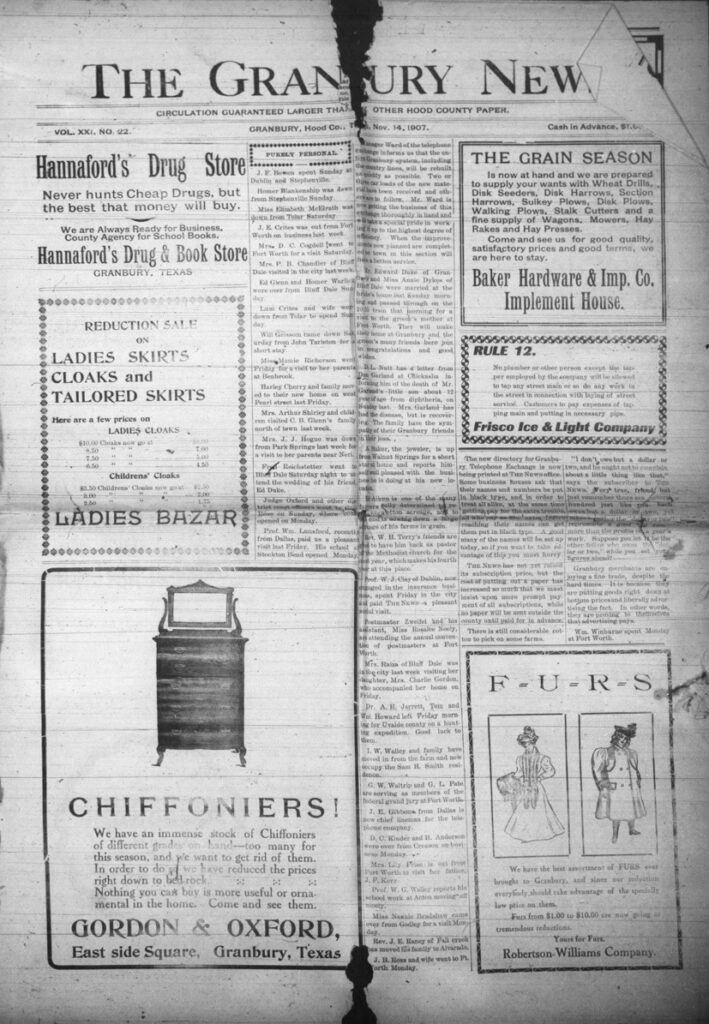
Historic Granbury newspaper illustrating how early newspapers served as the social media and community blogs of Hood County's past.

My mother used to say, quite wisely, that there are no new sins. And in the same vein… that people are just people, the same as they’ve always been. As a student of history, I basically agree. In my study of the contrasts between our fast-paced modern world and the slower-paced world of the past, the assumption has often been put forth that the 24-hour blow by blow news cycle and the seeming lack of privacy brought on by Cable News, Facebook, Twitter, and your neighbors’ Blog Posts are a modern issue. Likewise comes the accusation that the voracious hunger and thirst of the populace for all this juicy detail is a fallacy of the 21st century mentality.

NOT SO! Such thinking shows a woeful disregard of the existence of those stalwart predecessors of Facebook and ALL the news, both real and fake: Community and even City NEWSPAPERS!

Frontier newspapers are a hoot to read! If your eyesight is still fairly decent and you are looking for amusement – you could do worse than checking out a website called Newspapers.com – and calling up some densely printed, usually faded microfilm images of actual copies of literally hundreds of thousands of entire newspapers from 120 or more years ago. You will be amazed at what you will find!

Most of the papers followed a particular pattern. For you avid local news junkies and readers of all the local blog posts, the fun begins right on the FRONT PAGE! Unless something REALLY major had happened, like war being declared or a Presidential assassination (or the Governor being involved in a Gunfight or Duel), the Front Page is ALL LOCAL NEWS!

Are you filled with a burning desire to know who is visiting your neighbors, what they had for dinner, how many people (and animals) came to someone’s birthday party and who they were and who they were with? — All those juicy little tidbits about our fellow citizens’ personal lives that we devour on social media sites every day…? They are all right there, on the FRONT PAGE of the local weekly or biweekly newspaper. Are you a fan of those Buy, Sell, Trade websites? Check out all those ads around the outside edges of the Front Page! Then look along the bottom of that very same page, and you will find all these notes from people around town saying things like- “I am looking to breed my prize bull. If you have a good cow, inquire at……” or “Mrs. Ben Morris says the Dr. Watkins Cherry Tonic is just the thing if you are feeling poorly. It will perk you right up!” The variety of information available is usually astounding! There is usually a whole column reporting all the goings on at all the schools and churches, all with blow-by-blow descriptions of who all were involved. And get this — The hotels published lists of the people who had checked each day, where they were from and usually what they were in town for and for how long!

Who needs privacy, eh? There was usually a similar list of all the local folks who were away traveling out of town, including the mode of transportation, where they were going, who they were going with and who they were going to see. AND how long they planned to be gone. Another nearby bit is sure to inform the curious reader who in town was sick, what they suffered from, how long they had been ill, and what the prognosis might be. Sound familiar?

Page TWO and THREE are right behind, and it is here that those Cable News junkies can find THEIR type of news! WORLD NEWS from all over the globe was duly reported in amazing detail, and feature articles described foreign cultures, history and customs. National Issues and Politics are also reported in GREAT detail with issues-oriented articles often going on at great length! Political cartoons also pop up from time to time, and there are usually some spots where local citizens are quoted – stating their often strongly felt opinions about the issues at hand! There’s a fair amount of sensationalism too. You’ll find SCANDALS in Washington like the duel between Andrew Jackson and the man who insulted his wife, and stories of violent acts of terror such as John Brown’s raid on Harper’s Ferry abound, all illustrated by lurid drawings depicting dramatic versions of the same.

Further back – the FAKE NEWS folks could often get their jollies by checking out the SERIAL TALES where Outlaws and Famous Indian Fighters and Lost Gold Mines abound! The folks of Legend are found here — Buffalo Bill, Annie Oakley, the James Brothers, Wyatt Earp, and Butch Cassidy — real folk whose embellished exploits were turned into serialized cliff-hangers that were read aloud by many a fireside, as readers nationwide waited breathlessly for the next installment! Fifty years on those same stories became fodder for two new entertainment mediums: radio and the motion picture.

Further back there were market reports, sports reports and even puzzles and games for children and adults alike. The latest notable deaths, local and national and even international were reported in great detail on the Obituary page, and there was also usually a Religion page, with Bible lessons and excerpts from famous and local sermons. There were articles on history, and animals, and latest scientific discoveries. Sounds a lot like the lineup on your cable tv or Internet Media service doesn’t it?

So, we 21st century folks think we have no privacy? We think fake news and scandal are new inventions. We think people being obsessed with other folks lives, both near and far, is something new. Not hardly! Those things are as old as time itself. It is just the media that changes. Another family saying, this one from my grandmother sums it up. “It takes all kinds of people to make the world, and they are ALL here!” It’s true! Just check out all those channels and websites from across the world. Or go online or to a local museum and browse through an 1895 edition of the Granbury Tablet or Fort Worth Star! They’re all there too! Take a look and see!

Before Facebook and Instagram, Granbury residents shared news, announcements, advertisements, and community happenings through the pages of local newspapers.

A History of the Acton Community

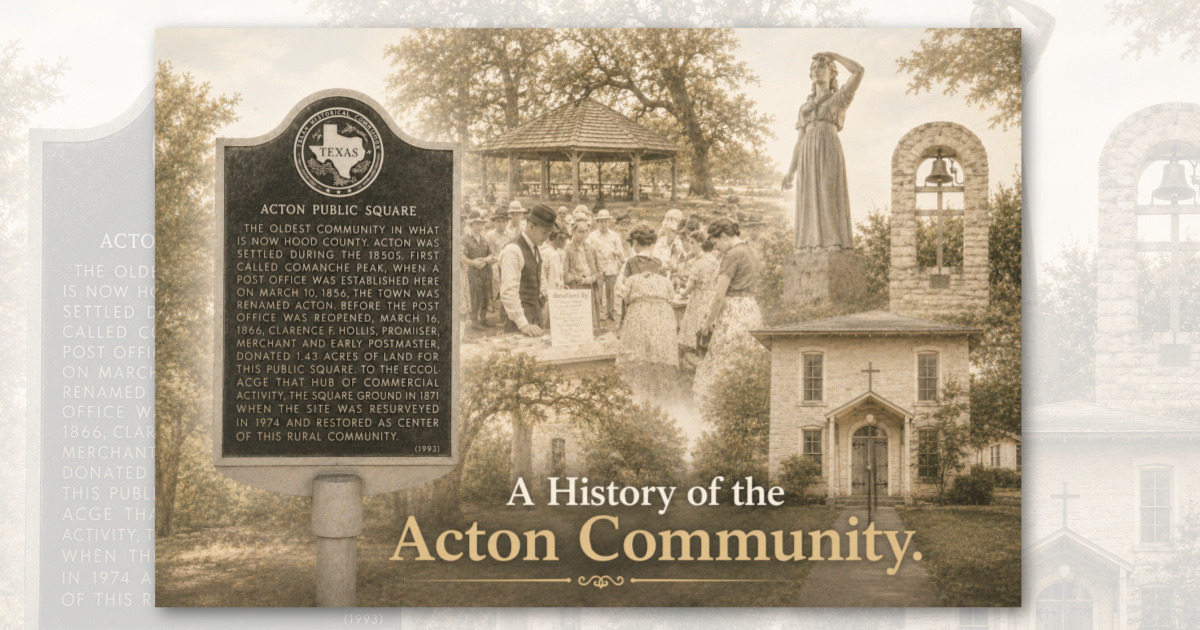
Historic collage of the Acton Community featuring the Acton Public Square historical marker, community gathering, church, bell monument, and Elizabeth Crockett statue in Hood County, Texas.

From the Columnist, Melinda Jo Ray:  Sometimes in research one finds a piece of writing so appropriate that it must be shared in its original form.  It provides both a glimpse of Acton’s early story and insight into the impact of growth and development in the modern Hood County we know, spawned by the 1969 damming of the Brazos River to form Lake Granbury. ENJOY!

In Her Own Words – An Article by Mary Lou Watkins – Written in 1975. A History of the Acton Community Prior to the War Between the States, the center of the present-day agricultural community of Acton was known as the Comanche Peak Post Office, Comanche Peak, / P.O., a designation chosen for its proximity to the highest point in the area some three or four miles to the west of Acton, Comanche Peak — a mesa clearly visible from the Acton community. Between Comanche Peak P.O. and Comanche Peak lay the Brazos River. Its fertile valley provided ample food and water for early travelers, and on its east bank the newcomers were relatively safe from marauding Indians. The Comanche Peak P.O. site was, therefore, a sensible terminal for settlers seeking a home in the west.

Moreover, the site was near (if not on) the old Spanish Trail which came up from South Texas and crossed the Brazos River near the present site of Granbury. This was probably the trail followed by the Butler and Lewis Expedition which set out from New Orleans Oct. 22, 1845, to make peace with the Indians. The Expedition got lost and ended up in Oklahoma. Meantime the Congress of the United States had voted to bring Texas into the Union; so, by the following March when the Expedition finally arrived back at Comanche Peak for the appointed meeting with the Nations, there was the important news that henceforth the Nations would be dealing not with the Republic of Texas, but with the President of the United States who had sent gifts. The Comanche, Delaware, Creek, Cherokee, Wichita, and Wacoan tribes were represented by their Chiefs and others camped on and around Comanche Peak. (Details of this meeting can be read in The History of Comanche Peak, Vance Maloney)

Previous to these attempted negotiations, Sam Houston had met on October 9, 1844, with Chief Buffalo Hump and Chief Old Owl in an attempt to define the line between the Indian hunting grounds and Texas proper. The Chiefs wanted the line to begin on the Brazos River and pass directly over Comanche Peak on its way south to the first stream west of the Colorado River below the San Saba, plus three days ride on a fast horse. (Frank Gaston Informal History of Texas.) Such a demarcation would, it appears, have put San Marcus in Indian territory, and Mr. Houston could not agree to it.

Nevertheless, these conferences do establish the fact that Comanche Peak was well known by name and by location to both the Anglos and the Indians in the early days of Texas, and that the Comanche Trail passed along the west bank of the Brazos River at that point (a mile or two south of Granbury). It seems quite natural, therefore, that the first white settlement within sight of the mesa should be called Comanche Peak even though that settlement was across the river from the Peak. The Comanche Peak P.O., later the Acton Square, was never a thriving business location. It was not on a waterway, a railroad, or even later on a major highway. Acton was and is the community center of a loosely knit agricultural area.

In his 1895, History of Hood County, T. H. Ewell “In those ante bellum days (half forgotten by the survivors) there were in this section many men in connection with whose lives and conduct doubtless many incidents of interest worthy to be recorded existed; but so vaguely remembered as to defy absolute verification. “We know only that men came west and settled at Acton, were followed by their families and friends, and by 1855 had formed an isolated but fairly strong little community. There were Presbyterians, Baptists, Methodists, and Reformed Christians who built a church near Walnut Creek for services held once a month. Between this Union Church and Buchanan, then the seat of Johnson County, there was 15 miles of uninhabited prairie. Adjacent to the church was a cemetery where they buried first the wife of Mr. Wash. Hutchinson.

In the fall of 1855, Aaron Farris settled a mile below the church to build a water mill and a still house. Presumably the  community was then complete, since in 1856 it was granted a U.S. Post Office named Comanche Peak. The first postmaster was James Plemmons. In May of 1857, Clarence P. Hollis was named postmaster. According to Ewell, the village of Acton was given its name by a Mr. Hollis, its first merchant; yet not until March of 1868 was the post office known as Acton. We postulate, therefore, that sometime between 1859 (James Allison replaced Hollis as postmaster) and 1867 (see deed ref. to Acton Square) the town of Acton was laid out and the Square donated by Clarence P. Hollis. (Hood County courthouse burned in 1875 and records were destroyed.)

Acton was never incorporated. It never concerned itself with lawmaking bodies or taxes or sewage or city water systems. The people lived apart — independent, self-reliant, yet giving freely to one another in time of need or stress. And the town was their gathering place. By horseback, buggy, and wagon, later by car, the solitary farm and ranch families came into Acton for mail, a few modest supplies, and to hear the gospel
preached on Sunday. There were singings and cemetery workings, burials and lodge meetings. Acton remained a community, a place called home, and the Square is its symbol. The people of Acton want to mark their Square. It is the central point of the oldest settlement in Hood County, Texas.

Ewell History of Hood County pages 98, 99, and 100 of Ewells work tell the story of the Acton Masonic Institute, a Greek Revival stone structure presently being re-built by the Episcopal church. The grave of Elizabeth Crockett, wife of Davey Crockett of Alamo fame, is within a stones throw of the old Masonic Institute. This gravesite, in the Acton Cemetery, has the distinction of being the smallest state park in Texas.

Five years ago, the Brazos River Authority completed a dam across the Brazos River at DeCordova Bend (a bend of the river named for Jacob de Cordova who owned that land in the early days), creating a lake 34 miles long. The dam site is below Acton, but residential development is occurring all the way up the lakeshore to Granbury. For the most part, the new residents are retired people and commuters seeking a rural lifestyle. They are being absorbed into the community with a minimum of change.

Pecan Plantation and De Cordova Bend Estates built by the Leonard brothers (of the Fort Worth store by the same name) are perhaps the only two typically upper-middle-class suburban developments; in the area. Their ubiquitous golf courses and country clubs surrounded by 50 x 100 foot lots serve a need and have made it possible for many week-end people to build lovely homes in the area. In general, however, and in spite of the affluent times, the rural pioneer spirit prevails. Even the lake was built by private enterprise. There is no federal money in it, so the people can own and care for their land right up to the waters edge — a condition which makes for a minimum of empty cans and picnic trash.

The Acton Public Square is still the center of a typically Texas rural community. The people may bank in Granbury, shop in Fort Worth and Dallas, vacation in Canada, Mexico, or Europe — but Acton is still the place called home.

Dust, Mud, and Plywood: Back in the Day on the Granbury Square!

Historic photographs showing early Granbury Square with dirt streets, original storefronts, and the Nutt Brothers mercantile in Granbury, Texas.

About twenty years back the city of Granbury undertook a massive street and sidewalk renovation project to keep our Historic Square a living and vital part of our community. During the project some “fun” things happened that were reminders of the square that once was and that “historic” Granbury was not always exactly as we sometimes picture it.

Visitors and locals alike, spoiled to relatively level and clean asphalt roadways and concrete sidewalks, had to be reminded that “construction zone” Granbury Square, with its dust, unlevel dirt, and sometimes muddy streets, makeshift pedestrian crossings, temporary signage, and plywood or gravel temporary egress from some buildings was MUCH more like the actual reality of the REAL Granbury Square of the late 1800s than the pristine jewel we have long created here in our historic district. In the REAL historic Granbury, the streets were hardpacked dirt that turned to and churned as mud during the spring rains. Sidewalks were sporadic or non-existent and made of every available variation of material from wood planks to limestone.

And signage — oh my goodness the signage! This author must admit to a hardy laugh from time to time over the vehemence which characterizes the enforcement of the “SIGNAGE” regulations on today’s storefronts around the square! Photographs provide the proof: signage on the real square of the late 1800s was LARGE and mostly made of simply lettered sheets of wood. Outside those storefronts, under equally crude wooden awnings, were porches, mostly cluttered with displays of merchandise. TRAFFIC was a morass of parked and moving wagons and carriages pulled by live animals that answered nature’s call as it occurred and intermingled with lots of pedestrian traffic, made up of folks who sloshed through it all to sell and buy their goods. There was no air-conditioning in the summer and no relief outside from the messy consequences of inclement weather. In the fall and winter the air was filled with the smell of nearby cotton gins and smoke from the wood and coal fires that heated the interior of the shops and businesses. Yet still, the people came; commerce, entertainment, eating, and worship all took place; and our town grew and prospered.

While we are talking realities – another misconception is that the current relatively pristine assortment of late Victorian era buildings is “how it has always been.” Another hearty laugh pops out upon hearing folks talk of events that happened in the 1870s or even the early 1880s as having taken place in this building or that one, when the reality is that there is not a single structure on the square that existed prior to 1883 although the town began in 1870-71. That means for twelve or more years, the citizens of Granbury were living and working out their stories in structures that no longer exist.

One of those old wooden structures, was preserved for a long time – Frank Gaston’s newspaper office, was moved many years ago to a site adjacent to the Old Granbury Light Plant behind the current post office. For decades you could drive by and take a look and imagine thirty or so such buildings on the lots surrounding the Courthouse Square! Unfortunately, it finally deteriorated and is no longer there. There is a photo that still exists from sometime in the 1870’s that shows the Nutt Brothers’ original frame mercantile building and a part of the stone barn that housed the original livery stable/wagon yard they ran behind it. They were located where the east side of the current Nutt House Hotel and north side of the current Wagon Yard Antiques businesses are located today.

And then, of course, there’s the Courthouse! The 1890 Hood County Courthouse has become the iconic symbol of all things Granbury and Hood County. Yet, note that date….1890! That means that for 20 years the centerpiece of our town was much different in appearance! For the first few years a tiny log structure occupied the site. Then, in the years between 1872 and 1889, smaller, 50’ x 50’ two story limestone courthouse stood on that site. It is this writer’s belief that the oldest buildings in Granbury are that north wing of the Wagon Yard building shown in the picture behind the Nutt’s original mercantile and the Yeats-Duke cabin that sits just across from it on Crockett street, just north of the square, which dates to the mid-1850s. The oldest buildings facing the square, standing on their original site, are the Hannaford-Baker Building (once called the ”Arch-block” building) and the first section of the First National Bank that stand diagonally across from each other on the northwest corner of the square. They were built between 1881 and 1883.
In every photo, look at those DIRT streets!

Peter Garland: Villain or Hero?

Historic portrait of Peter Garland with vintage Western design and the title “Peter Garland: Villain or Hero?” exploring controversial Hood and Erath County history.

Few figures in the history of old Hood and Erath counties are more controversial that Captain Peter Garland. To some a vile, violent, hate-filled man, – to others a hero. Garland’s story is still capable of sparking strong emotions in the descendants of some who knew him, even 150+ years after his death.

Capt. Peter Garland of Texas was born in 1805 in Henry County, Virginia, the grandson of Col. David Garland of the Revolution and son of Maj. Peter Garland of the Virginia 64th Regiment in the War of 1812. A family written biography describes Peter’s connection to this heritage by saying, “His grandfather and father had wars to fight. Capt. Peter Garland, some say, created his own war against the Indians of the Texas frontier.

After leaving Virginia, young Garland was first married to Lucinda Goff in Tennessee and second to Louisa Phillips in Mississippi as he moved westward to Texas. Over the years he fathered a total of at least 12 children. Before coming to Anderson County, Texas, in 1850, Garland was a Deputy Sheriff, Circuit Court Clerk, and saloonkeeper in Tishomingo County, Mississippi. In 1857, the Garlands braved the raw frontier of Erath County along with several other families, including the Thorntons, Hightowers, and Wylies. Ten years later, in Hood County, Peter and Louisa 16-year-old daughter, Melissa Virginia, was married to James Goodhope Thorp, eldest son of Pleasant and Nancy Thorp, founders of Thorp Spring.

The reasons for Peter’s zeal regarding total removal of the Native Americans from the area is unclear. There is some tradition that he had family and close friends who had been killed by the natives during his early years in Erath County. Certainly, as the Civil War loomed, bloody Comanche raids on the settlers of the frontier area continued and would for another decade, despite removal of all Indian tribes from northern Texas to the reservations of what is now Oklahoma.

Peter and Louisa (Phillips) Garland moved from near Stephenville in Erath County to Hood County in 1860, settling on Stroud’s Creek near Thorp Spring. Controversy followed the volatile Garland to Hood County, and some historical writers still debate the part he played in the early history of this  part of Texas. As a captain in the Frontier Guard, Garland has alternately been condemned as an Indian hater of the first order and murderer and hailed as a fearless Indian fighter, defender of the frontier, leading citizen, and hero. In retrospect, out of the context of the times, it is doubtful that controversy will ever be resolved.

Much of the controversy stems from an incident that occurred in August of 1859, when Garland and a group of men responded to news that a white woman had been kidnapped by a roving band of Indians. This was later proven to be a mistake – the woman was safe and sound at a friend’s house – but not before a tragedy of epic proportions occurred. Garland and a band of men set out to find and rescue the woman and punish (some said, annihilate) her kidnappers. Imagining the poor woman and her probable treatment at the hands of the Comanche, Garland and his men were already in a frenzy when they received a tip from a young man that he had seen some Indians camped with a white woman in their camp on the banks of a nearby creek. Garland and his men found and attacked the encampment. It was only after most of the camp had been leveled, no white woman found, and all its inhabitants but a few young children killed, that their bloodlust cleared enough to realize to their horror that possibly a mistake had been made. Most of the dead were squaws, old men, and children.

Confronted by the rancher who had given the small band of peaceful natives permission to camp on his property while their men hunted, Garland and company were accused of a senseless massacre. Feelings ran high and they departed the area in haste. News of the “massacre” spread and Indian troubles increased. According to family accounts, Garland was distraught over the incident but insisted he and his men had acted in defense of a neighbor on the basis of the information they had to hand. A descendent of the rancher quite recently described him as a mean recalling the story as told by his great-grandmother during his childhood.

In the fall of 1869, Peter Garland was one of the men from Thorp Spring involved in The Point of Timbers Fight, an incident which involved the killing of eight natives and one white man in what became known as the last Indian fight in Hood County. And so, the controversy lives on. In his History of Hood County, Thomas Ewell commented that Garland was honored and trusted by the people who knew him best and were personally cognizant of all the events. This must have reflected the views of many of Garland’s contemporaries, as he was elected Hood County Treasurer in 1872 and was serving in that post at the time of his death. He certainly had a profound influence on later history of the area, as several of his children married into prominent Hood County families.

Children of Peter Garland and his wives Lucinda and Louisa:
Thomas (m: Martha Wylie)
William
Mary Anna (m: Daniel L. Thornton)
Lucinda (m: Joshua L. Hightower)
Jefferson
Joseph
Melissa Virginia (m: James G. Thorp)
Susan Avarilla (m: David L. Nutt)
A. A.
Allison Nelson (m: Mollie Wright) Daniel T.
Martha Olive (m: J.C. Brown)

Capt. Peter Garland died in 1873 in Thorp Spring at age 69. He is buried there in the old Thorp Spring Cemetery.

John St. Helen – The Myth and the Mummy – The Final Chapter

Historic images of John St. Helen connected to the question of whether an assassin lived in Granbury, Texas

If you are just joining us please find part 1 & 2 here.

John St. Helen – An Assassin in Granbury? Part One

John St. Helen – An Assassin in Granbury? Part Two

THE FINAL CHAPTER

Now is where this story crosses the line from mysterious to bizarre. In 1903, in Enid, Oklahoma, a local house painter with a fondness for drink and for reciting Shakespeare, going by the name of David E. George, had committed suicide by ingesting a large quantity of arsenic. Shortly after George’s death, Rev. Enoch Harper came to view the body and relayed a story to the undertaker who was embalming the body. In April 1900, George had reportedly confessed to Mrs. Jessie Kuhn, the reverend’s fiancé, that he was John Wilkes Booth. Mrs. Kuhn had then dismissed the confessions as the product of drug-induced delirium. George was also quoted as saying, “I killed the best man that ever lived.”

The undertaker, William Penniman, hesitated to have George buried until the body could be claimed. On December 31, 1902, George had drawn up a will with local lawyer Niles Houston, and it was filed with the local probate court on January 16, 1903. However, the property listed in the will proved to be non-existent, and the body remained unclaimed and unburied at Penniman’s. The arsenic embalmed body sat for eight years on display in Enid at Penniman’s establishment. Penniman had tied the body to a chair, opened its eyes, and placed a newspaper in its lap, creating a spectacle for passersby in the Enid downtown. A local boy led dime tours into the funeral home to view the mummified body where it lay on a shelf. According to Penniman, 10,000 people viewed George’s body in Enid, including a few who clipped hair, buttons, and one even attempted to remove his ear.

Other papers found on George requested Finis Bates to be summoned. On January 23, 1903, Bates identified the body as that of his old acquaintance John St. Helen. Ultimately, with no one else to claim it, and after years on “display”, the body ended up in Bates’ care. Bates stored it in the garage of his home in Memphis, Tennessee, and toured the alleged mummy of Booth in circus sideshows for years. The body was shown at the 1904 St. Louis World’s Fair but was rejected by the 1933 Chicago World’s Fair. In 1920, Bates tried to sell it to automaker Henry Ford for $1,000, but Ford declined. A carnival barker named William B. Evans rented the mummy in 1920, paying Bates $1,000 every five months. That year, while traveling to San Diego, the mummy came out unscathed in a tragic train wreck that claimed eight lives.  Before Evans could restart his tour, the mummy was stolen. Evans ran ads offering a $1,000 reward for its return. Eventually, the kidnapper himself turned in the mummy for its reward.

Evans wanted to return it to Finis Bates, but Bates had died in 1923. Bates’ widow sold the mummy to Evans for the usual sum of $1,000. Evans displayed the mummy at his farm for several more years. Kansas City lawyer, James Wilkerson, an expert on John Wilkes Booth, examined the mummy in 1928, comparing its scars to those of Booth, and began touring the Southwest with it.  Enraged by its presence, Veterans of the Grand Army of the Republic threatened to lynch the mummy. Wilkerson and Evans were often run out of town by health officials and policemen and, ultimately, the two disbanded.

In 1931, the Chicago Press Club hired six doctors led by Dr. Orlando Franke Scott (1885–1950) to examine the mummy. Part of their description described, “a scarred right eyebrow that arched upwards, a thickening on the knuckle joint of the right thumb, and a piece of skin missing from the back of the neck” and “X-rays of the head, hands, and legs showed a thickening of the tissues over the right eyebrow, a thickening in the bones of the right thumb, and a marked thickening of the left fibula at its lower end, indicating an earlier fracture.” The results were not conclusive nor widely accepted. The event was viewed as a publicity stunt, and the doctors did not examine other elements such as height and facial features.  X-rays from this examination were later displayed with the body, which now had a large opening in its backside as a result. Somehow, the concept that this had once been a living, breathing human being had been lost long before.

In 1932, the maudlin journey continued as Joseph Harkin bought the mummy, then named “John,” for $5,000. Joseph and his wife, Agnes, shared the back of a truck with “John” by night and displayed him by day. After some years the mummy was seized as collateral for debt repayment. It next surfaced in the 1950s, when “John” was stored in a Philadelphia basement. A man purchased “John” from a female landlord who had held it as collateral for $15.00 and went to Philadelphia to claim it, but when he arrived, the entire neighborhood had been razed, and “John” was gone. It was last seen in a midwestern carnival in the late 1970s. Though rumors surface from time to time, the final or current resting place of the remains of this man who may have changed the course of history remains a sad question for the ages.

But even more questions remain. Back in 1865, when government doctors did the autopsy on the body from Garrett’s barn, before sending it off for burial they removed two vertebrae to keep as “evidence” for posterity that Booth had indeed been captured and killed. Those vertebrae are still “on file” at Bethesda Naval Hospital in Maryland. Over the years, four different times the Booth family descendants have petitioned to exhume the body of Edwin Booth, John’s brother, to obtain DNA for comparison with DNA from the vertebrae. Every time (most recently in 2011) a local judge approved the exhumation, but a federal court overruled, refusing access to the vertebrae “on the grounds of national security.”

Many people take this repeated denial as proof that the federal government has always known that the body at Garrett’s barn was not Booth. The last living descendant of Ida Booth, Booth/St. Helen’s alleged daughter, died in 2011, before DNA science advanced enough to prove descent from so many generations removed. So again, unless the mummy can be found, any provable answers are lost to the mists of time. Some suggest that John St. Helen, the man who confessed to being “John Wilkes Booth” to attorney Finis Bates, is a different man from the person who married Louisa Payne. My research suggests they are the same man. This man, Jack Booth/John St. Helen/David E. George, was either a deluded and deceptive man who pretended to be John Wilkes Booth for over four decades or, as many descendants of the Booth family and countless others have believed, this man who shouted Shakespeare from a tabletop in Granbury, Texas, was actually the man who shot Abraham Lincoln, John Wilkes Booth himself.

Melinda Jo Ray historian, author, and retired school teacher and librarian from Granbury Texas writing for the Nutts About Hood County History blog
Melinda Jo Ray, historian and author of five published books, writes the Nutts About Hood County History blog for the Bridge Street History Center in Granbury, Texas. Ray is a retired school teacher and librarian who has dedicated years to researching and preserving the history of Hood County.

John St. Helen – An Assassin in Granbury? Part Two

Historic images of John St. Helen connected to the question of whether an assassin lived in Granbury, Texas

During his time at the McDonald farm near Glenrose Mills in 1873, John St. Helen would travel with his landlord on occasion to Dallas, hauling crops by wagon. It was noticed that he made himself scarce if serious law-enforcement, like the Texas Rangers, came around. In late 1873, a local young lady announced her engagement and imminent marriage to a Texas Ranger. Learning that the couple planned to make their home in Glenrose Mils, St. Helen left overnight just prior to the wedding in the spring of 1874, even leaving some of his belongings behind. He had met and befriended a young lawyer from the nearby town of Granbury at a picnic, so he headed north up the Brazos. He appeared in Granbury, was hired as a bartender and lived forover a year in a log cabin located near the town square and owned by merchant A. P. Gordon.

Now to take a moment to dispel some misconceptions. The Granbury that John St. Helen came to in 1873 bore very little resemblance to the town we know today. First of all, there were NO massive stone buildings on theso-called town square, except for the two-story limestone courthouse built in 1871– the first really substantial building to be built on this land whose title was at the time under dispute. There MAY have been six to ten log/frame/partial stone one-story buildings scattered on the lots that had just been laid out a couple of years before. Granbury was only recently incorporated, and most if not all governmental power rested with the County Police Court headed by J. B. Spears and the County Sheriff A.J. Wright. A. P. Gordon, St. Helen’s new landlord, had a small grocery store on what was designated as the lot on the southeast corner of the infant town square, at the intersection of the almost imaginary Pearl and Crockett streets. Over on the southwest corner, where Pearl intersected the equally imaginary Houston St., stood the beginnings of the Stringfellow Hotel and diagonally across from it was the log house known as the Black Hawk saloon – most likely St. Helen’s original employer, in an equally small, primitive structure. There was no “opera house” at that time. While the popular myth goes that St. Helen’s drunken diatribe of memorized Shakespeare on April 14, 1874, and possibly again in 1875, took place on the Opera House stage, the early recorded recollections of people who were actually here at the time describe him standing on a tabletop in the saloon.

The strange thing about St. Helen’s assassination anniversary monologue, and what apparently made it so memorable, was that it apparently broke his usual pattern of behavior. He was described a quiet sort, almost to the point of being taciturn, and, unusual in a bartender, he was an avowed teetotaler. During his almost two years in Granbury, St. Helen apparently presented the same cultured persona he showed when living with the McDonalds. As the tenth anniversary of the Lincoln assassination approached, he would have been thirty-six years old.

St. Helen apparently knew many of the men of the town due to his bartending job, but befriended few, and confided in none. The exception to this appears to have been his young lawyer friend who was also from Tennessee, Finis Bates. Bates was by his own admission a grass green, ambitious young attorney, who had come west to make his mark on the world. He saw in St. Helen a fellow Tennessean, an educated and cultured well-read man, and St. Helen apparently saw the same thing in kind. The two hit it off and became close friends. But Bates could tell his friend was a man with secrets. Following the code of a society full of people seeking a fresh start, he respected his new friend’s privacy and didn’t press for his secrets.
“Saint,” as he was apparently called, for all his cultured teetotaling ways, did have one notable vice, foreshadowed by his threat to his young stepson a few years before. He had a formidable temper and was apparently fully capable of violence. There is a stunning and dramatic story documented in a sworn affidavit given to federal investigators in the 1920s by an elderly David Lee Nutt. The Nutt brothers’ first mercantile store on the Granbury Square was a smallish one-story wood structure backed by a livery stable on the
northeast corner of the square one-block directly north of A. P. Gordon’s grocery store.

Apparently young David Lee, then aged 26 or so, was on duty with his blind brother Jesse Nutt at their store sometime in early 1875 when a man ran in the front door of the building with “Saint” in pursuit – wielding a knife. There was a skirmish at the back of the shop, and then as the sheriff approached, “Saint” fled, leaving the man bloody but with only minor injuries. In the way of things in those days, since the man’s injuries were minor, St. Helen got off with a warning. What the outcome might have been had the sheriff’s imminent arrival not intervened no one knows. But certainly, again, here is a man obviously capable of deadly violence.

After the stabbing incident, “Saint” was apparently on thin ice with his landlord and now, employer and, according to Gordon’s own statement, he was seriously considering firing and evicting the man. But cold weather arrived, and fate intervened. Sometime toward the end of the winter of 1874-1875, St. Helen became seriously ill with what was probably pneumonia. Convinced death was near, St. Helen sent for his
friend, Finis Bates. In the late afternoon, as the sun headed down and the light grew dim, John St. Helen made his confession to his friend, telling his identity, and revealing details of the assassination, including where he had hidden the “second derringer” that he had planned to use on Lincoln’s bodyguard, but the man was passed out drunk — which apparently saved his life. Additionally, St. Helen begged Bates to find a priest come and hear his confession and give him absolution. No priest being available in the vicinity, Bate and others found a “local man of the Godly persuasion” to do the deed.

Oddly enough, Finis Bates’ account of St. Helen’s story does not have any mention of the woman St. Helen presumably married and left behind. Bates departed late that evening, knowing he had to leave for an out-of- town court date and would be gone for several days. He found St. Helen’s landlord, A. P. Gordon, and gave him money to pay for St. Helen’s burial, vowing to return and settle up any further expenses required for his friend’s care. He left, never expecting to see his friend alive again. He was right, just not in the way he expected.

As promised, he showed up to inquire after his friend a few days later. Told that St. Helen was gone, he nodded and inquired as to the place of burial. At this point, Gordon replied, “No, you don’t understand. His fever broke the night you were here, and the next morning, even though he was weak as water, he rode out of here before sunup, with just some saddlebags and the clothes on his back.” The note St. Helen left, some other personal items, and a derringer that matches the other of the pair from the same set, that was used to
shoot Lincoln, is still owned by the Gordon family.

For the next twenty-plus years, St. Helen wandered the far western areas of the United States, the name popping up occasionally in the public or anecdotal record. He actually met in California on at least two known occasions with members of the Booth family who had known John Wilkes Booth well, and they became convinced that he was indeed the man they had known. But he was always elusive, secretive, still conscious of the very real threat of the gallows should he be captured and his identity proven.

Stay tuned to PART 3 next week.

NOTE FROM THE AUTHOR MELINDA RAY
Some may question the veracity of the information mentioned in this tale of the man those in the Granbury and Glenrose area knew as John St. Helen between 1873 and 1875. I have spent almost twenty years exploring the tales of early Granbury and Hood County and their inhabitants.  I began my investigations into the St. Helen tale as an avowed skeptic. After reading Finis L. Bates recounting of the tale, published in 1908 as the book The Escape and Suicide of John Wilkes Booth, I was intrigued. Bates had spent the thirty years between 1875 and 1905 working as a reputable attorney, who dealt on a daily basis with issues of truth and the law. For someone who had spent his life that way to put their reputation on the line by going public with what was sure to be dismissed by many and even by the government as at best a tall tale…got my attention. So, I proceeded to follow in the steps of those who had searched before me, and what I found blew me away.
I found the record of and photos of Booth and Louisa Payne’s marriage certificate from February of 1872 in the courthouse in Franklin County, Tennessee. I also found the tale of their marriage as told by both Louisa’s son, McCager Payne and his half-sister, who lived her entire life as Laura Ida Elizabeth Booth. And then I learned that the federal government of the United States sent 2 Secret Service agents to Hood and Somervell counties in the 1920’s to interview anyone who was still alive who had known St. Helen. There are 25 sworn affadavits from those folks were taken, all signed by a Texas notary. Here are just a few of the names on the list – Ashley Crockett, B. M. Estes, D. C. Cogdell, David Lee Nutt, Katherine Doyle and Sadie McDonald Rylee. The affadavit transcripts and other documentation can be found in two places- the originals are housed in the archives at Georgetown University, and certified copies are held here in Texas, in the collection of the library at San Angelo State University, alma mater of the attorney daughters of Texas native and Federal Judge E.H. Swaim who was involved in the investigation into the case.

John St. Helen – An Assassin in Granbury? Part One

Historic images of John St. Helen connected to the question of whether an assassin lived in Granbury, Texas

Next Tuesday night, April 14, 2026, at about 9:15 in the evening, Granbury citizens might want to pause to
remember that it was at that hour 161 years ago that the man many consider to be one of America’s greatest presidents, Abraham Lincoln, was shot and killed by the stage actor, John Wilkes Booth. Many believe that man became one of Granbury’s most notorious residents – John St. Helen. Many believe he was the stage actor, John Wilkes Booth, and was the principal player of a story that before, during and after that tragic event is still, 161 years later, shrouded in mystery, conspiracy, inuendo, and enough plot twists to make it one of history’s most convoluted and tragic whodunits.
John St. Helen – An Assassin in Granbury?

Part One

A shot fired. The President dead as a nation mourns.
The manhunt begins, and ends, in a smoky blaze of fire. In Tennessee, a wife with infant child wait – abandoned.
In far-away Texas, a young girl stores memories – of the well-dressed stranger who lives with her family briefly on a farm near tiny Glenrose Mills. In frontier Granbury, a young lawyer befriends that stranger – who becomes the cultured teacher in whose temporary courthouse classroom Granbury College began and whose pupils performed a costumed, Shakespearean drama. Come summer, the stranger becomes the volatile, Shakespeare quoting bartender and saloonkeeper who drank only once a year, on the eve of the ides of April.

Decades pass, and relatives tell of the assassin believed dead – met on San Francisco’s streets, seen in a western mining camp… And finally, news of the death by suicide of an elderly Oklahoma man in in 1903, and a final call to that former Granbury lawyer, Finis Bates. Then – a human body – identified, mummified, displayed, disappeared. Bones held in secret, unopened graves shielded by federal courts. Fifty years on, federal agents are deployed – taking the sworn affidavits from 25 of Granbury’s most prominent citizens, collecting tales of a stabbing in his family’s shop…, of a deathbed confession…, of an empty bed – found after the sound of hoof-beats in the night.

And still today, a Nation wonders, awaiting the final act in the crime that shaped its fate – the play’s ending, perhaps forever – unknown. These are the elements, the bare bones – if you will – of a story that has spanned over 161 years, and still has no ending – no certain reality to finally close the book on the story of that greatest of American tragedies: the Civil War. For that is what this is. The assassination of Abraham Lincoln was the final ambush of one brother citizen against another in the nineteenth century war whose divisions our nation still grapples with today. The fact that the true fate of the assassin that waged that last attack is still shrouded in mystery is surely one of the great question marks of the American story.

At the center of this tale is the less than three-year glimpse of a man, that mysterious stranger, John St. Helen. In the spring of 1873 he appeared, arriving from the deep South, to linger here in the valley of the Brazos River on the frontier of Texas. He was alone, yet not alone – one of many immigrants to the area from what had once been the heart of the Confederate States of America. As such he should have felt himself among friends, and perhaps he was, as he soon made a deal for room and board with the family of farmer William McDonald, whose land was on the west side of the river near what is now Glen Rose in Somervell county. Or perhaps it was the cash he always paid with that made him welcome since, by all accounts, St. Helen was – at best – what my grandmother would have called “an odd duck.”

To say he did not blend in with the majority of the locals would have been an understatement. His ready cash was an anomaly in a culture where seasonal crops and or livestock were the primary sources of income. William McDonald’s daughter, Sadie McDonald Rylee, described him in recollections made almost seventy years later: “He was well-educated, and had fine manners, and he always wore the finest kind of clothes,
broadcloth and linen and silk. We would get mail only about every two or three weeks, and he would get lots of mail each time, and some of it would be fine clothing, and we were sure, though we didn’t know, that he got money through the mail. When we and other people of the community would have parties and entertainments, we would get St. Helen to read for us, which he did wonderfully. He was always poised, and he seemed to know Shakespeare by heart. Unless he were hiding out, it would seem strange for a man like him to be in a rough frontier country.”

Who was this cultured, dark-haired stranger; so suddenly appeared, so silent about his origins? Over the last sixteen or so decades a partial answer, most of it supported by some form of actual evidence, has been found. But the final answer, the one that matters, still eludes us. To put flesh on the bones of that story described in the summary above is to give substance to ghostly mystery, for the man called St. Helen appears then disappears again from history like a paranormal wraith in the night. Our only certainty is in the beginning — we know the event from which this man himself claimed John St. Helen sprang.

On April 14, 1865, several years before St. Helen’s arrival in northeast Texas, U.S. President Abraham Lincoln was shot and killed by a derringer wielding assassin as he attended a performance in Ford’s Theater in Washington, D.C. The assassin was a Shakespearean stage actor named John Wilkes Booth. Booth was a member of the then famous Booth family acting dynasty and was one of the most prominent and famous actors of the day. He was also a known Confederate sympathizer. Once Booth leaps from the Presidential box to the stage, and flees into the night, the mystery begins. We know he had accomplices; we know other murders were planned and attempted that night. We know Booth had a well-planned escape route. We know he had knowledge of a people across the Potomac in Southern territory ready to help him vanish. We know he had his broken leg tended by Dr. Samuel Mudd, and we think we know that, at least for a time, he hid in a barn owned by a farmer named Garrett. We know federal troops surrounded the barn. We know they fired multiple shots into the barn. We know the barn caught fire, either set or from a broken lantern, and partially burned. We know there was a body found in the barn afterward.

From there forward are myths and mystery. The myriad versions of the story of how government troops knew of Booth’s supposed presence in the barn, how long he was there, and what exactly transpired that evening do little to assure history of the veracity of the official government version of the tale. Even more staggering are the wildly divergent descriptions from many supposedly reliable sources as to the description and identity of the man who died there that day. But for the purposes of our story, let it suffice to say that descriptions vary from sworn statements that the body
matched the detailed description of John Wilkes Booth who clearly had dark hair and olive skin, to descriptions from supposed eyewitnesses who later swore the body they saw had reddish hair and fair, freckled skin.

From the Virginia confines of the barn on the Garrett’s farm, Booth fled, according to our tale. Heading first south and later west. For the next five plus years he wandered in the shadows, from “safe house” to “safe house,” moving often, and avoiding places where law enforcement or federal troops gathered. Finally, around 1871, he appears in the area of Franklin County, Tennessee, using the name John St. Helen. At this point he apparently decided enough time had passed that he could risk staying put for a while.

Louisa J. Payne was a Confederate Civil War widow. Her first husband, Confederate soldier C. Z. Payne, died in 1865 toward the end of the war. Louisa was left to care for her young son McCager (or Cage). Louisa worked as a seamstress for the recently opened The University of the South in Sewanee, Tennessee. In 1871 Louisa met a man named Jack Booth who claimed he was a distant cousin to John Wilkes Booth. Louisa fell in love and she married Jack in February 1872. However, after the wedding, Jack told Louisa that he had a past, and his name was not really Jack. He confessed that he was actually John Wilkes Booth, the assassin of the Republican President. Louisa, a devout Christian and southern Democrat, could forgive her husband for his war actions and personal deceptions to her, but she insisted that he sign their marriage certificate with his God-given name. And so, on February 24, 1872, a new certificate was signed in the presence of Rev. C. C. Rose, listing the marriage of John Wilkes Booth and Louisa Payne.

The late historiographer for The University of the South, Dr. Arthur Ben Chitty, did extensive research into Louisa Payne and her marriage to the man claiming to be John Wilkes Booth. Dr. Chitty eventually discovered the marriage certificate itself, located in the Franklin County Courthouse in Winchester, Tennessee. Dr. Chitty archived at The University of the South several audio tape interviews of men who personally knew McCager Payne, who in 1872 became John Wilkes Booth’s stepson. Dr. Chitty discovered that McCager had intimate knowledge while a youth that his stepfather was actually John Wilkes Booth.

As a newly married couple Louisa and John Wilkes Booth moved to Memphis, Tennessee, because, as Louisa would later say, “my husband had been told he would be paid a large sum of money owed him for his official work on behalf of the Confederacy.” While in Memphis, Louisa overheard some men on the street discussing her husband and pointing out where the “skunk” was now living. Louisa informed John that the men knew who he was, and his life was in danger. John told Louisa that it would be better if they separated for a season. He would go to Texas, and she should go back to Winchester, Tennessee, until things cooled off. John promised Louisa that he would return to Tennessee after things settled down.

Louisa went back east to Payne’s Cove, Tennessee, and the man claiming to be John Wilkes Booth headed south. Unbeknown to the couple at the time, Louisa was pregnant with John’s child. Louisa Payne would give birth to Laura Ida Elizabeth Booth, named after one of John Wilkes Booth’s sisters, while living alone in Tennessee in early 1873. Her second husband, the man who claimed to be “John Wilkes Booth” had gone to Hood County, Texas, and would change his name to John St. Helen.

Back in Tennessee, during 1873 Louisa Booth received financial help from the family of her deceased first husband. She went to work caring for her son, McCager, and her newborn infant girl. Louisa kept hope that her husband would return to her from Texas, but she never heard from him again. In 1879, 36-year-old Louisa Payne was burning leaves in her front yard when her dress accidentally caught fire. Louisa ran to a nearby creek to douse the flames, but her burns proved fatal. Before she died, Louisa called her six-year-old daughter Laura Ida Booth, and her fourteen-year-old son, McCager Payne, to her bedside. The mother informed her children that Ida’s father was John Wilkes Booth.

McCager Payne would later tell friends that he already knew John Wilkes Booth was his stepfather because of conversations he had overheard between his mother and the man when he was a boy. Caught once listening by his stepfather, McCager recalled being threatened by the man. If he told anyone his stepfather was Booth, the man told the boy, “I will kill you”.

Stay tuned to PART 2 coming Tuesday April 14th. 

NOTE FROM THE AUTHOR MELINDA RAY
Some may question the veracity of the information mentioned in this tale of the man those in the Granbury and Glenrose area knew as John St. Helen between 1873 and 1875. I have spent almost twenty years exploring the tales of early Granbury and Hood County and their inhabitants.  I began my investigations into the St. Helen tale as an avowed skeptic. After reading Finis L. Bates recounting of the tale, published in 1908 as the book The Escape and Suicide of John Wilkes Booth, I was intrigued. Bates had spent the thirty years between 1875 and 1905 working as a reputable attorney, who dealt on a daily basis with issues of truth and the law. For someone who had spent his life that way to put their reputation on the line by going public with what was sure to be dismissed by many and even by the government as at best a tall tale…got my attention. So, I proceeded to follow in the steps of those who had searched before me, and what I found blew me away.
I found the record of and photos of Booth and Louisa Payne’s marriage certificate from February of 1872 in the courthouse in Franklin County, Tennessee. I also found the tale of their marriage as told by both Louisa’s son, McCager Payne and his half-sister, who lived her entire life as Laura Ida Elizabeth Booth. And then I learned that the federal government of the United States sent 2 Secret Service agents to Hood and Somervell counties in the 1920’s to interview anyone who was still alive who had known St. Helen. There are 25 sworn affadavits from those folks were taken, all signed by a Texas notary. Here are just a few of the names on the list – Ashley Crockett, B. M. Estes, D. C. Cogdell, David Lee Nutt, Katherine Doyle and Sadie McDonald Rylee. The affadavit transcripts and other documentation can be found in two places- the originals are housed in the archives at Georgetown University, and certified copies are held here in Texas, in the collection of the library at San Angelo State University, alma mater of the attorney daughters of Texas native and Federal Judge E.H. Swaim who was involved in the investigation into the case.

PLEASANT THORP: PIONEER AND VISIONARY

Pleasant Thorp and wife Nancy, pioneers of Thorp Spring in Hood County Texas

A hardy pioneer from Virginia, Pleasant Earl Thorp settled on the west banks of the Brazos River in 1854.  Naming the spot for himself and nearby springs in a branch of Stroud’s Creek, Thorp envisioned not just another settlement but an important town, and he spent almost the next forty years making the dream come true.  At his death in 1890, the eighty-one-year-old pioneer had lived to see his vision become reality. In that year the town’s population was over 1,000, and it was known statewide. Many later, lesser settlements are now familiar names. But Thorp’s dream blossomed only for a short, glorious season, then withered.  By 1980, the population of the once-vibrant town was estimated at 184.  Pleasant Thorp could not have been pleased. 

The young blacksmith wandered to the wild place called Tejas while it was still under Mexico’s oppressive rule.  He fought in the 1836 revolution for the Republic of Texas, married a young widow named Nancy Hicks Oldham McEwen, and started raising a family in Burleson County of the lower Brazos Valley, beginning a lifelong love affair with the country along the banks and bluffs of the Brazos River. But he was not yet content to settle down.  He dreamed of more and better land, for running cattle, horses, with some set aside for farming…perhaps a great rock house on a gentle slope…maybe even a settlement, with his name on it.  Thorp’s vision was northwest, upriver, in the heart of Comanche country. Pleasant knew the spot – he had seen it. In January of 1841, he rode with Brig. Gen. Edwin Morehouse’s Indian hunting expedition, penetrating far up the Brazos.  The expedition proved futile, but Thorp wouldn’t forget what he saw upriver around a majestic double-mesa, the river weaving a pattern around it.  He saw the land he wanted a certain spot, beside a stream with a natural spring nearby. Pleasant knew that someday he would be back to get it.

Someday came in the early 1850s. At last, Thorp made his move.  Over the years, he grew his stack of land certificates – trading, buying–adding to his 340-acre land grant in what would become Hood County.  In 1853, he made the long ride upriver to survey his more than 18,000 acres as well as Nancy’s father’s claim of 1,280 nearby. It was a very different place “where the Cross Timbers seemed to struggle between mountain and valley for room.”  It was a land to test even hardy pioneers. Treeless for miles, then thickly wooded. Rising above it all was the ancient double-mesa companion to the Brazos, Comanche Peak, which loomed just a few miles from Pleasant’s land.

In 1854, the family became the first settlers on the west banks of the Brazos in that area.  Shortly after the move, another girl was born – Nancy Elizabeth, “Lizzie,” was the first white child born in a brand-new frontier outpost called Thorp Spring – Pleasant’s town. Setting aside land for the townsite, Thorp feverishly pursued his plans.  Streets were laid out forty feet wide; and work was started on the big stone house, with Thorp’s few slaves providing most of the labor.  But after five years, there were only a few families settled at the village.  But there were still other settlers nearby and Thorp was not discouraged. 

The year 1860 was hard for the area that would become Hood County.  Storm clouds of the Civil War were gathering. Pleasant didn’t suffer financially, for he was frugal.  In that “bad” year, his real estate was valued at $56,000 and personal assets at $18,000, a fortune at that time.  And even more land came to the family when Nancy’s father died, leaving her an adjoining 640 acres. But with secession came realities of war and frontier conditions deteriorated.  Most young men joined the Confederate army.  Federal troops left the area, inviting Indian attacks. Many frightened settlers deserted the area.  But Pleasant was not about to abandon his dream or his land – the Thorps were there to stay.  

After the war, a semblance of “normalcy” came. More settlers pushed into and past Hood County, and relative peace settled into the area. More people soon settled in and around Thorp Spring; and, to Pleasant’s delight, the town began to flourish.  He came to be known as “Col. Thorp,” an honorary title often given to flamboyant or powerful figures.  And the spacious house, begun before the war, was finally completed. It was “a showplace of rock and boards brought from New Orleans by ox-cart,” — a real mansion for its time.   Shaded by a towering live oak, it boasted a panoramic view of the town, Comanche Peak, and Pleasant’s beloved Brazos River.

In the 1870s, a colorful character appeared. Capt. Sam Milliken, a Kentuckian who had plied the Ohio and Mississippi rivers as owner of several steamboats, was lured to Thorp Spring by its location and excellent water.  Milliken invested heavily, buying a large portion of Thorp’s acreage.  Some of Milliken’s land was on Sulphur Spring Branch, and his vision was to promote the springs as a summer resort.  The place was already known, having been a rendezvous for frontier soldiers.  Families vacationed there, and it was not unusual to see up to 100 campsites in the area. Milliken opened a feedlot and livery stable in anticipation of stage coach teams, and travelers’ stock.  He built a comfortable house to welcome tourists, a springhouse and bathhouses to accommodate the visitors he hoped to draw for bathing, swimming and boating. His wife welcomed overnight guests with appetizing meals and clean beds.  The venture became a great success in the 1870s, attracting a large share of the traveling public.

The town square boasted a variety of enterprises and, of course, the post office.  Local religious sentiment did prohibit the saloons found in nearby towns. Nonetheless, the village became a relay point for mail coaches on the Texas – Fort Yuma stage route, longest in the world in 1879.  Originating in Fort Worth, with the Concord coach and six-horse team to Thorp Spring often loaded with tourists as well as mail, it switched to a two-horse surrey going on westward. Pleasant’s vision was becoming a busy, well-known place, and not just as a resort.  In 1872, Pleasant decided on a bold move – to build a school – not just a cabin for one teacher, but a college, with one fine building at first.  He chose a six-acre site west of his house, on the highest point of the townsite, built a two-and-a-half story white limestone building. and began a search for staff.  The story of the college which prospered for many years in Thorp Spring is told later in this volume. But suffice it to say that for a time both the college and the town prospered, the population peaking by 1890. In that year, Col. Thorp died, with most of his dream intact.

There were many other contributors to the town – farmers, ranchers, doctors, lawyers, shopkeepers, teachers, and preachers.  However, the leaders in the early days had been two men of different, though complementing, styles – the stoic Thorp, with land and capital, and the flamboyant Milliken, affable promoter-speculator.  What this partnership lacked was the personality or inclination for “playing politics.” There were two bad omens of things to come and both events were largely the result of a lack of political influence.  After Hood County’s boundaries were defined in 1866, Thorp Spring came in second in a hot political war that ended up locating the county seat in Granbury, then called Lambert Branch.  Later, aggressive politics again came into play when the all-important Fort Worth & Rio Grande Railroad route was also set through Granbury. Those two defeats didn’t seem to matter for a time, though there were lingering bitter feelings. But they eventually emerged as the first two strikes against the stability of Thorp Spring.  The third strike came as a series of other events just prior to the turn of the century.

Capt. Milliken was killed trying to stop a team of runaway horses. Larger and finer vacation spots were developed, tourism dropped off sharply at the resort on Sulphur Spring Branch, and it was closed.  The cotton gin burned and, with the coming of the railroad through Granbury, stagecoaches were phased out.  The loss of Milliken and Thorp, the prime movers, was a blow.  But, in 1895, the decision was made to relocate AddRan Christian University to Waco and that was the final blow from which the town would not recover. There was a gradual withering.  Some businesses closed or moved away.  After AddRan left, Thorp Spring kept a college for years, but never so large, and the school was closed for the last time in 1930. Pleasant and Nancy Thorp’s “showplace” home was occupied for years by their son Jim’s family. Jim’s son, John, died there alone in 1935. In disrepair, the house partially collapsed and was finally razed.  

What remains of a pioneer’s vision sleeps by the swollen Brazos near where it becomes a full lake and water backs up to cover the springs that bubbled up cold sulfur water.  There’s no downtown, just a smattering of churches, a grocery store, and a couple of service stations along the highway.  The hilltop where Thorp’s first college stood is bare; the nearby university campus a lonely sight. A few ancient structures and foundations barely suggest the grandeur of a bygone day. The stop on the major stage route no longer has a post office.  Acreage Thorp gave to the county for a park at the spring sits untended by backed-up water. Pleasant and Nancy Thorp are buried with many descendants and other pioneer settlers in the old cemetery right outside of “town” on a hill above Blue Branch of Stroud’s Creek, under the ever-watchful eye of Comanche Peak, and just a stone’s throw from the Brazos River — always the river…

Written By Melinda Jo Ray

Setting the Record Straight: How We Got Those Names!

Historic Hood County Courthouse in Granbury Texas representing the county that almost wasn’t after Civil War political conflict

By Melinda Jo Ray | March 26, 2026

Hood County was formed in November 1866 by an act of the Eleventh Texas Legislature. The area had been within the Mexican Municipality of San Felipe de Austin as early as 1823 and became part of the Municipality of Viesca in 1834. After Texas became a republic, the area now known as Hood County was, at one time or another, been part of Robertson, Navarro, McLennan, Erath, and Johnson counties. The formation of a new county mostly comprised of the western half of Johnson county was discussed as early as the late 1850’s, but the tumult of the U. S. Civil War delayed a decision for several years. Indeed, the formation of the county in 1866 was the occasion of a little-known battle between the state legislature and the governor because of the political chaos that followed the war. We were, in fact, the county that almost WASN’T.

When President Abraham Lincoln was killed in April 1865, his death opened the door for a huge political battle between the new president, Andrew Johnson, and the Congress of the United States over the process by which the southern rebel states would be readmitted to the Union. Johnson put forth a fairly lenient plan, while Congress mostly advocated a much more stringent set of requirements that included several provisions southern lawmakers found very unpalatable. This controversy between the president and the Congress lasted for over a year. During that time the southern states were left basically in limbo, defeated, conquered, and not yet fully reinstated as part of the Union. For that reason, the state legislatures of those states did not have official permission to operate. Finally, President Johnson gave some permission under his more lenient terms, but Congress’ terms were still different. So, when the Texas Legislature met in its Eleventh Session in 1866, it had permission from the president but not from Congress.

The governor at the time, William Throckmorton, was a moderate, and kept trying to pressure the legislature to meet the additional requirements from Congress so the state’s government could legally operate unimpeded. Through the spring and summer of 1866, the Texas Legislature met, in spite of the concerns of the governor. During that time they took a series of actions (or refusals to action) that were “In your face” defiance of the rules being put out by Congress. Among those acts was the bill for formation of just one new county in the state. The bill, sponsored by the representative from Johnson County, William Shannon, stipulated that the legislative committee had decided to name that one new county and its county seat after two of the Confederate officers Shannon had served under during the war. The county was to be named after Lt. General John Bell Hood, and the county seat was to be named in honor of General Hiram Bronson Granbury. The governor, who was fighting to prevent a Federal Declaration of Martial Law and takeover of government in Texas, was horrified. Convinced that the formation of a county with names so associated with the Confederacy could be the straw that broke the camel’s back with Congress, Throckmorton vetoed the bill and sent it back to committee with instructions to change the names.

Defiant, Shannon and the committee members refused and once again sent the bill to floor where it was passed once again. For a second time, Throckmorton angrily vetoed it, sending a letter saying, basically, you guys can keep doing this but I’m gonna veto this thing every time. Get over it and fix the names. By this time, it was well into October, and the legislative session was nearing its end. For a third time the committee sent the Hood County formation legislation to the floor. Again, it passed. Again, it was sent to the governor. By this time the governor was livid. He vetoed the legislation a third time. Being told that Shannon had finally gotten enough votes to override his veto, Throckmorton sent the committee a letter along with his veto reiterating vehemently his fears of the consequences of their actions. The letter was ignored and the bill for the formation of Hood County passed the legislature with one vote more than the number necessary to override the governor’s veto. The proclamation was signed into law and the eleventh session of the Texas Legislature adjourned. This was their final act. Three months later, in early 1867, federal troops marched into Austin, the legislature and all government offices were declared vacant, and martial law was declared.

Further turmoil ensued when the new carpetbagger legislature tried to rescind the names of the new county and county seat. One representative from Galveston pushed hard to rename the county seat Rubyville, after his daughter. But, the list of other deviances by the Texas Legislature was so long that the reconstruction government decided to let the formation and names of Hood County and Granbury stand. Abel Landers, a popular local man who was a known moderate in politics, was appointed county judge and given authority to hold local elections to fill the seats of local government. The results of those elections were subject to the approval of the reconstruction government in Austin.

A series of meetings was held in Acton, Stockton, Thorp Springs, and GlenRose Mills, in lieu of a formal countywide election since voter eligibility was a question still very much up in the air. The inclination of the men to elect to leadership positions the men who had so recently led them in battle was understandable, but Abel Landers over and over reminded them of the looming constraints most likely coming from afar. He welcomed participation and leadership of former soldiers in the process but preached the wisdom of allowing the older generation of non-combatants to serve as the elected community leaders – county commissioners and such – for a while longer. He pointed out this the allowed the younger men to focus on rebuilding lives and livelihoods so disrupted by the recent years of war.

Judge Landers consulted with leaders in each community and chose four older men of strong leadership reputation as commissioners for his police court. C.C. Alexander and Wilson Barker from the area near Glen Rose Mills and Barnard’s Trading Post, John Meek from over along the Paluxy, and Joe Robertson, the fiery preacher from Acton, were all eager to serve to promote the interests of the folks in their various parts of the county. C.C. had been county judge over the entirety of Johnson County for a time a few years back and so was a good source of information and comradery to Judge Landers in the daunting task at hand.

When the dust settled, in January of 1867, and the police court met at Abel’s cabin in Stockton for the first ever meeting of the Hood County Commissioners or Police Court, thirty or so observers gathered to watch. After discussing the consensus built at each of the far-flung county meetings, Abel Landers announced the election of Peter Garland, who had been a leader in protecting all from the Indians during the war years, as county treasurer, Gideon Mills a literate Scots-Irish farmer from over Paluxy way as tax assessor and collector, and John Morris a miller from over near Walnut Creek in Acton as clerk for the district court.

In spite of Abel’s advice to the contrary, the other two persons elected were former Confederate officers. A.J. Wright, husband to one of the Nutt’s daughters was elected as county sheriff. Relative newcomer, Alex McCamant, who had fought with one of the Indian protection regiments out in West Texas with some of the local men, was the new county clerk. He was a surveyor by trade, so many figured that made sense for him to have the office that dealt so much with the affairs of land ownership. These two elections did indeed end up being overturned by the military government amid much turmoil. Eventually, two local non-combatants in the war were chosen as replacements: John Hightower as Sheriff, with Wright hired as his deputy and blind businessman, Jesse F. Nutt as County Clerk with Alex McCammant working as his assistant and scribe.