John St. Helen – An Assassin in Granbury? Part One

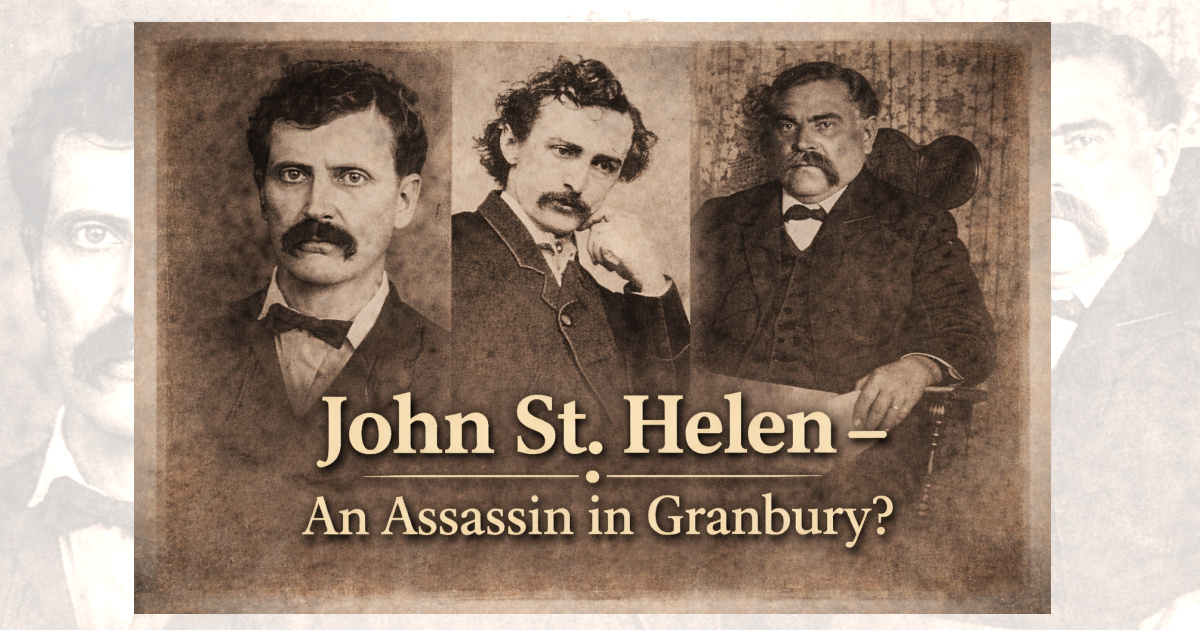
Historic images of John St. Helen connected to the question of whether an assassin lived in Granbury, Texas

Next Tuesday night, April 14, 2026, at about 9:15 in the evening, Granbury citizens might want to pause to
remember that it was at that hour 161 years ago that the man many consider to be one of America’s greatest presidents, Abraham Lincoln, was shot and killed by the stage actor, John Wilkes Booth. Many believe that man became one of Granbury’s most notorious residents – John St. Helen. Many believe he was the stage actor, John Wilkes Booth, and was the principal player of a story that before, during and after that tragic event is still, 161 years later, shrouded in mystery, conspiracy, inuendo, and enough plot twists to make it one of history’s most convoluted and tragic whodunits.
John St. Helen – An Assassin in Granbury?

Part One

A shot fired. The President dead as a nation mourns.
The manhunt begins, and ends, in a smoky blaze of fire. In Tennessee, a wife with infant child wait – abandoned.
In far-away Texas, a young girl stores memories – of the well-dressed stranger who lives with her family briefly on a farm near tiny Glenrose Mills. In frontier Granbury, a young lawyer befriends that stranger – who becomes the cultured teacher in whose temporary courthouse classroom Granbury College began and whose pupils performed a costumed, Shakespearean drama. Come summer, the stranger becomes the volatile, Shakespeare quoting bartender and saloonkeeper who drank only once a year, on the eve of the ides of April.

Decades pass, and relatives tell of the assassin believed dead – met on San Francisco’s streets, seen in a western mining camp… And finally, news of the death by suicide of an elderly Oklahoma man in in 1903, and a final call to that former Granbury lawyer, Finis Bates. Then – a human body – identified, mummified, displayed, disappeared. Bones held in secret, unopened graves shielded by federal courts. Fifty years on, federal agents are deployed – taking the sworn affidavits from 25 of Granbury’s most prominent citizens, collecting tales of a stabbing in his family’s shop…, of a deathbed confession…, of an empty bed – found after the sound of hoof-beats in the night.

And still today, a Nation wonders, awaiting the final act in the crime that shaped its fate – the play’s ending, perhaps forever – unknown. These are the elements, the bare bones – if you will – of a story that has spanned over 161 years, and still has no ending – no certain reality to finally close the book on the story of that greatest of American tragedies: the Civil War. For that is what this is. The assassination of Abraham Lincoln was the final ambush of one brother citizen against another in the nineteenth century war whose divisions our nation still grapples with today. The fact that the true fate of the assassin that waged that last attack is still shrouded in mystery is surely one of the great question marks of the American story.

At the center of this tale is the less than three-year glimpse of a man, that mysterious stranger, John St. Helen. In the spring of 1873 he appeared, arriving from the deep South, to linger here in the valley of the Brazos River on the frontier of Texas. He was alone, yet not alone – one of many immigrants to the area from what had once been the heart of the Confederate States of America. As such he should have felt himself among friends, and perhaps he was, as he soon made a deal for room and board with the family of farmer William McDonald, whose land was on the west side of the river near what is now Glen Rose in Somervell county. Or perhaps it was the cash he always paid with that made him welcome since, by all accounts, St. Helen was – at best – what my grandmother would have called “an odd duck.”

To say he did not blend in with the majority of the locals would have been an understatement. His ready cash was an anomaly in a culture where seasonal crops and or livestock were the primary sources of income. William McDonald’s daughter, Sadie McDonald Rylee, described him in recollections made almost seventy years later: “He was well-educated, and had fine manners, and he always wore the finest kind of clothes,
broadcloth and linen and silk. We would get mail only about every two or three weeks, and he would get lots of mail each time, and some of it would be fine clothing, and we were sure, though we didn’t know, that he got money through the mail. When we and other people of the community would have parties and entertainments, we would get St. Helen to read for us, which he did wonderfully. He was always poised, and he seemed to know Shakespeare by heart. Unless he were hiding out, it would seem strange for a man like him to be in a rough frontier country.”

Who was this cultured, dark-haired stranger; so suddenly appeared, so silent about his origins? Over the last sixteen or so decades a partial answer, most of it supported by some form of actual evidence, has been found. But the final answer, the one that matters, still eludes us. To put flesh on the bones of that story described in the summary above is to give substance to ghostly mystery, for the man called St. Helen appears then disappears again from history like a paranormal wraith in the night. Our only certainty is in the beginning — we know the event from which this man himself claimed John St. Helen sprang.

On April 14, 1865, several years before St. Helen’s arrival in northeast Texas, U.S. President Abraham Lincoln was shot and killed by a derringer wielding assassin as he attended a performance in Ford’s Theater in Washington, D.C. The assassin was a Shakespearean stage actor named John Wilkes Booth. Booth was a member of the then famous Booth family acting dynasty and was one of the most prominent and famous actors of the day. He was also a known Confederate sympathizer. Once Booth leaps from the Presidential box to the stage, and flees into the night, the mystery begins. We know he had accomplices; we know other murders were planned and attempted that night. We know Booth had a well-planned escape route. We know he had knowledge of a people across the Potomac in Southern territory ready to help him vanish. We know he had his broken leg tended by Dr. Samuel Mudd, and we think we know that, at least for a time, he hid in a barn owned by a farmer named Garrett. We know federal troops surrounded the barn. We know they fired multiple shots into the barn. We know the barn caught fire, either set or from a broken lantern, and partially burned. We know there was a body found in the barn afterward.

From there forward are myths and mystery. The myriad versions of the story of how government troops knew of Booth’s supposed presence in the barn, how long he was there, and what exactly transpired that evening do little to assure history of the veracity of the official government version of the tale. Even more staggering are the wildly divergent descriptions from many supposedly reliable sources as to the description and identity of the man who died there that day. But for the purposes of our story, let it suffice to say that descriptions vary from sworn statements that the body
matched the detailed description of John Wilkes Booth who clearly had dark hair and olive skin, to descriptions from supposed eyewitnesses who later swore the body they saw had reddish hair and fair, freckled skin.

From the Virginia confines of the barn on the Garrett’s farm, Booth fled, according to our tale. Heading first south and later west. For the next five plus years he wandered in the shadows, from “safe house” to “safe house,” moving often, and avoiding places where law enforcement or federal troops gathered. Finally, around 1871, he appears in the area of Franklin County, Tennessee, using the name John St. Helen. At this point he apparently decided enough time had passed that he could risk staying put for a while.

Louisa J. Payne was a Confederate Civil War widow. Her first husband, Confederate soldier C. Z. Payne, died in 1865 toward the end of the war. Louisa was left to care for her young son McCager (or Cage). Louisa worked as a seamstress for the recently opened The University of the South in Sewanee, Tennessee. In 1871 Louisa met a man named Jack Booth who claimed he was a distant cousin to John Wilkes Booth. Louisa fell in love and she married Jack in February 1872. However, after the wedding, Jack told Louisa that he had a past, and his name was not really Jack. He confessed that he was actually John Wilkes Booth, the assassin of the Republican President. Louisa, a devout Christian and southern Democrat, could forgive her husband for his war actions and personal deceptions to her, but she insisted that he sign their marriage certificate with his God-given name. And so, on February 24, 1872, a new certificate was signed in the presence of Rev. C. C. Rose, listing the marriage of John Wilkes Booth and Louisa Payne.

The late historiographer for The University of the South, Dr. Arthur Ben Chitty, did extensive research into Louisa Payne and her marriage to the man claiming to be John Wilkes Booth. Dr. Chitty eventually discovered the marriage certificate itself, located in the Franklin County Courthouse in Winchester, Tennessee. Dr. Chitty archived at The University of the South several audio tape interviews of men who personally knew McCager Payne, who in 1872 became John Wilkes Booth’s stepson. Dr. Chitty discovered that McCager had intimate knowledge while a youth that his stepfather was actually John Wilkes Booth.

As a newly married couple Louisa and John Wilkes Booth moved to Memphis, Tennessee, because, as Louisa would later say, “my husband had been told he would be paid a large sum of money owed him for his official work on behalf of the Confederacy.” While in Memphis, Louisa overheard some men on the street discussing her husband and pointing out where the “skunk” was now living. Louisa informed John that the men knew who he was, and his life was in danger. John told Louisa that it would be better if they separated for a season. He would go to Texas, and she should go back to Winchester, Tennessee, until things cooled off. John promised Louisa that he would return to Tennessee after things settled down.

Louisa went back east to Payne’s Cove, Tennessee, and the man claiming to be John Wilkes Booth headed south. Unbeknown to the couple at the time, Louisa was pregnant with John’s child. Louisa Payne would give birth to Laura Ida Elizabeth Booth, named after one of John Wilkes Booth’s sisters, while living alone in Tennessee in early 1873. Her second husband, the man who claimed to be “John Wilkes Booth” had gone to Hood County, Texas, and would change his name to John St. Helen.

Back in Tennessee, during 1873 Louisa Booth received financial help from the family of her deceased first husband. She went to work caring for her son, McCager, and her newborn infant girl. Louisa kept hope that her husband would return to her from Texas, but she never heard from him again. In 1879, 36-year-old Louisa Payne was burning leaves in her front yard when her dress accidentally caught fire. Louisa ran to a nearby creek to douse the flames, but her burns proved fatal. Before she died, Louisa called her six-year-old daughter Laura Ida Booth, and her fourteen-year-old son, McCager Payne, to her bedside. The mother informed her children that Ida’s father was John Wilkes Booth.

McCager Payne would later tell friends that he already knew John Wilkes Booth was his stepfather because of conversations he had overheard between his mother and the man when he was a boy. Caught once listening by his stepfather, McCager recalled being threatened by the man. If he told anyone his stepfather was Booth, the man told the boy, “I will kill you”.

Stay tuned to PART 2 coming Tuesday April 14th. 

NOTE FROM THE AUTHOR MELINDA RAY
Some may question the veracity of the information mentioned in this tale of the man those in the Granbury and Glenrose area knew as John St. Helen between 1873 and 1875. I have spent almost twenty years exploring the tales of early Granbury and Hood County and their inhabitants.  I began my investigations into the St. Helen tale as an avowed skeptic. After reading Finis L. Bates recounting of the tale, published in 1908 as the book The Escape and Suicide of John Wilkes Booth, I was intrigued. Bates had spent the thirty years between 1875 and 1905 working as a reputable attorney, who dealt on a daily basis with issues of truth and the law. For someone who had spent his life that way to put their reputation on the line by going public with what was sure to be dismissed by many and even by the government as at best a tall tale…got my attention. So, I proceeded to follow in the steps of those who had searched before me, and what I found blew me away.
I found the record of and photos of Booth and Louisa Payne’s marriage certificate from February of 1872 in the courthouse in Franklin County, Tennessee. I also found the tale of their marriage as told by both Louisa’s son, McCager Payne and his half-sister, who lived her entire life as Laura Ida Elizabeth Booth. And then I learned that the federal government of the United States sent 2 Secret Service agents to Hood and Somervell counties in the 1920’s to interview anyone who was still alive who had known St. Helen. There are 25 sworn affadavits from those folks were taken, all signed by a Texas notary. Here are just a few of the names on the list – Ashley Crockett, B. M. Estes, D. C. Cogdell, David Lee Nutt, Katherine Doyle and Sadie McDonald Rylee. The affadavit transcripts and other documentation can be found in two places- the originals are housed in the archives at Georgetown University, and certified copies are held here in Texas, in the collection of the library at San Angelo State University, alma mater of the attorney daughters of Texas native and Federal Judge E.H. Swaim who was involved in the investigation into the case.
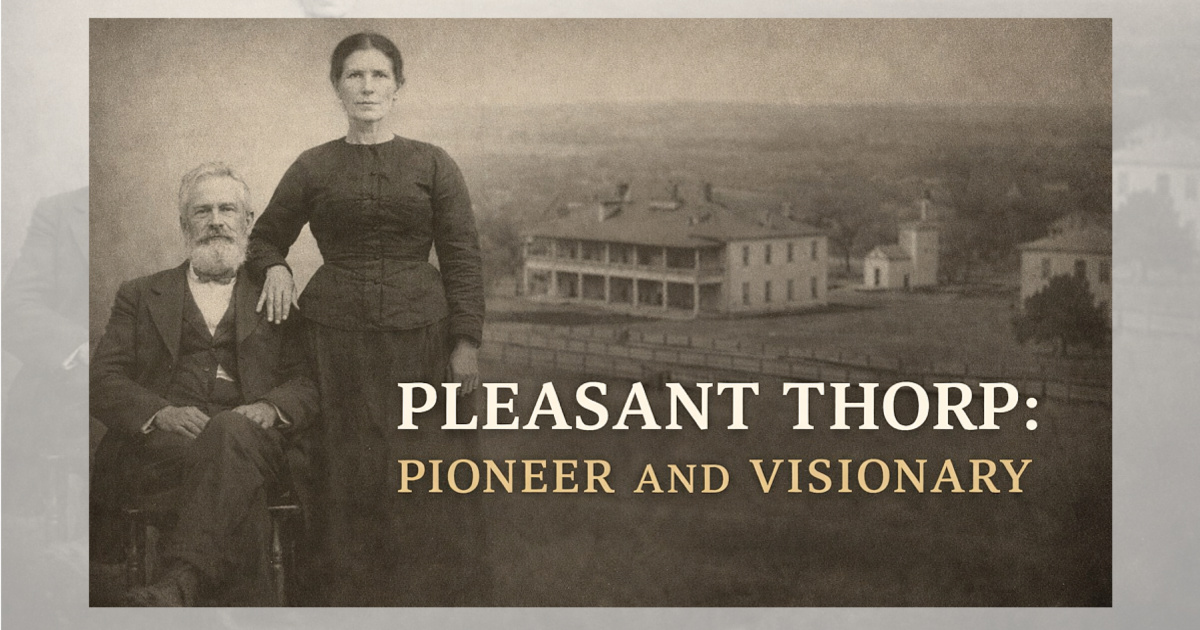
PLEASANT THORP: PIONEER AND VISIONARY

Pleasant Thorp and wife Nancy, pioneers of Thorp Spring in Hood County Texas

A hardy pioneer from Virginia, Pleasant Earl Thorp settled on the west banks of the Brazos River in 1854.  Naming the spot for himself and nearby springs in a branch of Stroud’s Creek, Thorp envisioned not just another settlement but an important town, and he spent almost the next forty years making the dream come true.  At his death in 1890, the eighty-one-year-old pioneer had lived to see his vision become reality. In that year the town’s population was over 1,000, and it was known statewide. Many later, lesser settlements are now familiar names. But Thorp’s dream blossomed only for a short, glorious season, then withered.  By 1980, the population of the once-vibrant town was estimated at 184.  Pleasant Thorp could not have been pleased. 

The young blacksmith wandered to the wild place called Tejas while it was still under Mexico’s oppressive rule.  He fought in the 1836 revolution for the Republic of Texas, married a young widow named Nancy Hicks Oldham McEwen, and started raising a family in Burleson County of the lower Brazos Valley, beginning a lifelong love affair with the country along the banks and bluffs of the Brazos River. But he was not yet content to settle down.  He dreamed of more and better land, for running cattle, horses, with some set aside for farming…perhaps a great rock house on a gentle slope…maybe even a settlement, with his name on it.  Thorp’s vision was northwest, upriver, in the heart of Comanche country. Pleasant knew the spot – he had seen it. In January of 1841, he rode with Brig. Gen. Edwin Morehouse’s Indian hunting expedition, penetrating far up the Brazos.  The expedition proved futile, but Thorp wouldn’t forget what he saw upriver around a majestic double-mesa, the river weaving a pattern around it.  He saw the land he wanted a certain spot, beside a stream with a natural spring nearby. Pleasant knew that someday he would be back to get it.

Someday came in the early 1850s. At last, Thorp made his move.  Over the years, he grew his stack of land certificates – trading, buying–adding to his 340-acre land grant in what would become Hood County.  In 1853, he made the long ride upriver to survey his more than 18,000 acres as well as Nancy’s father’s claim of 1,280 nearby. It was a very different place “where the Cross Timbers seemed to struggle between mountain and valley for room.”  It was a land to test even hardy pioneers. Treeless for miles, then thickly wooded. Rising above it all was the ancient double-mesa companion to the Brazos, Comanche Peak, which loomed just a few miles from Pleasant’s land.

In 1854, the family became the first settlers on the west banks of the Brazos in that area.  Shortly after the move, another girl was born – Nancy Elizabeth, “Lizzie,” was the first white child born in a brand-new frontier outpost called Thorp Spring – Pleasant’s town. Setting aside land for the townsite, Thorp feverishly pursued his plans.  Streets were laid out forty feet wide; and work was started on the big stone house, with Thorp’s few slaves providing most of the labor.  But after five years, there were only a few families settled at the village.  But there were still other settlers nearby and Thorp was not discouraged. 

The year 1860 was hard for the area that would become Hood County.  Storm clouds of the Civil War were gathering. Pleasant didn’t suffer financially, for he was frugal.  In that “bad” year, his real estate was valued at $56,000 and personal assets at $18,000, a fortune at that time.  And even more land came to the family when Nancy’s father died, leaving her an adjoining 640 acres. But with secession came realities of war and frontier conditions deteriorated.  Most young men joined the Confederate army.  Federal troops left the area, inviting Indian attacks. Many frightened settlers deserted the area.  But Pleasant was not about to abandon his dream or his land – the Thorps were there to stay.  

After the war, a semblance of “normalcy” came. More settlers pushed into and past Hood County, and relative peace settled into the area. More people soon settled in and around Thorp Spring; and, to Pleasant’s delight, the town began to flourish.  He came to be known as “Col. Thorp,” an honorary title often given to flamboyant or powerful figures.  And the spacious house, begun before the war, was finally completed. It was “a showplace of rock and boards brought from New Orleans by ox-cart,” — a real mansion for its time.   Shaded by a towering live oak, it boasted a panoramic view of the town, Comanche Peak, and Pleasant’s beloved Brazos River.

In the 1870s, a colorful character appeared. Capt. Sam Milliken, a Kentuckian who had plied the Ohio and Mississippi rivers as owner of several steamboats, was lured to Thorp Spring by its location and excellent water.  Milliken invested heavily, buying a large portion of Thorp’s acreage.  Some of Milliken’s land was on Sulphur Spring Branch, and his vision was to promote the springs as a summer resort.  The place was already known, having been a rendezvous for frontier soldiers.  Families vacationed there, and it was not unusual to see up to 100 campsites in the area. Milliken opened a feedlot and livery stable in anticipation of stage coach teams, and travelers’ stock.  He built a comfortable house to welcome tourists, a springhouse and bathhouses to accommodate the visitors he hoped to draw for bathing, swimming and boating. His wife welcomed overnight guests with appetizing meals and clean beds.  The venture became a great success in the 1870s, attracting a large share of the traveling public.

The town square boasted a variety of enterprises and, of course, the post office.  Local religious sentiment did prohibit the saloons found in nearby towns. Nonetheless, the village became a relay point for mail coaches on the Texas – Fort Yuma stage route, longest in the world in 1879.  Originating in Fort Worth, with the Concord coach and six-horse team to Thorp Spring often loaded with tourists as well as mail, it switched to a two-horse surrey going on westward. Pleasant’s vision was becoming a busy, well-known place, and not just as a resort.  In 1872, Pleasant decided on a bold move – to build a school – not just a cabin for one teacher, but a college, with one fine building at first.  He chose a six-acre site west of his house, on the highest point of the townsite, built a two-and-a-half story white limestone building. and began a search for staff.  The story of the college which prospered for many years in Thorp Spring is told later in this volume. But suffice it to say that for a time both the college and the town prospered, the population peaking by 1890. In that year, Col. Thorp died, with most of his dream intact.

There were many other contributors to the town – farmers, ranchers, doctors, lawyers, shopkeepers, teachers, and preachers.  However, the leaders in the early days had been two men of different, though complementing, styles – the stoic Thorp, with land and capital, and the flamboyant Milliken, affable promoter-speculator.  What this partnership lacked was the personality or inclination for “playing politics.” There were two bad omens of things to come and both events were largely the result of a lack of political influence.  After Hood County’s boundaries were defined in 1866, Thorp Spring came in second in a hot political war that ended up locating the county seat in Granbury, then called Lambert Branch.  Later, aggressive politics again came into play when the all-important Fort Worth & Rio Grande Railroad route was also set through Granbury. Those two defeats didn’t seem to matter for a time, though there were lingering bitter feelings. But they eventually emerged as the first two strikes against the stability of Thorp Spring.  The third strike came as a series of other events just prior to the turn of the century.

Capt. Milliken was killed trying to stop a team of runaway horses. Larger and finer vacation spots were developed, tourism dropped off sharply at the resort on Sulphur Spring Branch, and it was closed.  The cotton gin burned and, with the coming of the railroad through Granbury, stagecoaches were phased out.  The loss of Milliken and Thorp, the prime movers, was a blow.  But, in 1895, the decision was made to relocate AddRan Christian University to Waco and that was the final blow from which the town would not recover. There was a gradual withering.  Some businesses closed or moved away.  After AddRan left, Thorp Spring kept a college for years, but never so large, and the school was closed for the last time in 1930. Pleasant and Nancy Thorp’s “showplace” home was occupied for years by their son Jim’s family. Jim’s son, John, died there alone in 1935. In disrepair, the house partially collapsed and was finally razed.  

What remains of a pioneer’s vision sleeps by the swollen Brazos near where it becomes a full lake and water backs up to cover the springs that bubbled up cold sulfur water.  There’s no downtown, just a smattering of churches, a grocery store, and a couple of service stations along the highway.  The hilltop where Thorp’s first college stood is bare; the nearby university campus a lonely sight. A few ancient structures and foundations barely suggest the grandeur of a bygone day. The stop on the major stage route no longer has a post office.  Acreage Thorp gave to the county for a park at the spring sits untended by backed-up water. Pleasant and Nancy Thorp are buried with many descendants and other pioneer settlers in the old cemetery right outside of “town” on a hill above Blue Branch of Stroud’s Creek, under the ever-watchful eye of Comanche Peak, and just a stone’s throw from the Brazos River — always the river…

Written By Melinda Jo Ray

Setting the Record Straight: How We Got Those Names!

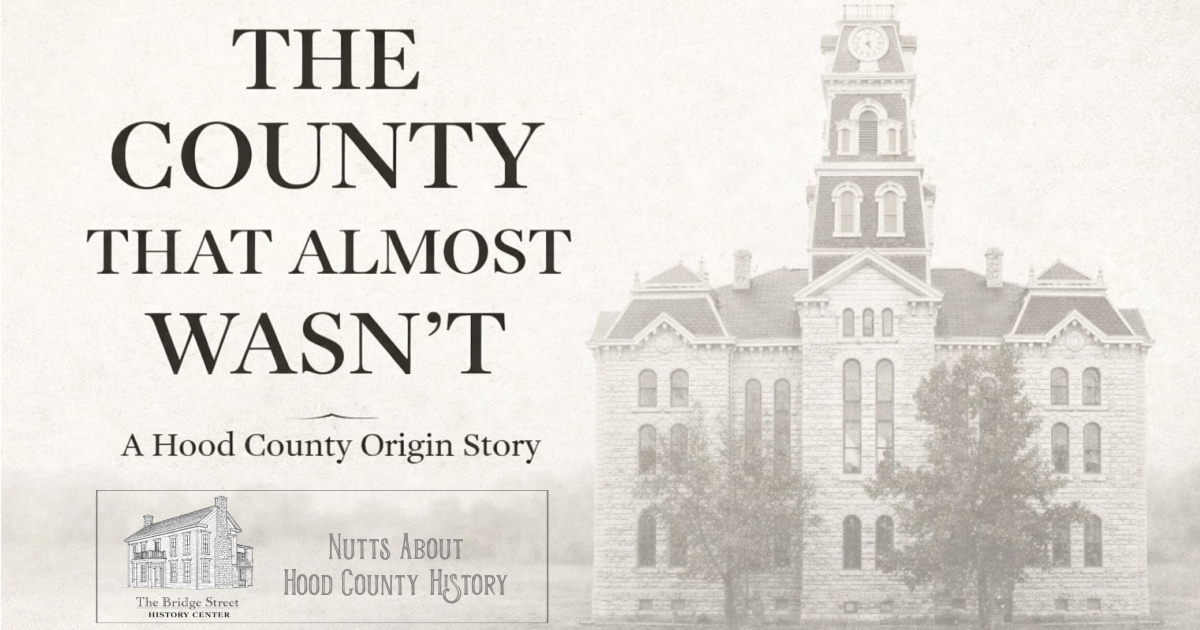
Historic Hood County Courthouse in Granbury Texas representing the county that almost wasn’t after Civil War political conflict

By Melinda Jo Ray | March 26, 2026

Hood County was formed in November 1866 by an act of the Eleventh Texas Legislature. The area had been within the Mexican Municipality of San Felipe de Austin as early as 1823 and became part of the Municipality of Viesca in 1834. After Texas became a republic, the area now known as Hood County was, at one time or another, been part of Robertson, Navarro, McLennan, Erath, and Johnson counties. The formation of a new county mostly comprised of the western half of Johnson county was discussed as early as the late 1850’s, but the tumult of the U. S. Civil War delayed a decision for several years. Indeed, the formation of the county in 1866 was the occasion of a little-known battle between the state legislature and the governor because of the political chaos that followed the war. We were, in fact, the county that almost WASN’T.

When President Abraham Lincoln was killed in April 1865, his death opened the door for a huge political battle between the new president, Andrew Johnson, and the Congress of the United States over the process by which the southern rebel states would be readmitted to the Union. Johnson put forth a fairly lenient plan, while Congress mostly advocated a much more stringent set of requirements that included several provisions southern lawmakers found very unpalatable. This controversy between the president and the Congress lasted for over a year. During that time the southern states were left basically in limbo, defeated, conquered, and not yet fully reinstated as part of the Union. For that reason, the state legislatures of those states did not have official permission to operate. Finally, President Johnson gave some permission under his more lenient terms, but Congress’ terms were still different. So, when the Texas Legislature met in its Eleventh Session in 1866, it had permission from the president but not from Congress.

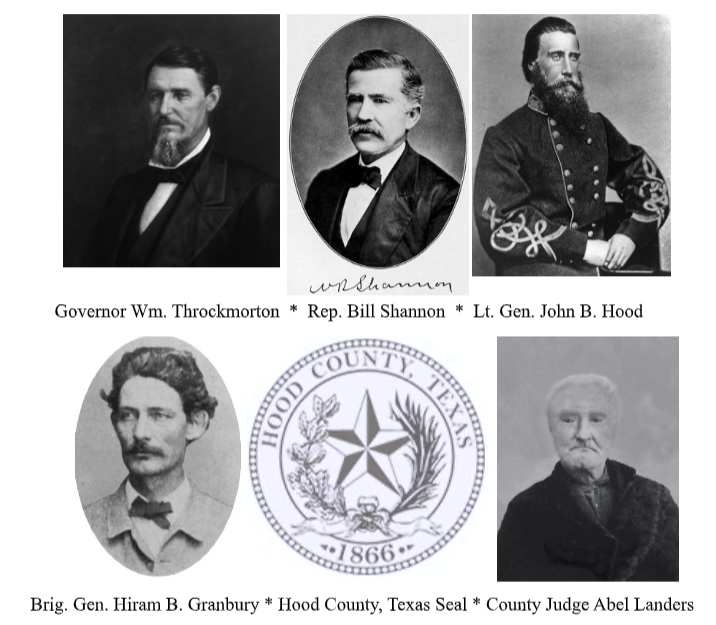
The governor at the time, William Throckmorton, was a moderate, and kept trying to pressure the legislature to meet the additional requirements from Congress so the state’s government could legally operate unimpeded. Through the spring and summer of 1866, the Texas Legislature met, in spite of the concerns of the governor. During that time they took a series of actions (or refusals to action) that were “In your face” defiance of the rules being put out by Congress. Among those acts was the bill for formation of just one new county in the state. The bill, sponsored by the representative from Johnson County, William Shannon, stipulated that the legislative committee had decided to name that one new county and its county seat after two of the Confederate officers Shannon had served under during the war. The county was to be named after Lt. General John Bell Hood, and the county seat was to be named in honor of General Hiram Bronson Granbury. The governor, who was fighting to prevent a Federal Declaration of Martial Law and takeover of government in Texas, was horrified. Convinced that the formation of a county with names so associated with the Confederacy could be the straw that broke the camel’s back with Congress, Throckmorton vetoed the bill and sent it back to committee with instructions to change the names.

Defiant, Shannon and the committee members refused and once again sent the bill to floor where it was passed once again. For a second time, Throckmorton angrily vetoed it, sending a letter saying, basically, you guys can keep doing this but I’m gonna veto this thing every time. Get over it and fix the names. By this time, it was well into October, and the legislative session was nearing its end. For a third time the committee sent the Hood County formation legislation to the floor. Again, it passed. Again, it was sent to the governor. By this time the governor was livid. He vetoed the legislation a third time. Being told that Shannon had finally gotten enough votes to override his veto, Throckmorton sent the committee a letter along with his veto reiterating vehemently his fears of the consequences of their actions. The letter was ignored and the bill for the formation of Hood County passed the legislature with one vote more than the number necessary to override the governor’s veto. The proclamation was signed into law and the eleventh session of the Texas Legislature adjourned. This was their final act. Three months later, in early 1867, federal troops marched into Austin, the legislature and all government offices were declared vacant, and martial law was declared.

Further turmoil ensued when the new carpetbagger legislature tried to rescind the names of the new county and county seat. One representative from Galveston pushed hard to rename the county seat Rubyville, after his daughter. But, the list of other deviances by the Texas Legislature was so long that the reconstruction government decided to let the formation and names of Hood County and Granbury stand. Abel Landers, a popular local man who was a known moderate in politics, was appointed county judge and given authority to hold local elections to fill the seats of local government. The results of those elections were subject to the approval of the reconstruction government in Austin.

A series of meetings was held in Acton, Stockton, Thorp Springs, and GlenRose Mills, in lieu of a formal countywide election since voter eligibility was a question still very much up in the air. The inclination of the men to elect to leadership positions the men who had so recently led them in battle was understandable, but Abel Landers over and over reminded them of the looming constraints most likely coming from afar. He welcomed participation and leadership of former soldiers in the process but preached the wisdom of allowing the older generation of non-combatants to serve as the elected community leaders – county commissioners and such – for a while longer. He pointed out this the allowed the younger men to focus on rebuilding lives and livelihoods so disrupted by the recent years of war.

Judge Landers consulted with leaders in each community and chose four older men of strong leadership reputation as commissioners for his police court. C.C. Alexander and Wilson Barker from the area near Glen Rose Mills and Barnard’s Trading Post, John Meek from over along the Paluxy, and Joe Robertson, the fiery preacher from Acton, were all eager to serve to promote the interests of the folks in their various parts of the county. C.C. had been county judge over the entirety of Johnson County for a time a few years back and so was a good source of information and comradery to Judge Landers in the daunting task at hand.

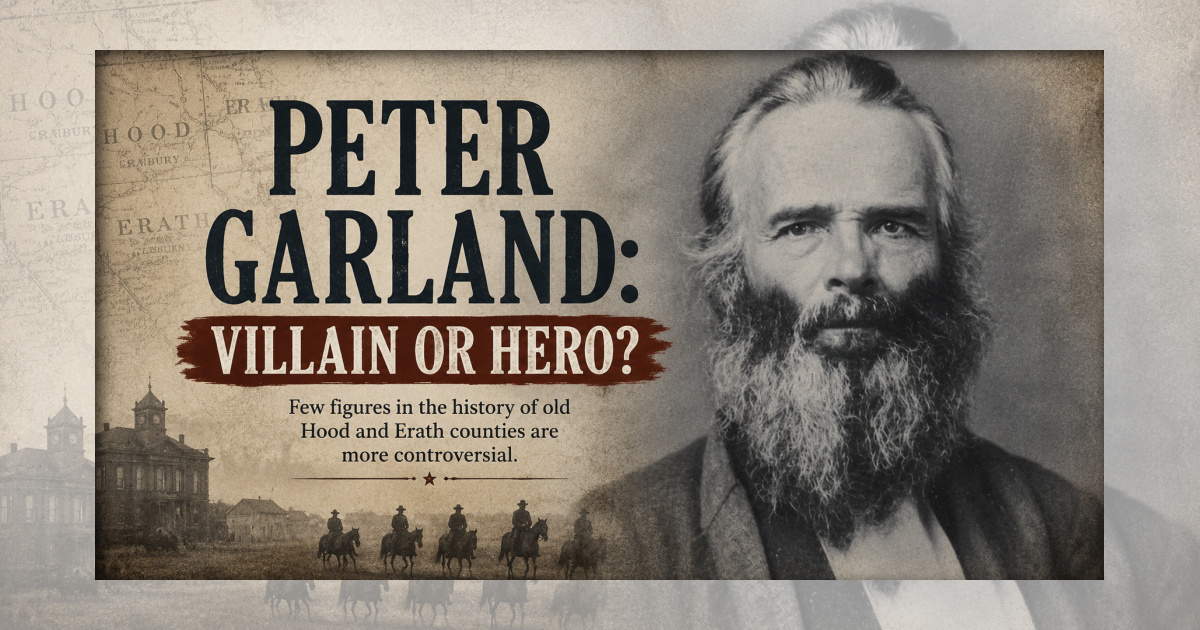
When the dust settled, in January of 1867, and the police court met at Abel’s cabin in Stockton for the first ever meeting of the Hood County Commissioners or Police Court, thirty or so observers gathered to watch. After discussing the consensus built at each of the far-flung county meetings, Abel Landers announced the election of Peter Garland, who had been a leader in protecting all from the Indians during the war years, as county treasurer, Gideon Mills a literate Scots-Irish farmer from over Paluxy way as tax assessor and collector, and John Morris a miller from over near Walnut Creek in Acton as clerk for the district court.

In spite of Abel’s advice to the contrary, the other two persons elected were former Confederate officers. A.J. Wright, husband to one of the Nutt’s daughters was elected as county sheriff. Relative newcomer, Alex McCamant, who had fought with one of the Indian protection regiments out in West Texas with some of the local men, was the new county clerk. He was a surveyor by trade, so many figured that made sense for him to have the office that dealt so much with the affairs of land ownership. These two elections did indeed end up being overturned by the military government amid much turmoil. Eventually, two local non-combatants in the war were chosen as replacements: John Hightower as Sheriff, with Wright hired as his deputy and blind businessman, Jesse F. Nutt as County Clerk with Alex McCammant working as his assistant and scribe.

THIS HOUSE WE CALL HOME

nutts about granbury history, the D L Nutt House, historic house, the bridge street history center home


THIS HOUSE WE CALL HOME
A History of the David Lee Nutt Family Home.
By Melinda Jo Ray  March 12, 2026

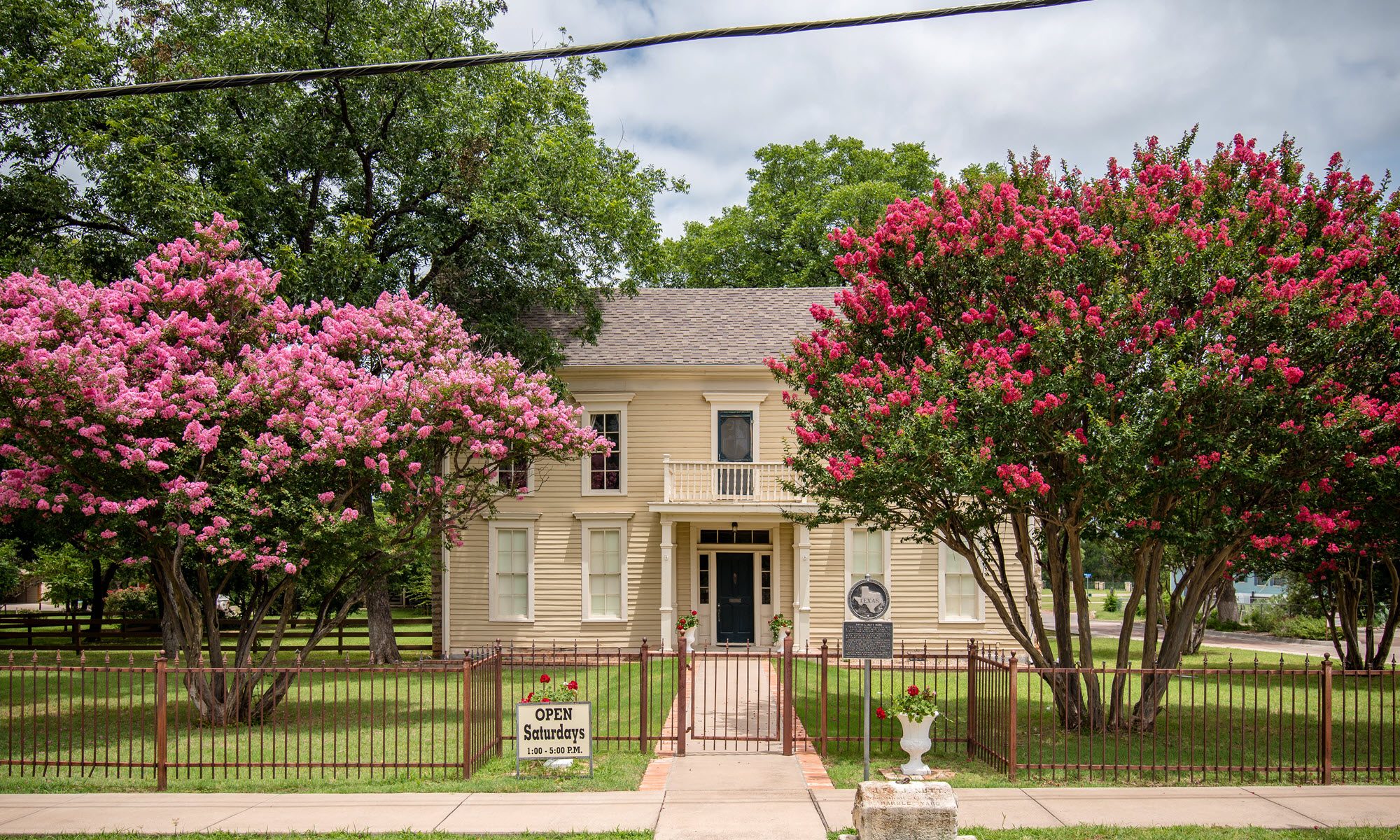
This house the Bridge Street History Center calls home
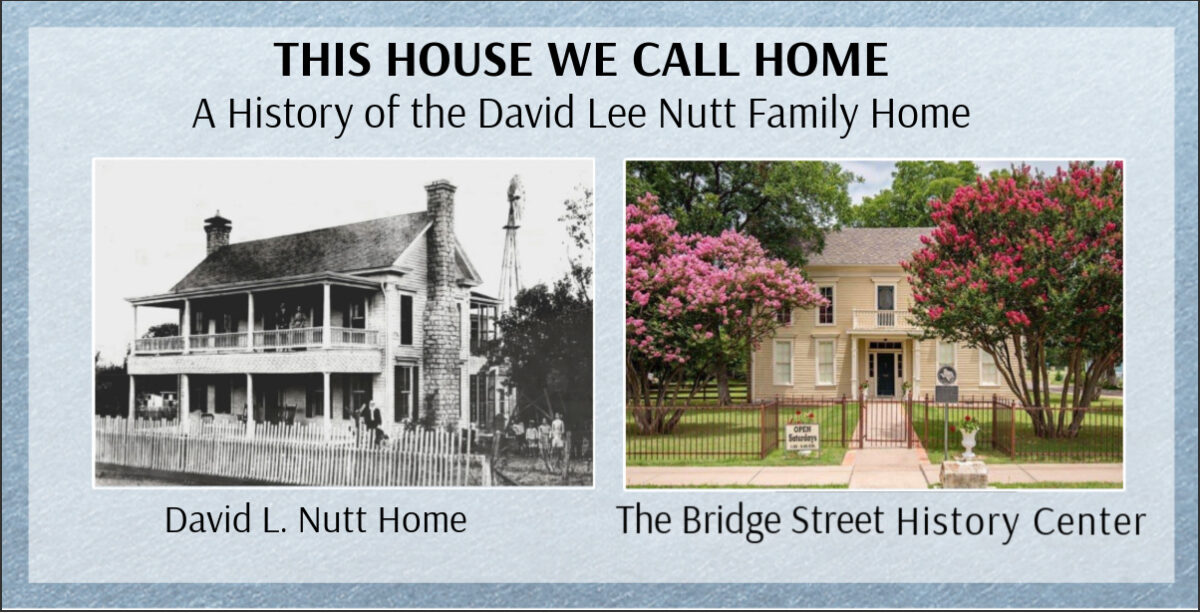
was never “just a house”. It was built as, and always will be – in one way or another, a Home. This historic photograph shows an early Granbury home with a windmill and large wraparound porch, typical of residential architecture in Hood County during the late nineteenth century.

David Lee Nutt, the man whose family built this house 1879 and lived in and loved it for over 120 years, was the youngest child of one of Hood County’s earliest pioneer families. He and his three brothers, Jesse, Jacob, and Abel all figure prominently in the story of Granbury and Hood County’s first sixty years of existence. The descendants of these men and their many family members have continued to play active rolls in business and civic leadership in Hood County and Granbury to this day.

David Lee Nutt is perhaps most well-known for his business partnerships with his blind brothers, Jesse and Jacob in the Nutt Bros. Mercantile, and the Nutt Ranch as well as the boarding house/hotel he and his wife Sue Garland (Sudie) Nutt married in 1872 and built this home and lived there from 1879. From the earliest years they boarded students from nearby Granbury College. During those years David Lee also became active in local politics, serving multiple terms on the Granbury city council. He was active in the local Masonic Lodge, and he and Sudie were founding members of the First Methodist Church of Granbury, and they were instrumental in its sponsorship and founding of Granbury College. David and Sudie lived in the house on Bridge Street until their deaths in 1929 and 1920. Their eldest son, Henry Lee Nutt took over both the mercantile and hotel businesses sometime around 1910 inherited the home and he and his wife, Euna Barefoot Nutt lived in the house for the entirety of their lives together and raised their three children there.

Euna Nutt lived for almost twenty years after Henry’s death in 1854. During her final years, aniece, Mary Lou Watkins (daughter of Henry’s sister, Mary Sue) came to live with her. When she came to care for her widowed mother and elderly
aunt, Mary Lou found Euna, the family home, and the family’s grand old hotel on the square all in need of some tender and loving care. And that is exactly what she gave all three. Euna was well cared for at home for the rest of her days, and both the old family home and the grand old Nutt Hotel on the square were in good hands with Mary Lou.

Under Mary Lou’s care the family home received a total renovation, as did the building on the square. Both became vibrant examples of the revitalization of the entire town of Granbury during the 1970’s and 1980’s. The Bridge Street History took over stewardship in 2011.  Today is is open to the public on Saturdays, with exhibits, multi media presentations and docent tour.

Recorded Texas Historic Landmark – 1967

Granbury Founder A. P. Gordon: Merchant, Civic Leader, and the John St. Helen Mystery

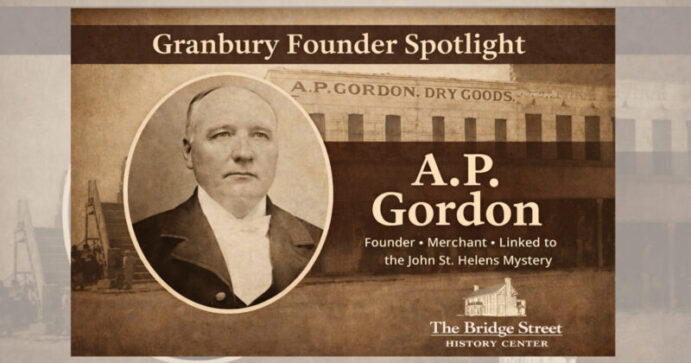
A.P. Gordon Granbury founder and merchant with historic photo of his dry goods store on the Granbury Square
A.P. Gordon Granbury Texas Founding Father.  Historic building, home and obituary.
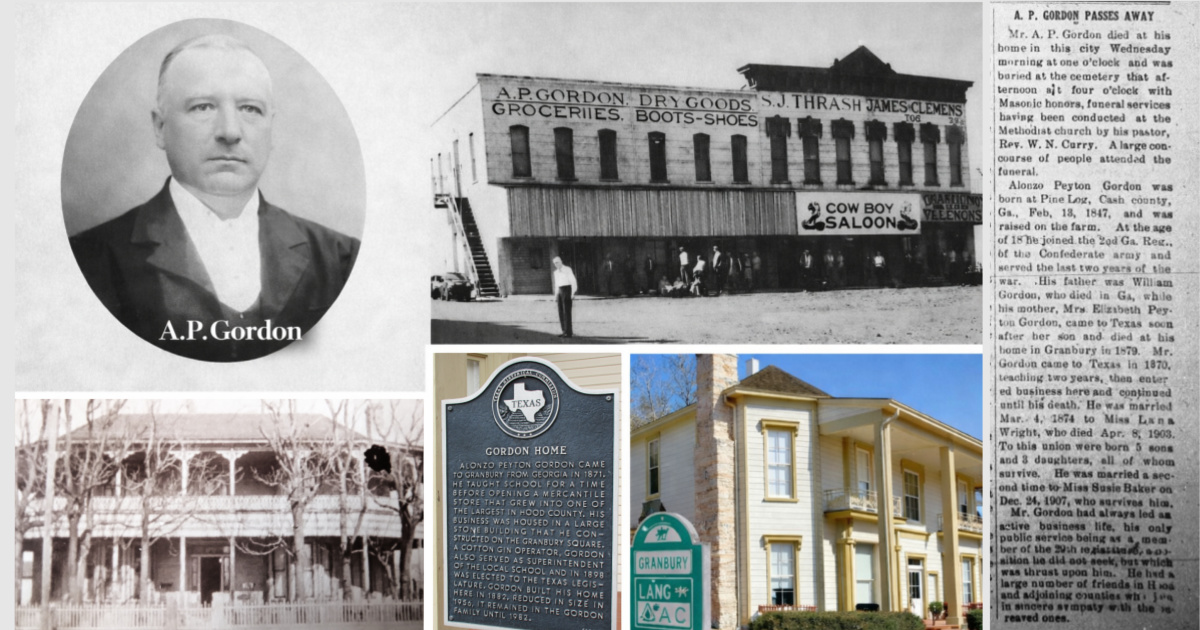
Images of Granbury founder Alonzo Peyton Gordon including his portrait, mercantile store on the Granbury Square, the Gordon home (now the Dora Lee Langdon Cultural Center), and the Texas Historical Commission marker honoring his legacy.

March 12, 2026
By Melinda Jo Ray

Granbury Founder A. P. Gordon: Merchant, Civic Leader, and Landlord to the Mysterious John St. Helen (aka John Wilkes Booth)  

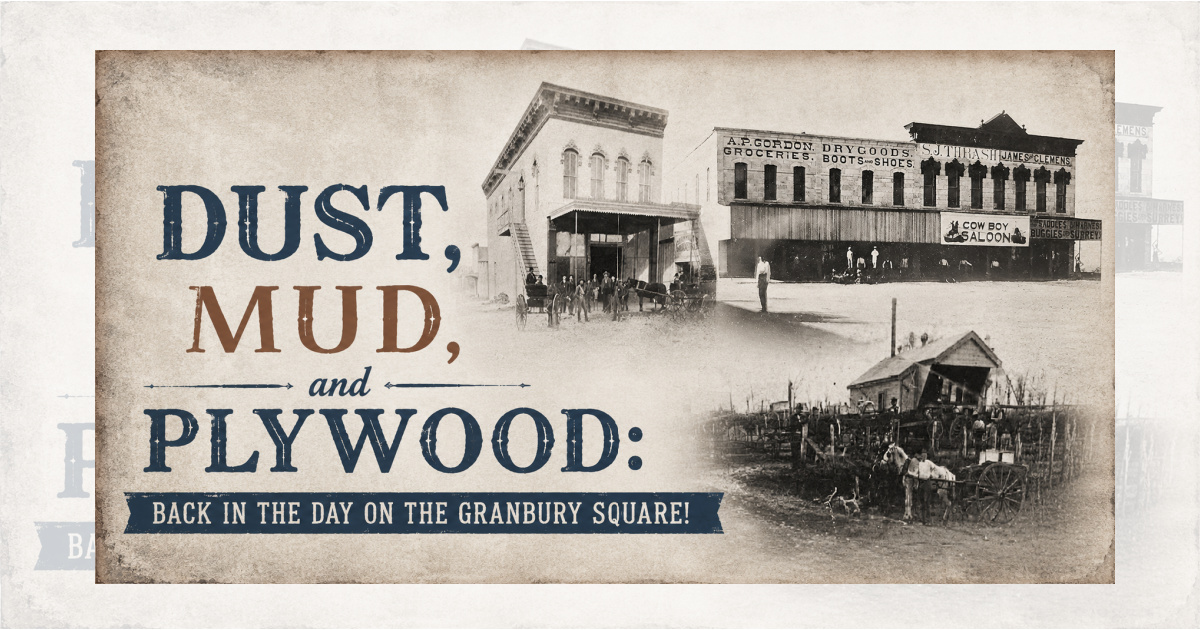
What do the Langdon Center Property, the building on the southeast corner of the Granbury Square that now houses a candle shop, and John St. Helen (aka John Wilkes Booth) all have in common? They are all connected to one man – Alonzo Peyton Gordon. Most folks who have been around Granbury very long have heard the name A. P. Gordon. His name is now on the historical markers located at his house, which now is headquarter of the Dora Lee Langdon Cultural Center, and the limestone building on the southeast corner of the Granbury Square began its existence as Gordon’s mercantile store! Gordon was also member of several early Granbury city councils and also figures prominently in local legend as the owner of at least one local saloon and landlord of the mysterious John St. Helen, the drifter who claimed to be Booth, the assassin of President Abraham Lincoln.

But Alonzo Gordon was much more than just an old-time saloon owner and landlord to a shady character. Indeed, Mr. Gordon was one of the “movers and shakers” in the town of Granbury almost from the moment of his arrival in 1871. Hailing from Georgia and a veteran of the Confederate Army, Gordon spent the first years after the war teaching school. A frugal young man, he steadfastly saved his meager salary, watching his nest egg grow, and dreaming of a more prosperous life as a businessman in some new and growing town “out west”. Finally, in 1870, he took his tidy sum of savings and headed westward to the little newly declared county seat of Hood County, Texas – Granbury.

Taking a teaching job quickly to pay room and board, Gordon used his funds to purchase two lots on the southeast corner of the brand-new Granbury town square. Like most during this time period he soon learned of the title dispute associated with the town lands, and chose, for the time being, to erect buildings using wood not stone, because of the cost. He also acquired the land east of the square where the Langdon Center is now, and homesteaded it, building a log cabin where he lived until his marriage. In 1873, contemplating marriage, Gordon added a living-quarters to his store building. He lived either behind or above the business for several years with his wife, Lana, until they built the large home on the property east of the square that is now the Langdon Center headquarters.

As one of the first business owners in Granbury and a well-educated man, Gordon took an active role in the city and county politics, serving on several early city councils in various capacities.  He was also active in the local Masonic Lodge, and other area organizations throughout his life. Around the time of his marriage, sometime in 1873, a stranger new to town came to Gordon to inquire about renting his vacant log cabin. Sober, well-spoken, standoffish, and hot-tempered are all words that were used to describe John St. Helen, the mysterious fellow Southerner who Gordon signed on as tenant from 1874 to early 1875. St. Helen had found employment as bartender and later manager of two local saloons.  The man had a policy of never indulging in the liquids he sold, “Saint” — as he was called — only got drunk (according to local lore) only once during his tenure — on April 14th in 1874. Tales were told later of him standing drunkenly on a table reciting lines from Shakespeare. It is said that after Saint was involved in a fight with a local man that spilled from the saloon to the street and across the square into the Nutt brothers store, where Saint actually pulled a knife and stabbed the man, that Gordon considered evicting St. Helen. Alas, he never had the chance, as St. Helen took ill a short time later, made his famous “deathbed” confession to Finis Bates, recovered, and disappeared in the middle of the night, leaving behind most of his belongings. Gordon family lore says that during his illness, St. Helen revealed, in his delirium, his true identity as John Wilkes Booth. As soon as he recovered, he fled, leaving behind a note to Alonzo Gordon, and one of two used derringer pistols used by Booth the night of the Lincoln assassination. That gun is still owned by A. P. Gordon’s descendants.

One can wonder if all the hoopla surrounding St. Helen was part of what inspired A. P. to scale or sell his interests in the saloon and focus on his grocery and dry goods store, and his shares in a local prosperous cotton gin enterprise. His wife was Lana Wright, whose father A. J. Wright was Hood County sheriff at the time of the marriage in 1874. He and Lana enjoyed many years of a good marriage together and had eight children. They were founding and long-time members of the Granbury First Methodist Church. Indeed, one of the stained-glass windows in the old Mission Style church that used to stand where Granbury Square Plaza is now was dedicated to their memory. After Lana died in 1903, A. P. married Susie Baker in 1907. They had 14 years together before his death in 1921.

In addition to his businesses and building the house and two buildings on the southeast corner of the square in the 1880’s, Gordon was also among the leaders who took bold steps to secure Granbury’s future during those formative years. He was among the group of businessmen who put up a total of $50,000.00 for the start-up of the First National Bank. In addition to his terms on the city council, also served as an early superintendent of schools, and as a local representative to the Texas Legislature for one term.

In the early years of Granbury, Alonzo Gordon was among the local men known for their prowess at hunting. Apparently, he and his fellows were not averse to travelling as far away as New Mexico in search of areas with plentiful game. Thomas Ewell tells the tale of one such trip in 1878 when Gordon and friends killed between them eighteen bears and literally 100’s of wild turkeys, 100 + by Gordon himself. Here’s hoping all of Granbury benefited from their efforts that year!

At the end of his days, according to accounts in the local papers, A. P. Gordon surely had one of the speediest funerals ever held anywhere. He died in his home early on the morning of November 9, 1921, and by four o’clock that afternoon he was in the ground at the local cemetery. His obituary notes that his funeral was held at the Methodist church, and burial with full Masonic honors was immediately after at 4 p.m. with a large number of family and friends in attendance. In spite of his speedy interment, his contribution to the fabric of Granbury has certainly been long lasting, as the home and buildings he built continue to be a vital and vibrant part of our community.

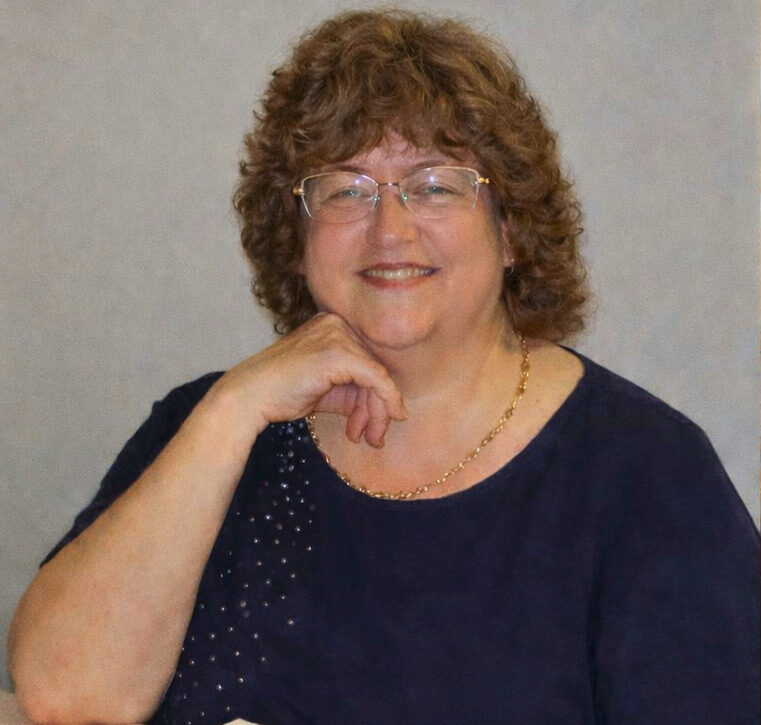
Melinda Jo Ray historian, author, and retired school teacher and librarian from Granbury Texas writing for the Nutts About Hood County History blog
Melinda Jo Ray, historian and author of five published books, writes the Nutts About Hood County History blog for the Bridge Street History Center in Granbury, Texas. Melinda is a retired school teacher and librarian who has dedicated years to researching and preserving the history of Hood County.


Welcome to “Nutts About Hood County History” Blog

Nutts About Hood County History granbury history hood county history historical images and stories

March 4, 2026
Written By Melinda Jo Ray

An Introduction

Greetings Readers and Friends!

First off, thank you to the board members of The Bridge Street History Center for allowing me to contribute to this websites blog on a weekly basis.

Welcome to a blog dedicated to doing the very thing our mission statement describes – sharing the stories of the people, places and events of our local past. As the writer of five books on this subject, I combined my love of history and of this place where I live with my passion for education and storytelling and the research skills acquired as a career teacher and librarian. Now this new project brings the opportunity to continue that journey. Now I look forward to sharing a delightfully wide variety of true stories about the people and events that made a difference here – from the early days of pioneer settlement through the nearly 175 years of change and growth since then. “Nutts about Hood County History” will strive to introduce you to some of the lesser- known people and aspects of our county’s quintessentially American story while not neglecting to share some of the little-known stories about some folks you’ve probably already heard of. There may even be a few tales featuring some really famous people with connections to our story that most people today have never heard about. Throw in a good mystery or two and I think we can all have a great time together!

So check back here each week and spend a little time with me poking around to see what went on around here in those “days gone by”. You just never know who we might meet up with – Wanderin’ round the Hood!

Melinda Jo Ray historian, author, and retired school teacher and librarian from Granbury Texas writing for the Nutts About Hood County History blog
Melinda Jo Ray, historian and author of five published books, writes the Nutts About Hood County History blog for the Bridge Street History Center in Granbury, Texas. Ray is a retired school teacher and librarian who has dedicated years to researching and preserving the history of Hood County.