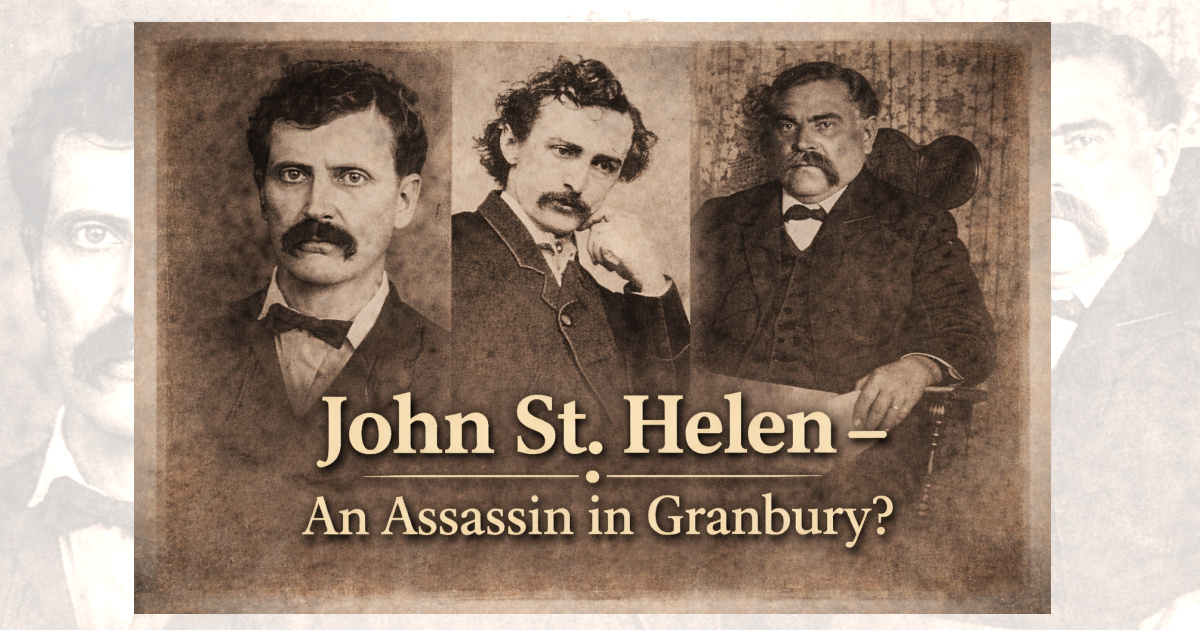
During his time at the McDonald farm near Glenrose Mills in 1873, John St. Helen would travel with his landlord on occasion to Dallas, hauling crops by wagon. It was noticed that he made himself scarce if serious law-enforcement, like the Texas Rangers, came around. In late 1873, a local young lady announced her engagement and imminent marriage to a Texas Ranger. Learning that the couple planned to make their home in Glenrose Mils, St. Helen left overnight just prior to the wedding in the spring of 1874, even leaving some of his belongings behind. He had met and befriended a young lawyer from the nearby town of Granbury at a picnic, so he headed north up the Brazos. He appeared in Granbury, was hired as a bartender and lived forover a year in a log cabin located near the town square and owned by merchant A. P. Gordon.
Now to take a moment to dispel some misconceptions. The Granbury that John St. Helen came to in 1873 bore very little resemblance to the town we know today. First of all, there were NO massive stone buildings on theso-called town square, except for the two-story limestone courthouse built in 1871– the first really substantial building to be built on this land whose title was at the time under dispute. There MAY have been six to ten log/frame/partial stone one-story buildings scattered on the lots that had just been laid out a couple of years before. Granbury was only recently incorporated, and most if not all governmental power rested with the County Police Court headed by J. B. Spears and the County Sheriff A.J. Wright. A. P. Gordon, St. Helen’s new landlord, had a small grocery store on what was designated as the lot on the southeast corner of the infant town square, at the intersection of the almost imaginary Pearl and Crockett streets. Over on the southwest corner, where Pearl intersected the equally imaginary Houston St., stood the beginnings of the Stringfellow Hotel and diagonally across from it was the log house known as the Black Hawk saloon – most likely St. Helen’s original employer, in an equally small, primitive structure. There was no “opera house” at that time. While the popular myth goes that St. Helen’s drunken diatribe of memorized Shakespeare on April 14, 1874, and possibly again in 1875, took place on the Opera House stage, the early recorded recollections of people who were actually here at the time describe him standing on a tabletop in the saloon.
The strange thing about St. Helen’s assassination anniversary monologue, and what apparently made it so memorable, was that it apparently broke his usual pattern of behavior. He was described a quiet sort, almost to the point of being taciturn, and, unusual in a bartender, he was an avowed teetotaler. During his almost two years in Granbury, St. Helen apparently presented the same cultured persona he showed when living with the McDonalds. As the tenth anniversary of the Lincoln assassination approached, he would have been thirty-six years old.
St. Helen apparently knew many of the men of the town due to his bartending job, but befriended few, and confided in none. The exception to this appears to have been his young lawyer friend who was also from Tennessee, Finis Bates. Bates was by his own admission a grass green, ambitious young attorney, who had come west to make his mark on the world. He saw in St. Helen a fellow Tennessean, an educated and cultured well-read man, and St. Helen apparently saw the same thing in kind. The two hit it off and became close friends. But Bates could tell his friend was a man with secrets. Following the code of a society full of people seeking a fresh start, he respected his new friend’s privacy and didn’t press for his secrets.
“Saint,” as he was apparently called, for all his cultured teetotaling ways, did have one notable vice, foreshadowed by his threat to his young stepson a few years before. He had a formidable temper and was apparently fully capable of violence. There is a stunning and dramatic story documented in a sworn affidavit given to federal investigators in the 1920s by an elderly David Lee Nutt. The Nutt brothers’ first mercantile store on the Granbury Square was a smallish one-story wood structure backed by a livery stable on the
northeast corner of the square one-block directly north of A. P. Gordon’s grocery store.
Apparently young David Lee, then aged 26 or so, was on duty with his blind brother Jesse Nutt at their store sometime in early 1875 when a man ran in the front door of the building with “Saint” in pursuit – wielding a knife. There was a skirmish at the back of the shop, and then as the sheriff approached, “Saint” fled, leaving the man bloody but with only minor injuries. In the way of things in those days, since the man’s injuries were minor, St. Helen got off with a warning. What the outcome might have been had the sheriff’s imminent arrival not intervened no one knows. But certainly, again, here is a man obviously capable of deadly violence.
After the stabbing incident, “Saint” was apparently on thin ice with his landlord and now, employer and, according to Gordon’s own statement, he was seriously considering firing and evicting the man. But cold weather arrived, and fate intervened. Sometime toward the end of the winter of 1874-1875, St. Helen became seriously ill with what was probably pneumonia. Convinced death was near, St. Helen sent for his
friend, Finis Bates. In the late afternoon, as the sun headed down and the light grew dim, John St. Helen made his confession to his friend, telling his identity, and revealing details of the assassination, including where he had hidden the “second derringer” that he had planned to use on Lincoln’s bodyguard, but the man was passed out drunk — which apparently saved his life. Additionally, St. Helen begged Bates to find a priest come and hear his confession and give him absolution. No priest being available in the vicinity, Bate and others found a “local man of the Godly persuasion” to do the deed.
Oddly enough, Finis Bates’ account of St. Helen’s story does not have any mention of the woman St. Helen presumably married and left behind. Bates departed late that evening, knowing he had to leave for an out-of- town court date and would be gone for several days. He found St. Helen’s landlord, A. P. Gordon, and gave him money to pay for St. Helen’s burial, vowing to return and settle up any further expenses required for his friend’s care. He left, never expecting to see his friend alive again. He was right, just not in the way he expected.
As promised, he showed up to inquire after his friend a few days later. Told that St. Helen was gone, he nodded and inquired as to the place of burial. At this point, Gordon replied, “No, you don’t understand. His fever broke the night you were here, and the next morning, even though he was weak as water, he rode out of here before sunup, with just some saddlebags and the clothes on his back.” The note St. Helen left, some other personal items, and a derringer that matches the other of the pair from the same set, that was used to
shoot Lincoln, is still owned by the Gordon family.
For the next twenty-plus years, St. Helen wandered the far western areas of the United States, the name popping up occasionally in the public or anecdotal record. He actually met in California on at least two known occasions with members of the Booth family who had known John Wilkes Booth well, and they became convinced that he was indeed the man they had known. But he was always elusive, secretive, still conscious of the very real threat of the gallows should he be captured and his identity proven.
Stay tuned to PART 3 next week.