‘Far above the Brazos River,
On a Hallowed site,
Stands our noble Granbury High School
Bathed in golden light.
Raise the chorus, send it onward
Over hill and dale.
Hail to thee, beloved old high school,
Granbury High School. Hail!’
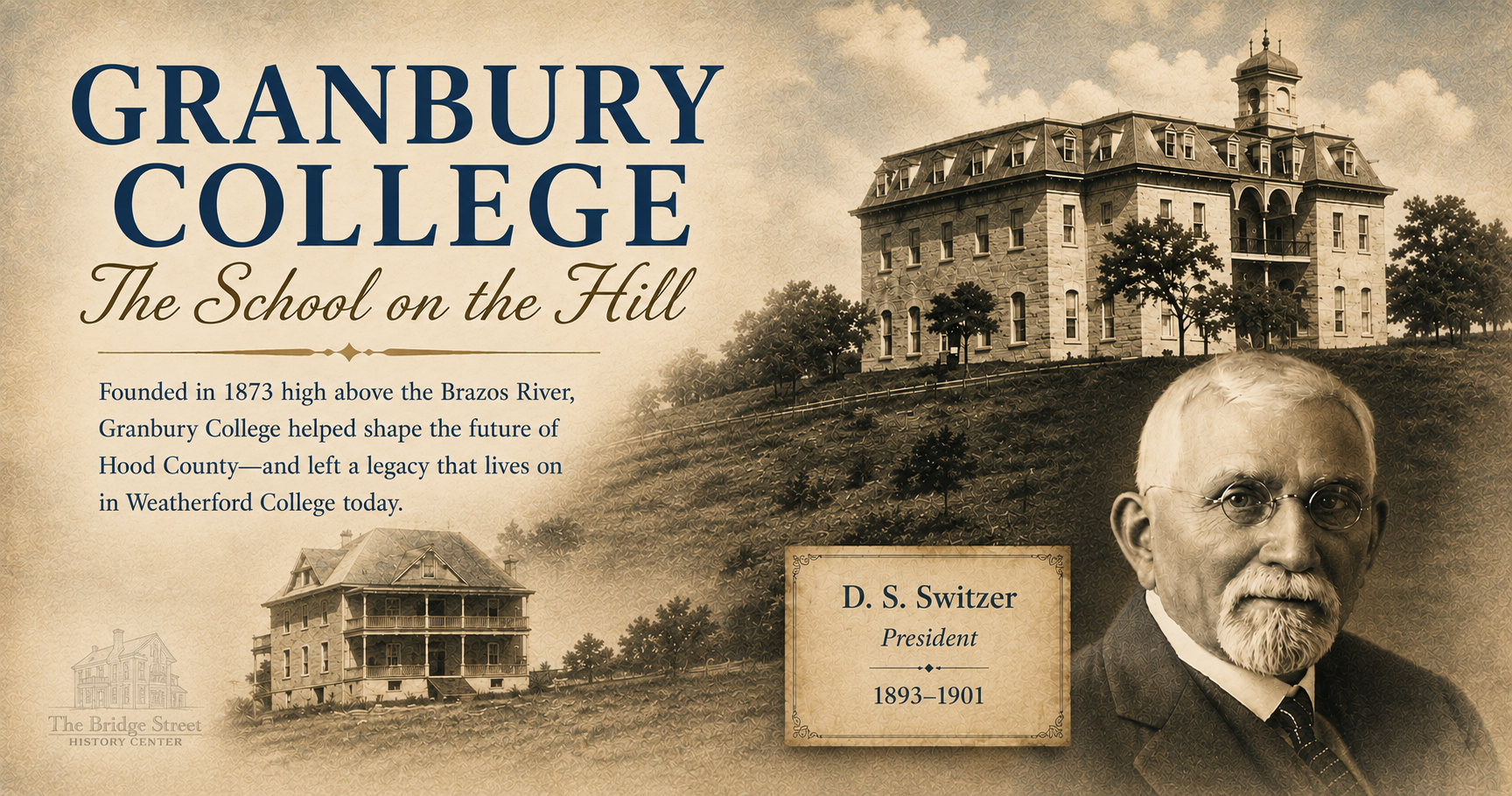
The above words are the words to the school song for Granbury High School and have been so since early in the twentieth century. However those words were originally been written about another school “far above the Brazos River” — Granbury College, the first secondary school in the city of Granbury — the school on the hill.
Granbury High School and College was begun by the Methodist Church District Conference in 1873, the same year as Ad-Ran College was opened in nearby Thorp Springs by the Churches of Christ. The two schools combined to make Hood County known nationwide as a center for higher learning in the latter years of the nineteenth century. Of both schools there are no physical remains save those that have been reused in the building of other structures. Of both schools few if any remain alive who have any actual memory of their existence. However, both schools were the seedlings – planted here in Hood County for a season – that were the foundation and beginnings of two long-time institutions of higher learning that still serve the students of North Texas and the world. Most people know that Ad-Ran College moved to Fort Worth and became Texas Christian University, but few remember or know that Granbury College which closed here in 1912, moved to Weatherford, and became what is now Weatherford College!
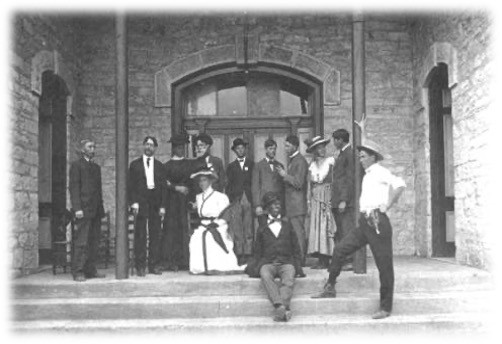
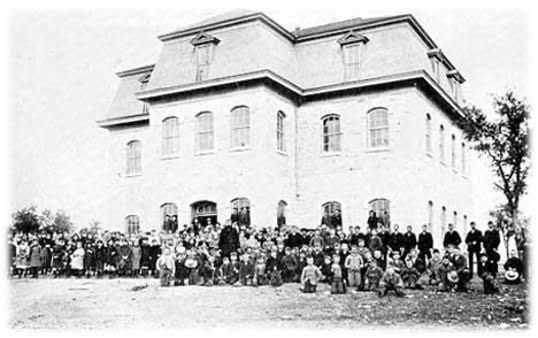
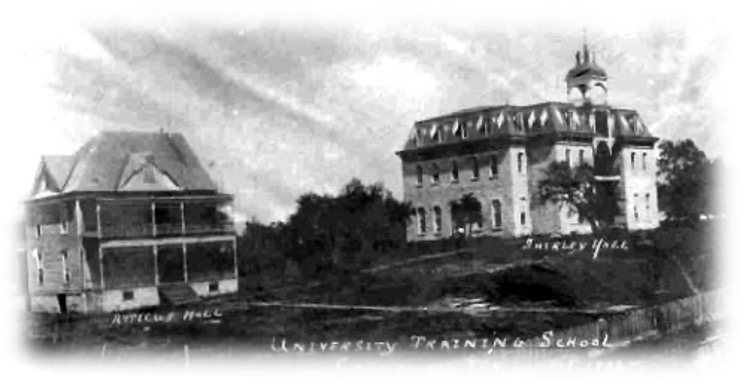
It may surprise many to learn that Granbury College and Training School, as it was known, existed at all. Even more surprising to some would be its location! Literally – far above the Brazos River on one of the highest points in the city of Granbury now stands – the Granbury Cemetery. Near the location of the middle of the current cemetery, where a water tower now stands adjacent to the oldest part of this hallowed site once stood the proud limestone structure of Granbury College. Believe it or not the college eventually was housed in a building that stood three stories high and measured 62’ by 80’. This was by comparison almost as tall as the current courthouse building minus the clock tower, and similar in size at ground level to the Nutt House Hotel building on the downtown square which measures roughly 50’ by 80’. It must have been an imposing sight up there on that hill above the town, and even more impressive is the fact that in an era when secondary education was still an opportunity often only offered to males, for its entire history – from 1873 to 1912 – the Granbury College was a co-educational institution!
In the summer of 1873, the District meeting of the Weatherford Methodist Conference was held in Acton. At that meeting, Rev. James Jones was the presiding elder. Many of the officials from throughout the conference recognized a need for an educational facility in this area of the state. Many expected it would be placed at Weatherford as that was the largest town in the area at the time. A strong presentation and proposal was made by the folks from the Granbury area, and it was decided that a District High School would be opened in Granbury instead.
Records indicate that the school opened that very fall in 1873, housed temporarily in a rock structure on the southeast corner of the square. The exact location and ownership of that building has been lost to the mists of time, but surely a debt of gratitude is owed to those unknown owners who lent their building to Granbury’s first institution of higher learning. A frame building was built on land given for the school to the north of town up on what is now the eastern most end of the Granbury Cemetery. The first headmaster of the school was Rev. W. P. Wilson and teachers were hired to teach students from grade school through what we would now consider community college level classes.
The school grew so much in the first two years that by 1875 it was a fully chartered and accredited school. It was originally intended that it would be a feeder school for the four-year Southwestern University in Georgetown, Texas. A few more terms and expansion of building space was needed. The citizens of Granbury recognized the value of having this institution of higher learning right here at home, and they rallied to the expansion needs, and in 1880-81 raised the money and built a three-story rock building measuring 42’ by 60’ on the land just west of the frame building. That building came into use in the fall of 1881. The elementary department covered grades one through seven, with an advanced eighth grade which is what we would consider high school today. The college department offered a two-year co-educational program offering a variety of courses including English, Latin, literature, mathematics, history, foreign language, music and art.
By 1883, the school had a total enrollment of 313 pupils and eight diplomas were granted in 1886. Rates were listed as board (including room), $10 to $12 a month with “washing” $1.00 per month. The school enjoyed several prosperous years until tragedy struck. The building and all of its contents were completely destroyed on January 9, 1887. Students had just returned from their Christmas holidays. D. S. Switzer (one of the college’s presidents) wrote of the distress of both faculty and students in the immediate aftermath of the fire. That despair quickly turned to hope as once more the town rallied around the school. Switzer wrote, “before the sun had set on the following day, a demoralized body of boarding pupils was pacified and ready to carry on their work. The Methodist and Baptist churches and Gordon Hall were engaged to provide classroom space and money sufficient to insure a better building was promised.”
The building that followed within the year was bigger and better with dimensions of 62’ by 80’, but with it came the huge debt. That debt along with the following years of drought and other problems brought the downfall of the college.
A 1909 Granbury College catalog lists expanded subject offerings including history, English, mathematics, Latin, science, Greek, German, a course in Bible and church methods, and a commercial course which included bookkeeping, penmanship, typewriting, et cetera. The school had a fine arts department, art department, and an athletics program which included tennis and baseball. There were two collegiate societies, the Phaino, a literary group, and the Aldelphian. Enrollment for that year was 124 and the cost for board, fuel, light and tuition was about $220 for the full term.
In the 1890s there was a terrible drought in the area. It was so bad that even the larger ranching operations were hard hit. An example is Jacob Nutt, who had a ranch out by Paluxy with over 2,500 acres. He had been running over 250 head of cattle on that land. In 1901 he was forced to sell off all but fifty head. The financial impact of the drought hit the families of many students hard. The resulting economic downturn had a disastrous impact on the school. Also, more and more communities were moving toward publicly funded schools located in each community and paid for through taxes.
The hard times for both local and far away student families caused enrollment to drop precipitously. After D. S. Switzer left as president at the end of the spring 1901 term, the school, over the next several years, offered fewer and fewer college level classes, as older students who chose to stay on finished their courses of study. It is thought the college formally closed its doors in 1912 and that some part of it went on to become (or already had become) part of Weatherford Junior College. Its effects like those of the other local college, Add-Ran, were great upon the local population and many enjoyed the quality education provided. The community at large also benefited greatly from the fine arts presentations made through the years by both faculty and students. The younger students continued their studies in newly constructed more centrally located public schools incorporated in Granbury and the various surrounding communities.