Hood County‘s First County Judge : Abel W. Landers

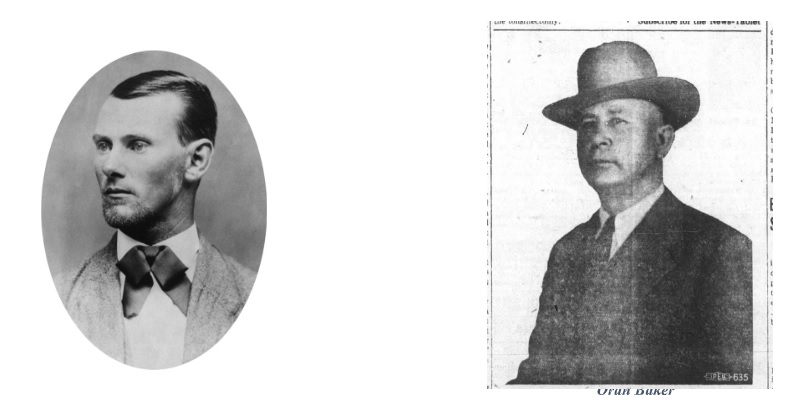
Portrait of Abel W. Landers, Hood County's first county judge and one of the founders of Granbury, Texas.

Editor’s Note: Abel W. Landers is often remembered simply as Hood County’s first county judge. Yet his influence reached far beyond the courtroom. Drawing upon years of research, this article explores the remarkable life of a pioneer whose leadership helped shape the founding of Granbury and the future of Hood County.

I want to tell you about Abel W. Landers. I mean, I really, really do. For me, it’s almost personal. Twenty years ago, when I set out to write a novel about the Nutt brothers and the beginnings of Granbury, I had in my mind this older uncle, who was getting on in years, who came with them Texas and kind of hung around like some honorary grandfather on the periphery of events. Then, I read an article by one of his descendants and amended that to cantankerous honorary grandfather. Then I read T. H. Ewells “account” and amended it to ornery, eccentric and cantankerous…but still basically a “minor” character. Then, I got into serious research about the background and span of this man’s life, and he reached across and through the mists of time and grabbed me by the collar, got in my face, and said “Missy, I may be a lot of things, and you can be right up front about all of’em. But I am not, nor will I ever be ‘a MINOR character’!”

Twenty plus years, five books, and hundreds of hours of research later I am absolutely convinced that the people of Granbury and Hood County owe more of who we have been and who we are to this one man than to any other single human who ever walked the tops of these limestone bluffs or gazed across the majesty of valley of the “River of the Arms of God.” Abel Landers got that eccentric, cantankerous caricature label from a single paragraph mention in T. H. Ewell’s 1895 History of Hood County. Writing twenty plus years after Landers’ death, Ewell basically dismisses Landers’ almost twenty years of leadership during the formation of the community that became Granbury, and portrays his tenure as our first county judge as that of a legal hack. One has to wonder what axe Ewell had to grind – or if he even bothered to research the background and actual history of this man whose career and contributions he made such light of for the sake of an entertaining story.

This is not to say that Abel Landers was of docile character, or that he didn’t have a forceful personality, or even that he was above pushing hard and engaging in political hard ball in pursuing a course he believed to be right. But he was an honorable man, an educated and astute man, and was well-thought-of by those who truly knew him, and also- surprisingly- by those who only knew him by reputation. So how did this happen? And who was Abel Landers, really? What can we know about someone who lived so long ago, from what records remain of the sum of his life? I’ve read those records, everything I can find. My journey has taken me from Kentucky and Tennessee westward to Missouri and finally onward here to Texas. And what I have found is the story of a man of remarkable character, who still – across all these years – comes to us as a REAL human being.

Abel Landers was born in 1796 in Warren County, Kentucky, where his father Christopher had received a land grant. Both of his parents were descended from very successful, landed colonial families, his father from a Norman British family whose name was originally spelled Landis, and his mother Phoebe from the famed Lee’s of Virginia. His parents had met and married in North Carolina, in 1793 and moved to Kentucky sometime prior to his birth. Born only 4 years after their marriage, he was nonetheless their third child, being proceeded by two older brothers. Sometime after the turn of the century, Abel’s father acquired by grant a larger amount of land in Bedford County, Tennessee, and the family moved there to what would be his parent’s permanent home. It was there that destiny began its work. Young Abel met and forged friendships with two other boys there, David G. Nutt – another son of a family with deep North Carolina roots, and Amon Bond – son of a young Quaker couple from Baltimore, Maryland. These three lads were of an age, all born within eighteen months of each other, and all of their fathers owned and farmed the land. They all grew up with a growing appreciation of the prosperity that the land, properly nurtured could bring. They watched and listened as young teens to the men around them plan and dream as they built the nearby county seat town of Shelbyville – the place that became one of the first in the new nation to build a prosperous business district on a plan that became known as “the Shelbyville model” – a central town square with the courthouse and seat of government at the center, surrounded on four sides by a block of retail and service businesses facing inward, surrounded by blocks of residences, parks, churches, and schools – the model that became the blueprint for a nation.

These three young men listened well, and observed much, including the differences between their families. While they shared much in common, one large difference was the Quaker faith practiced by Amon Bond’s family. While all three sprung from devout, church-going folk, the Quakers stood out in that Tennessee of so long ago, not just in their language and their dress, but in another very important way- they didn’t believe in slavery. And the records show that example apparently spoke not only to the conscience of young Amon Bond, but to his friends Abel Landers and David Nutt as well. Upon reaching adulthood, the three young men worked as laborers for their fathers, apparently earning a stake- a startup of land for themselves. Each one shows no record at any point in their lives, from that beginning forward, of ever owning slaves for labor.

Amon shows no record of ever owning slaves in his lifetime. Abel and David both inherited a small number of slaves from their fathers as part of their inheritance. Both were young married men at the time, with land and families. Abel had apparently also done some study of the law, and had begun to do some legal work, mostly for family members, dealing with estate matters. But he was keenly aware of the legal ramifications of his and David’s situations. It would do no good for them to free their slaves in Tennessee, since Tennessee law did not recognize emancipation. Even a former slave with signed and witnessed emancipation papers could be picked up at will by anyone and declared property by that person. Also, it was illegal for slaves in Tennessee to be taught to read, write or cypher. To release the people in their care under those circumstances would be tantamount a sentence of death, or imprisonment, or both.

Correspondence with his wife Sally’s Shipman relations in the new state of Missouri provided Abel and his now brother-in-law David Nutt the answer they needed. Emancipation was legal and honored by the law in Missouri. Quietly, Abel saw to it that the slave families he and David had inherited (plus another orphaned black child he purchased apparently on impulse to keep her from being sold into a lifetime of captivity) were educated and taught job skills to equip them for freedom. In 1837 emancipation papers were signed and the two men sold their land, gathered their families and worldly goods, and struck out via covered wagon almost 500 miles across the Ozark mountains to the newly forming settlement of Neosho Missouri. Their newly freed slaves traveled there as well. Abel gave each of them, his and David’s slaves alike, $35 (a sizable sum back then) in start-up money. Both white and black members of the party purchased land and set up farms in the area, worked by all of them and several of their now grown or teen-aged sons and daughters.

Abel also began doing legal work, and soon became active in community affairs. In the latter, it is apparent that he quickly brought insights and information from his Shelbyville observations that impressed his fellow citizens. In 1838, his new hometown of Neosho, situated on Hickory Creek, was named county seat of the new county of Newton, and Abel’s input was apparently valued. In 1839, he was appointed to the independent commission that selected the site for and made the initial plans for the county seat of the newly forming Barry County, Missouri. The city of Carthage was established on the banks of the Spring River in the new Barry County, and remains the county seat today. In 1841, another county, Jasper, was forming, and once again Abel Landers was chosen as one of the commissioners who would choose a site and do the initial planning. The town of Cassville was placed on the banks of a small spring fed creek known as the Roaring River whose origins have only recently been traced to deep within an Ozark mountain cave system, miles away.

In addition to serving on these planning commissions, Abel also served during these early Missouri years as a tax assessor and Justice of the Peace. Then in 1842 he ran for state office and won. He was elected to three terms as a member of the Missouri State House of Representatives and served one term in the Missouri State Senate. In a total of 8 years out of the next ten he worked as a moderate in the Missouri Legislature. A supporter of an end to the expansion of slavery and a gradual end to slavery nationwide, he worked with Senator Benton and others to rally support to that end, often treading a fine line with some of the slaveholders in his home district. Seeing the tide turning toward war with the passing by Congress of the Missouri compromise in 1854, he chose not to seek another term in the Missouri Senate.

About this time, Amon Bond and his family, also seeing the tides of war rising, decided to head for the frontier lands of far-removed Texas. Amon invited his old friends to join the adventure. There was land for the taking, and Amon’s son Ed had already procured a start, a grant on the west bank of a river known as “El Rio de los Brazos de Dios” – The River of the Arms of God. The free land beckoned, and the fact that Abel knew of a certainty of Texas governor Sam Houston’s staunch opposition to secession gave hope of a war to be avoided. Over the next few years the majority of the Nutt and Landers family members came to agree that removal to Texas was the right thing to do. A quick mass exodus was delayed by illnesses, tragedies, marriages, births, and business concerns. But in the spring of 1856 Amon came back to Neosho to lead the first small group to Texas. Abel’s relative Logan Landers and his family, Abel’s daughter Elizabeth and her husband, Jesse Nutt- one of the blind brothers, and Abel’s middle son Henry went with this small group. Their plan – to get land claimed and cabins built for a much larger party to follow in a couple of years.

The advance party arrived in Texas and wrote back to Abel with glowing reports. But he was getting on in years and his wife, Sally was in fragile health. The unsettled times made the selling off of property a challenge for both him and David. But finally, in the spring of 1858, a long line of wagons rolled through the Neosho square. The Landers and Nutts and many kinfolk and friends were pulling up stakes one last time and were “gone to Texas”! Upon arrival, Abel, Amon, and Jesse Nutt quickly became leaders of the fledgling little community on the banks of the Brazos, known as Stockton Bend.

The first years were incredibly hard. The hardships of the frontier proved too much for Abel’s beloved Sally, who died in January 1859. 18 months later secession and war came in deadly earnest. The Confederacy instituted the first military draft ever invoked on American soil, and most of the young men, except for the blind Jesse and Jacob Nutt were caught up in it. All told, Amon, Abel, and David sent nine sons off to fight in a war for a cause they didn’t support. Only five of those sons came home.

During the war, Abel Landers worked tirelessly with Johnson county officials to be sure that war widows and orphans in the western areas of the county received the assistance they needed. Beginning with the hotly contested elections in 1860, he led local efforts to ensure universal voter registration of all eligible voters and free and open access to the polls for same. He had a reputation for finding common sense solutions to sticky problems and was already looking forward to the coming end of the conflict, when he knew that population increases, and distance would probably lead to the formation of a new western county. At an age when most men, including his friends David and Amon were content to retire and leave the hard work of governing to the younger generation, Abel brought a depth of experience and expertise to “growing a new place” that was badly needed during those early years, when so many of the young and middle-aged men had been lost too soon. To illustrate – the sparsely populated Johnson county had sent over 600 men off to war. Almost 300 of those men did not return.

The post-war shenanigans involved in the formation of Hood county are described in several local history books. Nowhere were the political maneuverings of various factions more complex than those regarding location of the county seat. Citing his experience and reputation for honorable and moderate politics, Abel – a local man – was elected county judge and head official in the new county in 1866 and this was approved by the reconstruction government. That approval was not always readily given in those times and the people of Hood county knew it and breathed a sigh of relief. But there were no less than five locations vying to be the site of the new county seat. Even today, resentments and might have beens pop up in conversation. There was and is talk that Abel blocked due process, and refused to validate elections etc. The pure unvarnished truth when one looks at the situation objectively is this – First, this was not Abel’s first rodeo, it was his fourth – fifth if you count his original observations in Shelbyville. He knew better than anyone the requirements, both by law and logistics, for a new county seat.

The contenders were Glen Rose Mills, Acton, Thorp Spring, Lambert Branch, and a foothill at the base of Comanche Peak known as “the Center” (as it was literally the geographic center of the county). State law required only two things, that the county seat be named Granbury, and that it be located within 6 miles of the geographic center of the county. Two of the contenders, the two oldest settlements- Acton and Glen Rose did not fall into that 6-mile requirement. Other logistical requirements included an adequate and readily available and easily defended water source, and adequate space for expansion over decades. The “Center” was too far from the river for it to be a viable water source, and todays residents of the area can testify to the inadequacies of its ground water situation. That brought realistic consideration down to Thorp Spring and Lambert Branch.

At this point Thorp Spring had the larger population and a town already started. Lambert Branch had more open land and was located admittedly on Nutt, Landers and Bond family land holdings. But this writer believes that there were other factors that Abel’s experienced eye could see. One was that Lambert Branch would be a fresh start, and an open community. The other was its location on the high point above the river with a ferry crossing and potential bridge location at each end. When election failed to resolve the issue in a manner he felt was satisfactory (they kept choosing the Center (that hill where Lakeside Baptist Church stands today), with its inadequate water situation. Abel did the same thing his predecessors in Missouri had done – he persuaded the county commissioners to appoint an independent commission of men from outside the county and those gentlemen looked at all the factors and chose Lambert Branch. And the rest as they say, is history.

Abel was also instrumental in guiding the young county and its property owners through the beginnings of an almost twenty-year long legal battle with Milam County over ownership of School Lands located in Hood County. Abel was instrumental in retaining the respected and highly qualified A. J. Hood of Parker County as legal counsel for both individual defendants and the county in the matter. In the years from 1868 to 1872, his personal dialogue with Representative William Henry Sinclair, who became Speaker of the Texas House in 1871, obtained much needed State intervention in the matter to provide, at least for a time, the stability the new county needed to grow.

Abel was now past 70 years old, a long life in those times. Although he resigned as judge in mid-1869 in protest over a disqualification of duly elected commissioners by the Reconstruction Government, in his final years he oversaw the layout of the plats and lots, working with men he had raised up to understand and share his vision. Prior to his death in May, 1873 he witnessed the beginnings- those first wooden buildings going up, that first stone courthouse being built, all on lots in a quadrangle atop bluffs of limestone, overlooking the River of the Arms of the God he loved so well – his final gift and legacy to us and to the ages – our town, Granbury, on the Brazos.

“The towns that Abel built….”

Carthage, Barry County, Missouri

Cassville, Jasper County, Missouri

Neosho, Newton County, Missouri

Granbury, Hood County, Texas

Until next week,

Melinda Ray

Festival Parades from Days Gone By: Granbury’s Texas Independence Day & San Jacinto Celebrations (1923–1924)

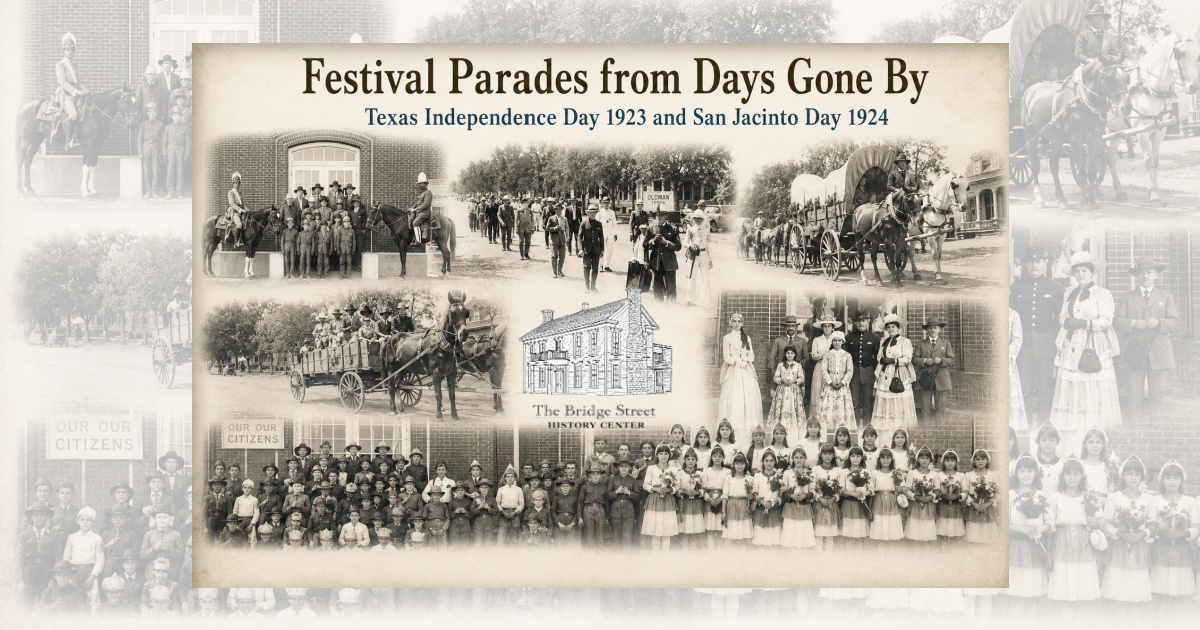
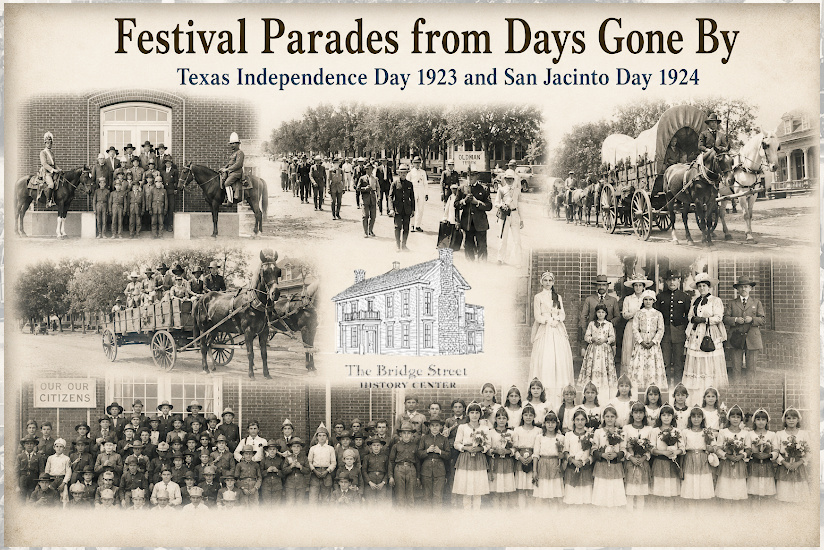
Historic collage of Granbury's 1923 Texas Independence Day and 1924 San Jacinto Day festival parades featuring schoolchildren, horse-drawn wagons, period costumes, and community celebrations around the Granbury Square.

Featuring Photos From:
Texas Independence Day 1923 and San Jacinto Day 1924

Well folks, if you didn’t know it already, let me share something with you! GRANBURY HAS ALWAYS KNOWN HOW TO THROW A PARADE!!! As we gather for the year’s July 4th Parade and festivities around the Granbury, it seems a good time to share these photos I collected of past festivities during my years of research and working with the good folks at the old Hood County Jail Museum. Join me in visualizing a couple of Granbury Festivals of years gone by! We’ll have a blast! Like most of our festivals today, these were duly reported in the local newspapers and the folks who were in charge took lots of pictures! So, come with me, as we go down to the Square to wander around 1923 and 1924 to catch some glimpse of the celebrations on TEXAS INDEPENDENCE DAY and SAN JACINTO DAY!

On both March 2, 1923, and April 21, 1924 – It is a fine spring day on one of the state public holiday when we celebrate Texas winning her War for Independence from Mexico! As always in Granbury, the parade is set to come right down Pearl Street from the school to the square, make that turn up Crockett, and then left on Bridge right back down to the schoolhouse! We’ve got the perfect seats right here in front of the Nutt Hotel! Uncle Henry Nutt and his wife, Aunt Euna, have made us welcome, as citizens from all over Hood County crowd the limestone sidewalks! Many are jostling to get a good view of their children and classmates!

All of the schools in Hood County have signed up to participate in the parade! Assisted by their teachers and the ladies of the Granbury Parent Teacher Organization, the children have constructed an extravaganza to honor 100 years of Texas History! This Pageant of Texas is designed to give the children and all of us a greater appreciation of the wonderful history of our state! If you look at your program you will see the names of the various children and adults involved in each part of the celebration.

“Oh, look here they come now!!!” The parade is led by three pupils portraying OLD MAN TEXAS, accompanied by the ladies PROSPERITY and OPTIMISM! And following them are the six wonderful floats! Oh, look, all the children are in costumes and so are the adults, all depicting a special part of Texas history. At each school, all the students helped with researching the proper costumes and the details that needed to be shown on each float! Oh, my goodness, there is Frank Gaston, that fellow who owns the Granbury News!! Let’s look over his shoulder and see what he has to say about this scene!

“Our teachers, pupils, and the ladies of the Parent-Teacher Association have reason to feel proud of the success of the historical pageant… celebrating San Jacinto Day. We are glad to say the program was carried out exactly as advertised and in every feature was far better than the public expected! In six episodes of Texas history the costuming was historically correct, older people in the audience recognizing the true representations of costumes and manner of life in some of the episodes, especially those of the Confederacy. In this latter was a unique feature, the slave section being represented by Barney Hightower and Aunt Judy Anderson, two ex-slaves, with a number of children from the negro school, in an old-fashioned wagon and riding on a bale of cotton.

Other features were also specially attractive, and none more so than the pioneers, with the old moving wagon, even with the cow being led behind, the young ladies representing the red, white and blue, those representing the colonies and the states of the union, the boy scouts, the future citizens, and especially the little tots representing the Texas state flower, ‘The Blue Bonnet’. The individual characters listed in the program were also well represented in their costumes and actions. The parade consumed nearly an hour, being well timed so as to give the best effect, and upon returning to the school building there was a program of splendid talks, with some music and readings, all in harmony with the great historical occasion. To carry out such a program required much study of detail and all connected therewith have reason to feel a just pride in its universally pronounced success!”

PRESENT DAY — Wow, that just about says it all! It was so much fun seeing all the pictures of the children and adults involved! So many of the children became leaders in our community in the years to come. But, the truly remarkable thing about this moment in Granbury history is the shining example of its inclusiveness. In a day when segregation, Jim Crow, and the KKK were tearing nearby communities apart, in Granbury the people, young and old alike, of all colors, joined together for a day-long celebration of our common history.

The newspaper account goes on to tell in detail about the program and how ALL of the people gathered to share a meal and see the program put on by students from ALL of the schools! A point was made to show the spirit of community and fun shared by all, with anecdotes of highlights of contributions from every part of the county! The mere fact, preserved in print, of this celebration reminds us of just what a remarkable community Granbury/Hood County has always been! “Where Texas History Lives” is our motto and, when we look to our past, we are blessed to have the example set by the folks from “around here” back in those days. It’s so remarkable that they were already celebrating that history, even in those bygone days of just over 100 years ago! The tradition lives on!

CLICK TO ENLARGE.

Collage Caption: A collage of pictures showing some of the time period groups from each year. Featured here are: Indian Era – 1924, Texas War for Independence – 1923, Pioneers 1923, Slavery – 1923, Civil War -1924, Citizens of the Future – Boys and Girls – 1924

The Bon Ton – Early Eatery Brings Twenty Years of Good Eats

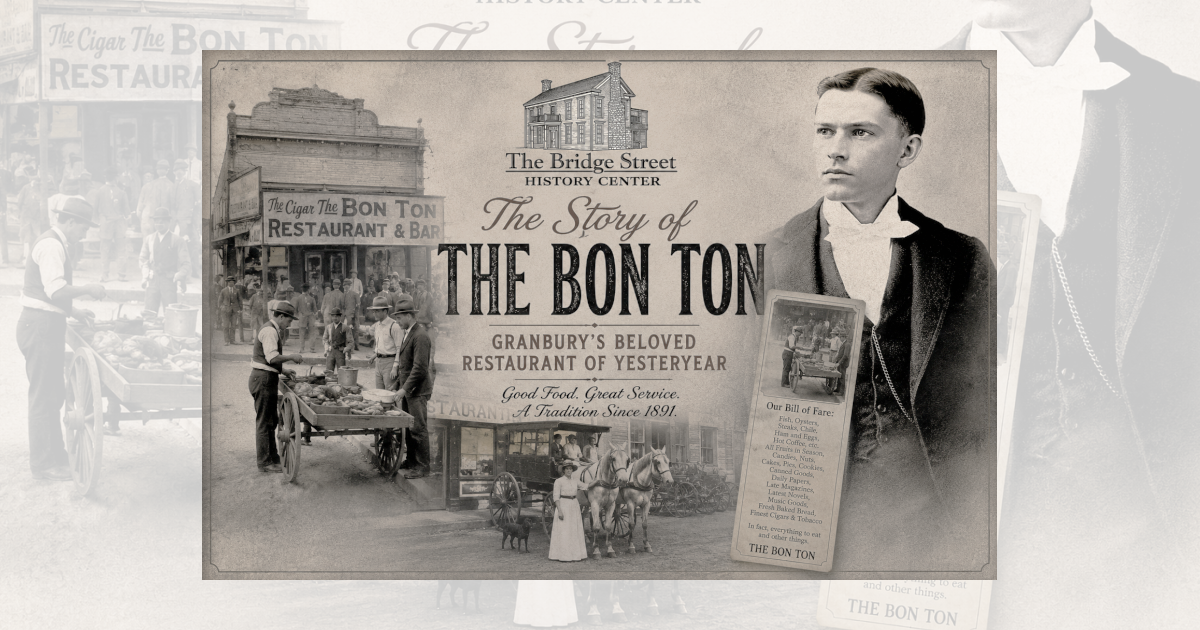
Historic collage featuring The Bon Ton Restaurant on the Granbury Square, founder Ralph Bowden, and vintage scenes from downtown Granbury, Texas.


In 1891 Granbury businessman Ralph Bowden decided to open an eatery on the Granbury Square. His new restaurant would not be the first on the Granbury Square, but it would become one of the longest lasting in those early days. The Bon Ton Eatery opened on the west side of the square in the building that now houses another business that offers great food and drink in a unique atmosphere — The Silver Saddle Saloon! The new eating establishment joined a hodgepodge of eating choices available to the early citizens of our community.

Several small establishments known as lunch stands were operating in the spices around the downtown area. Also, several of the saloons had opened lunch counters as well. But The Bon Ton set out to be a real full-service restaurant. The Granbury citizens took note and a twenty- plus year love affair began. The Bon Ton offered a wide variety of cuisine, including the apparent culinary obsession of the time, fresh fish and oysters! This was apparently a big deal – as almost every eating place in town boasted about their fish and oysters in their weekly newspaper ads. The Bon Ton also mentions steak, ham and eggs, sandwiches, fresh fruit in season, canned goods, and fresh bread as part of their daily offerings.

Also, on the menu are listed a wide variety of desserts- including cakes, pies, cookies, and a whole confectionery shop full of candy! Apparently, the desserts were a hit. In one local paper there is an ad soliciting 500 eggs. The restaurant offered cash payment in the ad to any local persons with eggs for sale! It should be noted that one could make a good living in those days selling eggs, milk, and butter to local restaurants and grocery stores.

Coffee, tea, and cigars rounded out the menu but that wasn’t all one could get at this very special eatery. In the offering of customer service, the Bon Ton apparently was the forerunner of the modern-day Starbucks! In addition to all the food they also sold newspapers, magazines, and the latest novels!

Mr. Bowden owned the Bon Ton for almost fifteen years, all the while running several other businesses on the side. Around 1895 he announced that the restaurant would begin serving evening meals as well as lunch. Even today, that is a lot of hours for a restaurant to be open each day, and one has to wonder how Mr. Bowden did it all.

In 1903 he purchased the local phone company and decided to sell his restaurant business in order to devote all his time to expanding local phone service. The Bon Ton was sold to two young men, Rochelle Daniel and Henry Williams. They continued to operate the restaurant for several more years. Apparently, Mr. Bowden kept his interest in the confectionery end of the business, as he and his wife were still running a candy store on the Square as late as the 1940’s.

Today, the Silver Saddle Saloon occupies the Bon Ton’s old home on the west side of the Granbury Square! It is part of a thriving Culinary District that continues the tradition of good food and beverages along with good service that began over a century ago with those tiny lunch stands and The Bon Ton. Through the years we’ve seen long time favorites like the Nutt House Dining Room and the Merry Heart Tearoom and Rinky Tinks become part of the fabric of the community in their day. We’ve even had a famous chef or two among us, such as Grady Spears. Be sure to go downtown and check out the menus! — You’ll be sure to find some great folks continuing those traditions of down-home good times, great beverages and wonderful food, right here – on the Granbury Square!

Captured But Never Defeated: The Incredible Story of Josephine Cavasos Barnard

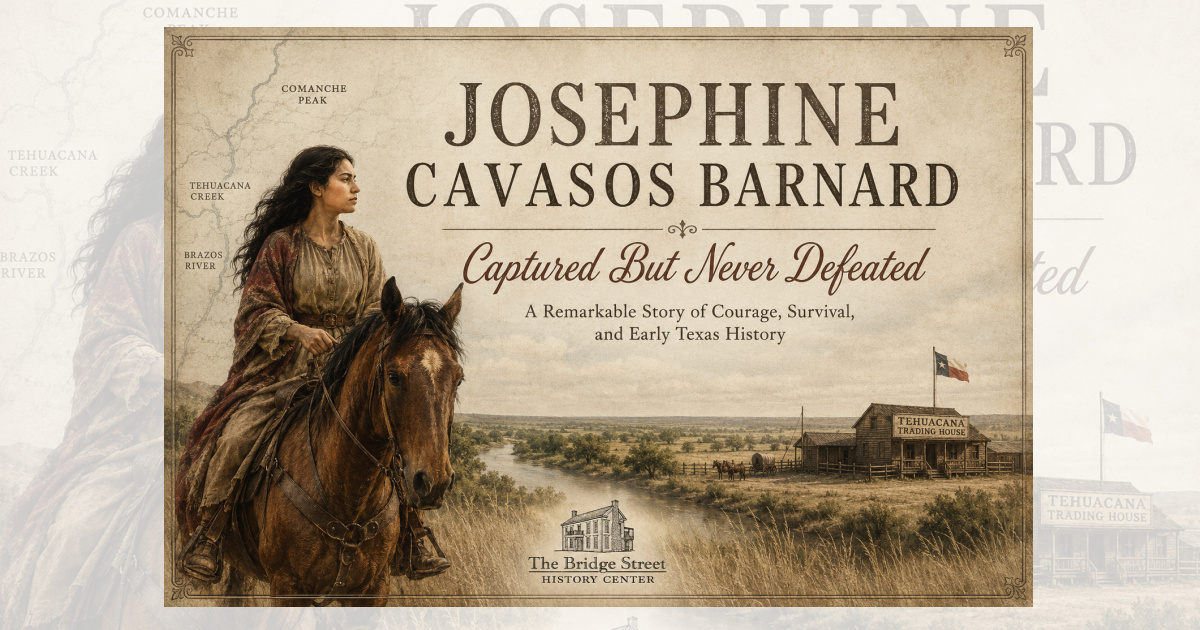
Josephine Cavasos Barnard on horseback, a survivor of Comanche captivity who became a pioneering settler in Hood County, Texas.


Josephine Cavasos Barnard – Captured But Never Defeated – PART ONE

This is the story of Josephine Cavasos Barnard, who was wrenched from all she knew and suffered abuse and great trauma, before being rescued – by the man she would go on to build a life with. Josephine (or Juana, as she was called by many) and her husband Charles Barnard were among the earliest settlers in the area that now straddles the line between Hood and Somervell Counties. .Many don’t know that area was within the original boundaries of Hood County when it was established in 1866. But Juana’s story begins many years before… in a time long before Texas was even a State.

Josephine Maria Cavasos was born June 24, 1824, in the Canary Islands of Spanish-Italian ancestry. Her parents, Juan Jose and his wife, migrated from there to Matamoros, Mexico because his father, Don Narciso Cavasos, had received l06 leagues of land or 601,657 acres from the King of Spain. This was the largest land grant ever made in the New World and later part of it became part of what is now northern Mexico and south Texas.

In August 1842 Josephine was 18 years old. Texas was still part of Mexico then and friends and relatives passed freely back and forth across the Rio Grande. Josephine was great friends with a girl named Mary Alice whose family lived on the north side of that great river. As was the custom in those days, visits lasted days or even weeks. So, Josephine went to spend a few days visiting with her friend. While she was there, a band of Comanche attacked the house. Chaos ensued. Josephine ran from the house as the thunder of hoof beats filled the air. She hid in the woods nearby, but was found by a young Indian brave, who grabbed her by the hair and slung her across the horse in front of him. Over the course of the next few hours she saw him kill a mother and baby with his tomahawk and endured many miles of travel over rough terrain. Every moment she feared a downswing of the tomahawk that would end her life. Finally, they stopped at a dry creek, where she was thrown to the ground and tied to a tree. As night fell, Josephine heard sobs and cries from nearby. She recognized the voice as that of her friend, Mary Alice. She struggled against her bonds and called out to her friend. She received a fist in the face for her trouble.

This was the beginning of a harrowing nightmare of years of captivity. The band of Comanche first stayed in the area of south Texas and tortured the girls, trying to get them to tell them the location of the largest horse ranches in the area. Fearing for their fellow settlers, the girls at first refused, but later, in desperation, concocted a story hoping to lead the Indians astray. The raiding party returned, empty handed and furious. The girls were badly beaten. Mary Alice cried and begged for mercy and Josephine was made to watch as she was brutally killed.

In defiance, Josephine glared through her tears as a brave approached her, knife at ready. “Go ahead, do it!” she hissed.

Startled by her courage, he stopped, placed his hand over her heart, and said, “Brave, like Comanche! No kill!”

Alone now, Josephine was determined to survive and escape. As the Indian band turned north, she was tied each day to the horse she rode but was allowed to swim when water was available. She had experienced and seen horrific brutality, yet she was never brutalized again. She was befriended by one of the old women of the tribe and from her learned to live as the Indians did. She learned to cook and eat their food and how to soften skins for clothing. Other women joined in to teach her about herbal medicine, how to speak Comanche, and how to wash with soapwort.

Winter that year was spent on the Guadalupe River. A family trying to pass through was captured. The family was killed, except for a small boy. The Indians entertained themselves by holding the child’s bare feet in the flames. Josephine, unable to stand it, burst past the laughing Indians and snatched the boy. The Old One who had befriended her motioned that she come and bring the boy to her teepee. She not only dressed the child’s feet but salvaged some food for them. She told Josephine that she had insulted the Indians and she and the child were to be abandoned to starve. The next morning all the other Indians were gone and Josephine and the child were alone. After some period of days, the Indians returned; but the child was dead and Josephine was near death. Again, the Old One adopted her and nursed her back to health.

For most of the next two years Josephine lived with the Comanche. She was expected to work hard, but was allowed freedom to swim, shoot, and ride wild mustangs. She became so skillful at breaking horses that some of the braves became jealous. Because she understood Comanche, she learned of a trading post on Tehuacana Creek that treated the white man and red man the same.

George Barnard had established trading posts near Marlin Falls and Tehuacana. His brother, Charles, had come from New York to join him in the venture in Texas. They had made friends with Sam Houston and were well known for their business and trade with both Indians and white settlers at all their establishments. It was said by 1845 that relations with the Indians were so bad that settlers hardly slept except in the areas where the Barnards and their associates, the Torreys, had established a relationship with the Comanche.

On February 7, 1846, at Comanche Peak, the federal agents had called for a powwow. The Indians accepted many gifts and exchanged some polite talk, but the treaty with the Indians did not materialize. Instead, another meeting in May at Tehuacana Trading House was set.

By April, Indians were gathering on Tehuacana and Trading House creeks. All the Indians, including the women and children, attended, but Josephine was left in a canyon 20 miles away to tend The Old One — the woman who had protected her. Despite Josephine’s best effort, she died. When this happened, Josephine was taken to join the others. One of the activities was a sort of rodeo with each tribe entering its best riders. The ponies were wild; but one in particular had never been ridden. On the second day, Josephine leaped past her watchers and ran to the wild one. Grabbing its hackamore, she leaped aboard and rode the wild mustang until it was exhausted.

Charles Barnard was watching. He realized that this was not an Indian. As she leaped from the tamed horse, the tribe circled round Josephine, preventing anyone from approaching her. But she had seen Charles. As she was led away she was able to send a look which was unmistakably a cry for help.

End of PART ONE.

Josephine Cavasos Barnard – Captured But Never Defeated – PART TWO

This is the story of Josephine Cavasos Barnard, who was wrenched from all she knew and suffered abuse and great trauma, before being rescued – by the man she would go on to build a life with. Josephine (or Juana, as she was called by many) and her husband Charles Barnard were among the earliest settlers in the area that now straddles the line between Hood and Somervell Counties. .Many don’t know that area was within the original boundaries of Hood County when it was established in 1866. But Juana’s story begins many years before… in a time long before Texas was even a State.

Charles and George Barnard quickly came up with a plan and tried to bargain for the girl they had seen with the Indians at their Trading Post, but at that time she was not for ransom. A treaty was signed May 16, 1846, for a definite line some distance west of the westernmost settlements. Indians were to stay west; settlers were to stay east. During these negotiations, Josephine was nowhere to be seen. Just as the Indians were preparing to leave, she was taken to the trading house. There Charles and George Barnard were behind the counter with the chief and tribal leaders on the other side. The counter was covered with piles of blankets, knives, beads, flour, and sugar. Negotiations began. George was the bargainer. The Indians were very demanding. Each time the Chief would shake his head, George would nod and Charles would add to the pile. At last the chief grunted and left with his men carrying the bounty, leaving Josephine free for the first time in over three years.

Josephine was placed under the care of an Irish lady named Katy. Charles Barnard became a regular visitor at Katy’s home, and romance quickly blossomed between Josephine and her rescuer. But the decision to marry him was made difficult because of the life he had planned. He wanted her to go with him to establish a new trading post far up the Brazos River to the north in the shadow of the mesa called Comanche Peak where the tribes had gathered the year before. She would be the only white woman in the remote area. In 1847, Charles left to go start building the new post, while Josephine pondered her decision.

Love won out over fear and she and Charles were married in October of 1848. While the construction of the post continued, Josephine and Charles began married life with his traveling between his new post on the Brazos, and George’s post in central Texas. In August,1849, their daughter Maria was born. Shortly afterward, she and her mother joined her father on the Texas frontier. Josephine and Charles began their long life together in the log and limestone house on the banks of the Brazos in what is now southern Hood County. Their second child, John, was born the next year. He was the first child born to white settlers in the area. Throughout their marriage, Charles and Josephine were devoted to each other. He always allowed her the freedom to indulge her need for open spaces and ride fast horses. She bore him fourteen children, but in the way of those days – only four lived to adulthood.

In 1851, friendly Indians settled in a village across the creek from the trading post. They farmed, hunted, and were peaceful and enjoyed horse racing gatherings with Charles and Josephine and other folks passing through. There were no schools in the territory, so Charles (a Harvard graduate) tutored the Indian children right along with his own. Later they attended the Acton Institute and then Baylor College in Waco. The Acton Institute was housed on the ground floor of the 19 Acton Masonic Lodge, of which Charles was a charter member. That building also doubled as a church meeting house for the various denominations in the Acton community. After many years of neglect, it was restored in the 1970s and is now the chapel of Good Shepherd Anglican Church.

In 1854 the Indians were removed to the reservation at Fort Belknap. Prior to that time it was common for the Commanche to come to Josephine for medical help, as her skills in that realm were remembered by their people. At one point, three Comanche brought a sick child to Josephine. She recognized him as a Mexican child, deathly sick with pneumonia. After nursing him back to health, she and Charles raised Ambrosio Hernandez and treated him as their own for the rest of his life.

At the age of 37, with his work with the Indians finished, Charles built a mill on the Paluxy River. Known as Barnard’s Mill, it took four years to build and cost $30,000.00. One winter afternoon at the mill, Josephine recognized the voice of Capt. Sullivan Ross, a friend who was a Texas Ranger. He and his men had captured a white woman with a baby who was a captive of the Comanche. The only thing they could learn from her was that she was Peta Nacona’s widow. Cynthia Ann Parker finally allowed herself and the baby to be bathed and accepted some clean clothing. When she left, she told Josephine, speaking for the first time in English, “You are kind, and I thank you.”

The mill was sold some years later to T. C. Jordan who changed the name to Glen Rose.

Near the trading post there was a shallow, stone-paved crossing on the Brazos where thousands crossed on the Chisholm Trail. In 1870, a large herd came from South Texas on the way to Fort Dodge, Kansas. The trail boss learned that the Brazos was on the rise and did not want to lose even a day. After the river became fordable, he went across to the trading post to thank Charles for giving them permission to camp. When Charles went out to greet the trail boss, Josephine heard him speak and recognized the voice of her twin brother. She screamed, “That’s Juan! That’s my brother!” At that Juan leaped for the porch and a 28-year-long separation had ended. In 1872, he bought land from Charles and came to live nearby.

During her many years in what is now southern Hood County and northern Somervell County Juana became known for her excellent midwifing skills. Taught her skills by the women of the Comanche, she saved the lives of many women and children across the area, continuing to travel on horseback to care for women in childbirth. She was respected and treated with admiration for her skills, even by many of the medical doctors in the area.

Charles died June 23,1900 and is buried in the Barnard Cemetery which is now in the middle of land long used as a peanut field.

Josephine lived on and spent part of each day riding her horse, Pigeon. On February 1, 1906, Pigeon was led to the mounting block so that she could visit two of her sick friends. When she arrived home before sunset, she sat a moment on Pigeon looking across the fields toward the river she loved. About midnight she was heard moving around. When asked what was wrong, she replied that she needed to rub some white liniment on her head because it was hurting. As she was talking, Josephine stiffened and fell backward and was gone. She had met death as she had lived life — never giving up, never backing down — with the same bravery and determination that her Indian captors had seen in her all those years ago.