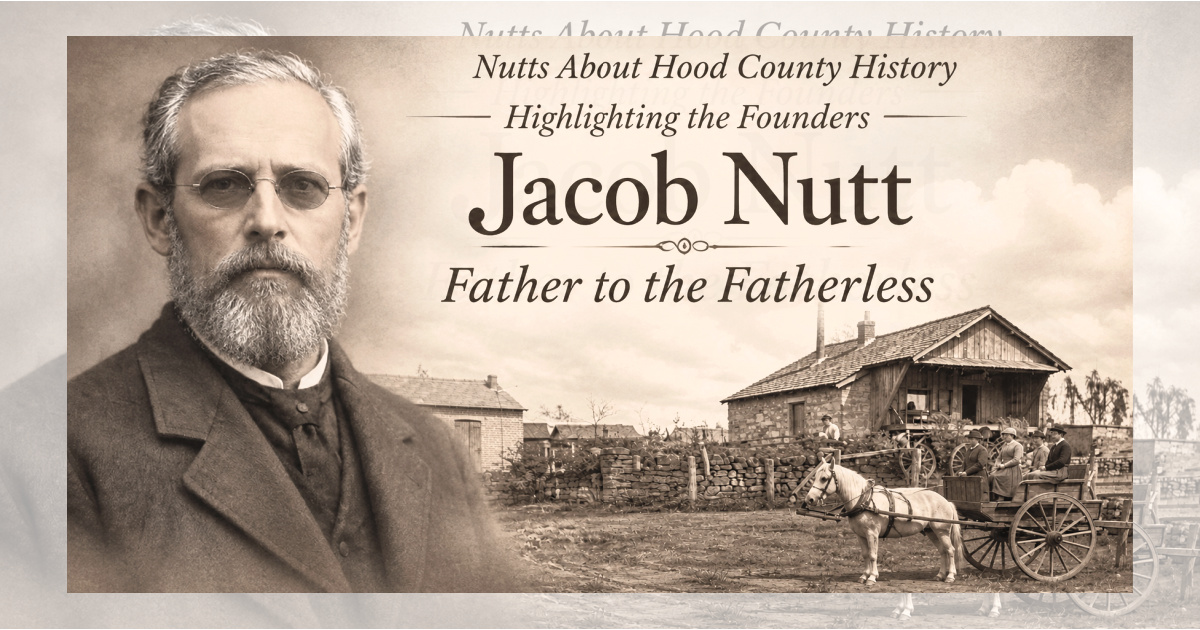
It was in the winter of 1854 that Jacob Nutt burst into his brother Jesse’s office with the report – Down on the waterfront, Neosho was burning. The two brothers joined others trying desperately to save the women and children caught in the path of the blaze – set by pre-Civil War rioting factions in the small city where they lived. Many children owed their lives to the brothers that day of tragedy, but the price was high. Both brothers were blinded for life and the course of their lives changed forever. The middle of the three Nutt Brothers involved in business and leadership in the early days of Granbury, Jacob was already a hero at a young age. But that was only the beginning. Still waters ran deep in the quietest most unassuming of the brothers, and his passionate defense of defenseless children continued throughout his life. He never married, having loved once and been rejected, but neither that experience nor his handicap deterred him from caring for those least able to care for themselves. Not only did he provide a home for his widowed mother in the house on his ranch near the Paluxy River, he also opened his doors and his heart to seven of his nieces and nephews who were orphaned at tender ages. The first children taken in by Uncle Jake were the five children left by his younger sister Susan. Susan first married her cousin Henry Landers during the early days of the Civil War. In spite of the war’s separations, Henry’s times home on leave produced two children to the couple before Henry was killed battle in the last months of horrible conflict. A few years after the war Susan married veteran Wray Hopping. Five years and three children later, Susan died in what may have been yet another childbirth. Wray Hopping had neither strength of body nor inclination of spirit to stick around and care for five children and shortly departed for California – alone. Jacob Nutt and his mother bundled up Susan’s five offspring and took them home. According to a book written by the youngest Hopping boy, Coke, Uncle Jake became a true father to all five children, not only providing food and shelter, but love, education, sage advice, and practical support through all their growing up years. George and Belinda Landers were practically grown when their mother died but lived with their Uncle Jake until their respective marriages. The Hopping children, Jesse, Flora, and Coke were ten, eight and five when they went to live with Jacob and his mother on the ranch in far western Hood county. The loving, Christian, caring but firm father described in Coke Hopping’s stories is a man not afraid to hold a crying child in his arms, who gives wise and caring advice to his youngsters, but does not abandon or condemn them for going their own way as they grow into adulthood. He provided for all opportunity for a quality education, and support enough to give them a start in life. He encouraged hard work and academic excellence but loved even when things went awry. A wonderful example of the wisdom and compassion shown by Jacob is remembered in Coke’s book. Coke has graduated from high school and is head over heels in love. He and his young lady want to get married, but Coke has no job and no place for them to live. Coke, knowing that Uncle Jake wants him to go to college, goes and asks permission to quit and get married. Jacob voices his concern about their youth and lack of skills and resources. So he strikes a deal with young Coke- go to college for a year, also work and earn and get experience part time and at the end of a year, if you are still of the same mind to marry, I will give you a stake to get started. Coke took his advice but did marry the next year. By that time he had acquired education and skills that led to lifetime careers in both law enforcement and ranching. George W. Landers became a prominent Granbury businessman. Belinda and Flora both married well and became leaders in the Granbury community. Coke Hopping became a sheriff and later worked for the famous Spade Ranch in far west Texas. Jesse Hopping, always delicate of health and afflicted with lung and vision problems from being born pre-mature, operated the first ice cream and candy shop on the Square in the west side of his uncles’ mercantile building (the Nutt Hotel), before his death at a young age from weak lungs. Abel Nutt, Jacob’s younger brother actually died a full year before their sister Susan. On a cold winter night, in December 1879, a family arrived at the ferry landing Abel operated on the Brazos River. They were trying to get home for Christmas. Normally Abel did not operate the ferry after dark because of the danger of hitting a sandbar in the river. Pity for the travelers’ plight caused him to make a fatal error in judgment. Despite the darkness, he agreed to take them across. When the ferry bounced against a hidden sandbar, Abel was thrown into the frigid waters. He did not drown but developed pneumonia and died days later in the first week of 1880. His widow, Indiana, remarried, and but a few years later, died, leaving Abel’s two daughters in the care of a stepfather who had no desire to care for them. So, Mattie and Ora Nutt also went to live with Uncle Jake. It is in his care for these two young women that Jacob Nutt truly went above and beyond. The girls were their father’s sole heirs, since they had no brothers. Abel Nutt had extensive land holdings at the time of his death. Much of that land had been purchased using at least partly, funds from their mother’s dowry. When Abel died, the girl’s maternal relatives tried to seize that land, claiming that since dowry funds had been used that the land belonged to them, not to Abel’s daughters. Jacob Nutt, overcoming all the obstacles that a blind man had to deal with – filed a lawsuit, which dragged on for ten years. But in the end, he saved his nieces’ birthright. They got their inheritance. They also got something else their uncle insisted upon- a college education. Jacob Nutt, along with his brothers Jesse and David, were staunch proponents of equal educational opportunity for girls- forward thinking almost unheard of in those days. Mattie Nutt and her sister Ora both attended Granbury College. Unfortunately, tragedy struck, as illness took the life of young Mattie- a gifted writer and painter. But Ora grew to adulthood and took possession of the inheritance her uncle had won for her. The land Ora handed down to her children and grandchildren stayed in the family until the late twentieth century and is now the development known as Abe’s Landing after her father Abel Nutt. In his later years, Jacob acted as grandpa and great-uncle to many children. Along the way, he was also quick to lend help to young people in the community who were struggling for one reason or another. It is fitting we remember the selfless devotion shown by this brave man, who, in spite of his own affliction, offered fatherly love and affection and support to so many young people. Jacob Nutt- A Father to the Fatherless is carved on his tombstone- a fitting tribute to this man by the men and women he helped to raise.

The Bridge Street History Center
"Bringing Our History to Life"