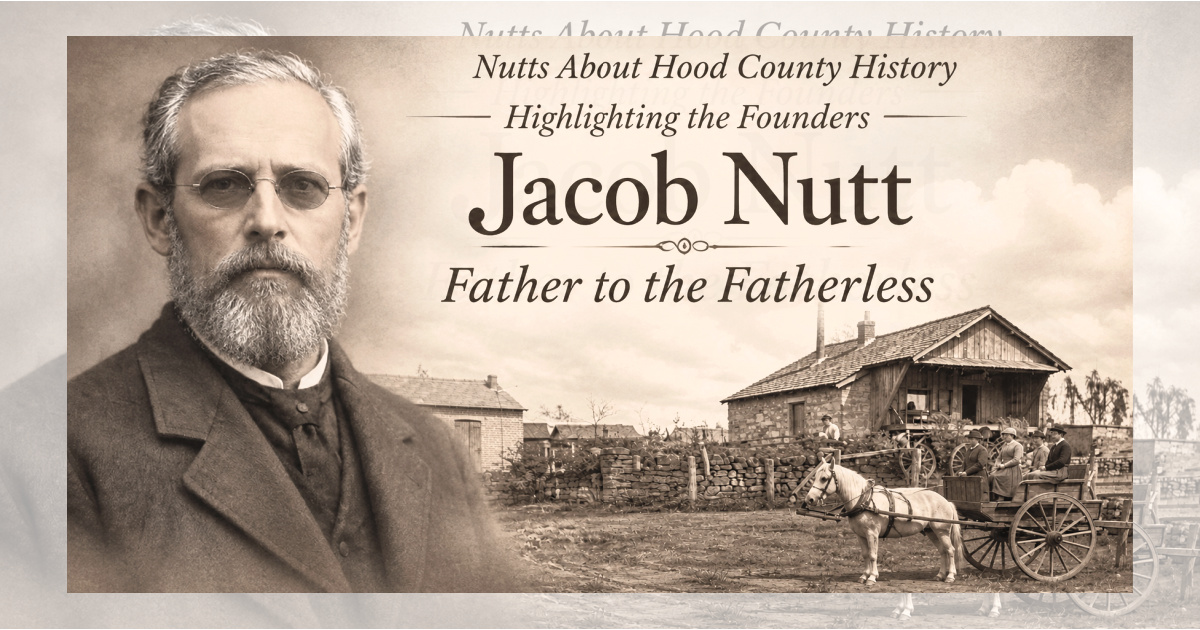
It was in the winter of 1854 that Jacob Nutt burst into his brother Jesse’s office with the report – Down on the waterfront, Neosho was burning. The two brothers joined others trying desperately to save the women and children caught in the path of the blaze – set by pre-Civil War rioting factions in the small city where they lived. Many children owed their lives to the brothers that day of tragedy, but the price was high. Both brothers were blinded for life and the course of their lives changed forever. The middle of the three Nutt Brothers involved in business and leadership in the early days of Granbury, Jacob was already a hero at a young age. But that was only the beginning. Still waters ran deep in the quietest most unassuming of the brothers, and his passionate defense of defenseless children continued throughout his life. He never married, having loved once and been rejected, but neither that experience nor his handicap deterred him from caring for those least able to care for themselves. Not only did he provide a home for his widowed mother in the house on his ranch near the Paluxy River, he also opened his doors and his heart to seven of his nieces and nephews who were orphaned at tender ages. The first children taken in by Uncle Jake were the five children left by his younger sister Susan. Susan first married her cousin Henry Landers during the early days of the Civil War. In spite of the war’s separations, Henry’s times home on leave produced two children to the couple before Henry was killed battle in the last months of horrible conflict. A few years after the war Susan married veteran Wray Hopping. Five years and three children later, Susan died in what may have been yet another childbirth. Wray Hopping had neither strength of body nor inclination of spirit to stick around and care for five children and shortly departed for California – alone. Jacob Nutt and his mother bundled up Susan’s five offspring and took them home. According to a book written by the youngest Hopping boy, Coke, Uncle Jake became a true father to all five children, not only providing food and shelter, but love, education, sage advice, and practical support through all their growing up years. George and Belinda Landers were practically grown when their mother died but lived with their Uncle Jake until their respective marriages. The Hopping children, Jesse, Flora, and Coke were ten, eight and five when they went to live with Jacob and his mother on the ranch in far western Hood county. The loving, Christian, caring but firm father described in Coke Hopping’s stories is a man not afraid to hold a crying child in his arms, who gives wise and caring advice to his youngsters, but does not abandon or condemn them for going their own way as they grow into adulthood. He provided for all opportunity for a quality education, and support enough to give them a start in life. He encouraged hard work and academic excellence but loved even when things went awry. A wonderful example of the wisdom and compassion shown by Jacob is remembered in Coke’s book. Coke has graduated from high school and is head over heels in love. He and his young lady want to get married, but Coke has no job and no place for them to live. Coke, knowing that Uncle Jake wants him to go to college, goes and asks permission to quit and get married. Jacob voices his concern about their youth and lack of skills and resources. So he strikes a deal with young Coke- go to college for a year, also work and earn and get experience part time and at the end of a year, if you are still of the same mind to marry, I will give you a stake to get started. Coke took his advice but did marry the next year. By that time he had acquired education and skills that led to lifetime careers in both law enforcement and ranching. George W. Landers became a prominent Granbury businessman. Belinda and Flora both married well and became leaders in the Granbury community. Coke Hopping became a sheriff and later worked for the famous Spade Ranch in far west Texas. Jesse Hopping, always delicate of health and afflicted with lung and vision problems from being born pre-mature, operated the first ice cream and candy shop on the Square in the west side of his uncles’ mercantile building (the Nutt Hotel), before his death at a young age from weak lungs. Abel Nutt, Jacob’s younger brother actually died a full year before their sister Susan. On a cold winter night, in December 1879, a family arrived at the ferry landing Abel operated on the Brazos River. They were trying to get home for Christmas. Normally Abel did not operate the ferry after dark because of the danger of hitting a sandbar in the river. Pity for the travelers’ plight caused him to make a fatal error in judgment. Despite the darkness, he agreed to take them across. When the ferry bounced against a hidden sandbar, Abel was thrown into the frigid waters. He did not drown but developed pneumonia and died days later in the first week of 1880. His widow, Indiana, remarried, and but a few years later, died, leaving Abel’s two daughters in the care of a stepfather who had no desire to care for them. So, Mattie and Ora Nutt also went to live with Uncle Jake. It is in his care for these two young women that Jacob Nutt truly went above and beyond. The girls were their father’s sole heirs, since they had no brothers. Abel Nutt had extensive land holdings at the time of his death. Much of that land had been purchased using at least partly, funds from their mother’s dowry. When Abel died, the girl’s maternal relatives tried to seize that land, claiming that since dowry funds had been used that the land belonged to them, not to Abel’s daughters. Jacob Nutt, overcoming all the obstacles that a blind man had to deal with – filed a lawsuit, which dragged on for ten years. But in the end, he saved his nieces’ birthright. They got their inheritance. They also got something else their uncle insisted upon- a college education. Jacob Nutt, along with his brothers Jesse and David, were staunch proponents of equal educational opportunity for girls- forward thinking almost unheard of in those days. Mattie Nutt and her sister Ora both attended Granbury College. Unfortunately, tragedy struck, as illness took the life of young Mattie- a gifted writer and painter. But Ora grew to adulthood and took possession of the inheritance her uncle had won for her. The land Ora handed down to her children and grandchildren stayed in the family until the late twentieth century and is now the development known as Abe’s Landing after her father Abel Nutt. In his later years, Jacob acted as grandpa and great-uncle to many children. Along the way, he was also quick to lend help to young people in the community who were struggling for one reason or another. It is fitting we remember the selfless devotion shown by this brave man, who, in spite of his own affliction, offered fatherly love and affection and support to so many young people. Jacob Nutt- A Father to the Fatherless is carved on his tombstone- a fitting tribute to this man by the men and women he helped to raise.
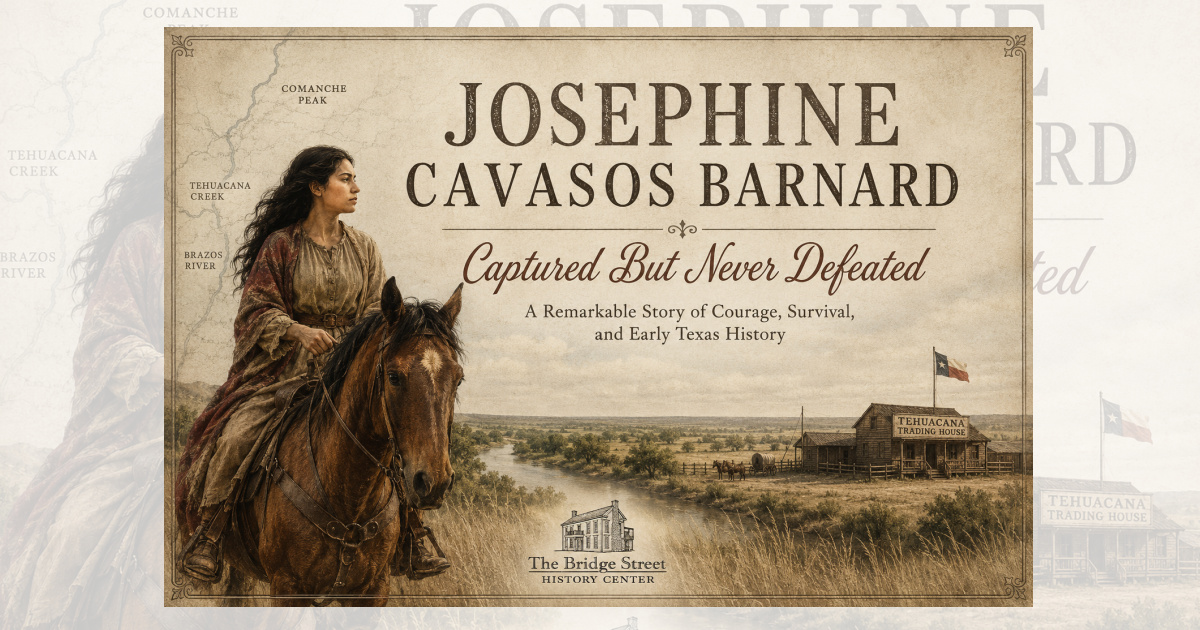
Captured But Never Defeated: The Incredible Story of Josephine Cavasos Barnard
Josephine Cavasos Barnard – Captured But Never Defeated – PART ONE
This is the story of Josephine Cavasos Barnard, who was wrenched from all she knew and suffered abuse and great trauma, before being rescued – by the man she would go on to build a life with. Josephine (or Juana, as she was called by many) and her husband Charles Barnard were among the earliest settlers in the area that now straddles the line between Hood and Somervell Counties. .Many don’t know that area was within the original boundaries of Hood County when it was established in 1866. But Juana’s story begins many years before… in a time long before Texas was even a State.
Josephine Maria Cavasos was born June 24, 1824, in the Canary Islands of Spanish-Italian ancestry. Her parents, Juan Jose and his wife, migrated from there to Matamoros, Mexico because his father, Don Narciso Cavasos, had received l06 leagues of land or 601,657 acres from the King of Spain. This was the largest land grant ever made in the New World and later part of it became part of what is now northern Mexico and south Texas.
In August 1842 Josephine was 18 years old. Texas was still part of Mexico then and friends and relatives passed freely back and forth across the Rio Grande. Josephine was great friends with a girl named Mary Alice whose family lived on the north side of that great river. As was the custom in those days, visits lasted days or even weeks. So, Josephine went to spend a few days visiting with her friend. While she was there, a band of Comanche attacked the house. Chaos ensued. Josephine ran from the house as the thunder of hoof beats filled the air. She hid in the woods nearby, but was found by a young Indian brave, who grabbed her by the hair and slung her across the horse in front of him. Over the course of the next few hours she saw him kill a mother and baby with his tomahawk and endured many miles of travel over rough terrain. Every moment she feared a downswing of the tomahawk that would end her life. Finally, they stopped at a dry creek, where she was thrown to the ground and tied to a tree. As night fell, Josephine heard sobs and cries from nearby. She recognized the voice as that of her friend, Mary Alice. She struggled against her bonds and called out to her friend. She received a fist in the face for her trouble.
This was the beginning of a harrowing nightmare of years of captivity. The band of Comanche first stayed in the area of south Texas and tortured the girls, trying to get them to tell them the location of the largest horse ranches in the area. Fearing for their fellow settlers, the girls at first refused, but later, in desperation, concocted a story hoping to lead the Indians astray. The raiding party returned, empty handed and furious. The girls were badly beaten. Mary Alice cried and begged for mercy and Josephine was made to watch as she was brutally killed.
In defiance, Josephine glared through her tears as a brave approached her, knife at ready. “Go ahead, do it!” she hissed.
Startled by her courage, he stopped, placed his hand over her heart, and said, “Brave, like Comanche! No kill!”
Alone now, Josephine was determined to survive and escape. As the Indian band turned north, she was tied each day to the horse she rode but was allowed to swim when water was available. She had experienced and seen horrific brutality, yet she was never brutalized again. She was befriended by one of the old women of the tribe and from her learned to live as the Indians did. She learned to cook and eat their food and how to soften skins for clothing. Other women joined in to teach her about herbal medicine, how to speak Comanche, and how to wash with soapwort.
Winter that year was spent on the Guadalupe River. A family trying to pass through was captured. The family was killed, except for a small boy. The Indians entertained themselves by holding the child’s bare feet in the flames. Josephine, unable to stand it, burst past the laughing Indians and snatched the boy. The Old One who had befriended her motioned that she come and bring the boy to her teepee. She not only dressed the child’s feet but salvaged some food for them. She told Josephine that she had insulted the Indians and she and the child were to be abandoned to starve. The next morning all the other Indians were gone and Josephine and the child were alone. After some period of days, the Indians returned; but the child was dead and Josephine was near death. Again, the Old One adopted her and nursed her back to health.
For most of the next two years Josephine lived with the Comanche. She was expected to work hard, but was allowed freedom to swim, shoot, and ride wild mustangs. She became so skillful at breaking horses that some of the braves became jealous. Because she understood Comanche, she learned of a trading post on Tehuacana Creek that treated the white man and red man the same.
George Barnard had established trading posts near Marlin Falls and Tehuacana. His brother, Charles, had come from New York to join him in the venture in Texas. They had made friends with Sam Houston and were well known for their business and trade with both Indians and white settlers at all their establishments. It was said by 1845 that relations with the Indians were so bad that settlers hardly slept except in the areas where the Barnards and their associates, the Torreys, had established a relationship with the Comanche.
On February 7, 1846, at Comanche Peak, the federal agents had called for a powwow. The Indians accepted many gifts and exchanged some polite talk, but the treaty with the Indians did not materialize. Instead, another meeting in May at Tehuacana Trading House was set.
By April, Indians were gathering on Tehuacana and Trading House creeks. All the Indians, including the women and children, attended, but Josephine was left in a canyon 20 miles away to tend The Old One — the woman who had protected her. Despite Josephine’s best effort, she died. When this happened, Josephine was taken to join the others. One of the activities was a sort of rodeo with each tribe entering its best riders. The ponies were wild; but one in particular had never been ridden. On the second day, Josephine leaped past her watchers and ran to the wild one. Grabbing its hackamore, she leaped aboard and rode the wild mustang until it was exhausted.
Charles Barnard was watching. He realized that this was not an Indian. As she leaped from the tamed horse, the tribe circled round Josephine, preventing anyone from approaching her. But she had seen Charles. As she was led away she was able to send a look which was unmistakably a cry for help.
End of PART ONE.
Josephine Cavasos Barnard – Captured But Never Defeated – PART TWO
This is the story of Josephine Cavasos Barnard, who was wrenched from all she knew and suffered abuse and great trauma, before being rescued – by the man she would go on to build a life with. Josephine (or Juana, as she was called by many) and her husband Charles Barnard were among the earliest settlers in the area that now straddles the line between Hood and Somervell Counties. .Many don’t know that area was within the original boundaries of Hood County when it was established in 1866. But Juana’s story begins many years before… in a time long before Texas was even a State.
Charles and George Barnard quickly came up with a plan and tried to bargain for the girl they had seen with the Indians at their Trading Post, but at that time she was not for ransom. A treaty was signed May 16, 1846, for a definite line some distance west of the westernmost settlements. Indians were to stay west; settlers were to stay east. During these negotiations, Josephine was nowhere to be seen. Just as the Indians were preparing to leave, she was taken to the trading house. There Charles and George Barnard were behind the counter with the chief and tribal leaders on the other side. The counter was covered with piles of blankets, knives, beads, flour, and sugar. Negotiations began. George was the bargainer. The Indians were very demanding. Each time the Chief would shake his head, George would nod and Charles would add to the pile. At last the chief grunted and left with his men carrying the bounty, leaving Josephine free for the first time in over three years.
Josephine was placed under the care of an Irish lady named Katy. Charles Barnard became a regular visitor at Katy’s home, and romance quickly blossomed between Josephine and her rescuer. But the decision to marry him was made difficult because of the life he had planned. He wanted her to go with him to establish a new trading post far up the Brazos River to the north in the shadow of the mesa called Comanche Peak where the tribes had gathered the year before. She would be the only white woman in the remote area. In 1847, Charles left to go start building the new post, while Josephine pondered her decision.
Love won out over fear and she and Charles were married in October of 1848. While the construction of the post continued, Josephine and Charles began married life with his traveling between his new post on the Brazos, and George’s post in central Texas. In August,1849, their daughter Maria was born. Shortly afterward, she and her mother joined her father on the Texas frontier. Josephine and Charles began their long life together in the log and limestone house on the banks of the Brazos in what is now southern Hood County. Their second child, John, was born the next year. He was the first child born to white settlers in the area. Throughout their marriage, Charles and Josephine were devoted to each other. He always allowed her the freedom to indulge her need for open spaces and ride fast horses. She bore him fourteen children, but in the way of those days – only four lived to adulthood.
In 1851, friendly Indians settled in a village across the creek from the trading post. They farmed, hunted, and were peaceful and enjoyed horse racing gatherings with Charles and Josephine and other folks passing through. There were no schools in the territory, so Charles (a Harvard graduate) tutored the Indian children right along with his own. Later they attended the Acton Institute and then Baylor College in Waco. The Acton Institute was housed on the ground floor of the 19 Acton Masonic Lodge, of which Charles was a charter member. That building also doubled as a church meeting house for the various denominations in the Acton community. After many years of neglect, it was restored in the 1970s and is now the chapel of Good Shepherd Anglican Church.
In 1854 the Indians were removed to the reservation at Fort Belknap. Prior to that time it was common for the Commanche to come to Josephine for medical help, as her skills in that realm were remembered by their people. At one point, three Comanche brought a sick child to Josephine. She recognized him as a Mexican child, deathly sick with pneumonia. After nursing him back to health, she and Charles raised Ambrosio Hernandez and treated him as their own for the rest of his life.
At the age of 37, with his work with the Indians finished, Charles built a mill on the Paluxy River. Known as Barnard’s Mill, it took four years to build and cost $30,000.00. One winter afternoon at the mill, Josephine recognized the voice of Capt. Sullivan Ross, a friend who was a Texas Ranger. He and his men had captured a white woman with a baby who was a captive of the Comanche. The only thing they could learn from her was that she was Peta Nacona’s widow. Cynthia Ann Parker finally allowed herself and the baby to be bathed and accepted some clean clothing. When she left, she told Josephine, speaking for the first time in English, “You are kind, and I thank you.”
The mill was sold some years later to T. C. Jordan who changed the name to Glen Rose.
Near the trading post there was a shallow, stone-paved crossing on the Brazos where thousands crossed on the Chisholm Trail. In 1870, a large herd came from South Texas on the way to Fort Dodge, Kansas. The trail boss learned that the Brazos was on the rise and did not want to lose even a day. After the river became fordable, he went across to the trading post to thank Charles for giving them permission to camp. When Charles went out to greet the trail boss, Josephine heard him speak and recognized the voice of her twin brother. She screamed, “That’s Juan! That’s my brother!” At that Juan leaped for the porch and a 28-year-long separation had ended. In 1872, he bought land from Charles and came to live nearby.
During her many years in what is now southern Hood County and northern Somervell County Juana became known for her excellent midwifing skills. Taught her skills by the women of the Comanche, she saved the lives of many women and children across the area, continuing to travel on horseback to care for women in childbirth. She was respected and treated with admiration for her skills, even by many of the medical doctors in the area.
Charles died June 23,1900 and is buried in the Barnard Cemetery which is now in the middle of land long used as a peanut field.
Josephine lived on and spent part of each day riding her horse, Pigeon. On February 1, 1906, Pigeon was led to the mounting block so that she could visit two of her sick friends. When she arrived home before sunset, she sat a moment on Pigeon looking across the fields toward the river she loved. About midnight she was heard moving around. When asked what was wrong, she replied that she needed to rub some white liniment on her head because it was hurting. As she was talking, Josephine stiffened and fell backward and was gone. She had met death as she had lived life — never giving up, never backing down — with the same bravery and determination that her Indian captors had seen in her all those years ago.