Granbury College : The School on the Hill

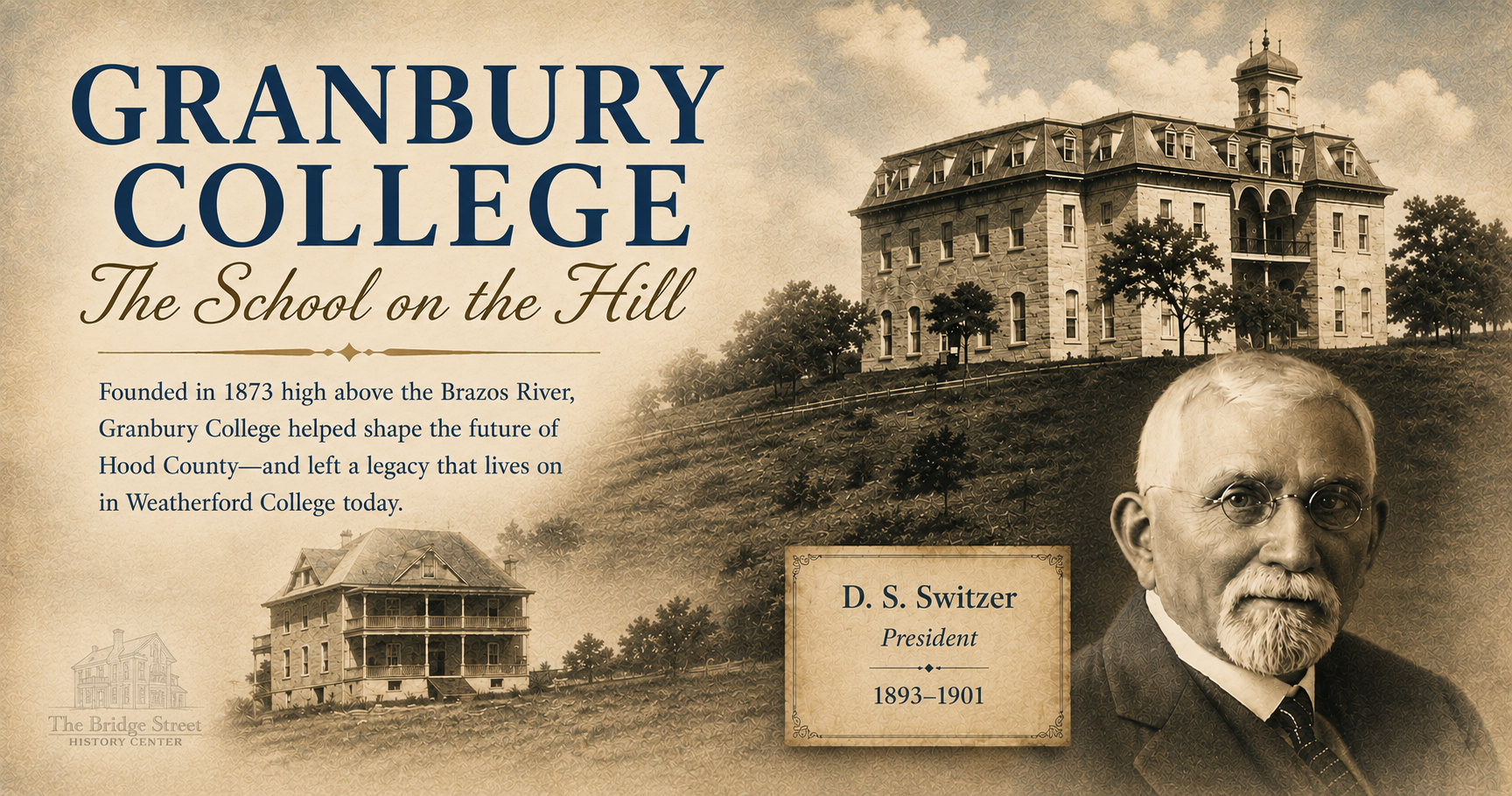
Historic Granbury College, known as the School on the Hill, with former president D. S. Switzer in Granbury, Texas.

‘Far above the Brazos River,
On a Hallowed site,
Stands our noble Granbury High School
Bathed in golden light.
Raise the chorus, send it onward
Over hill and dale.
Hail to thee, beloved old high school,
Granbury High School. Hail!’

The above words are the words to the school song for Granbury High School and have been so since early in the twentieth century. However those words were originally been written about another school “far above the Brazos River” — Granbury College, the first secondary school in the city of Granbury — the school on the hill.

Granbury High School and College was begun by the Methodist Church District Conference in 1873, the same year as Ad-Ran College was opened in nearby Thorp Springs by the Churches of Christ. The two schools combined to make Hood County known nationwide as a center for higher learning in the latter years of the nineteenth century. Of both schools there are no physical remains save those that have been reused in the building of other structures. Of both schools few if any remain alive who have any actual memory of their existence. However, both schools were the seedlings – planted here in Hood County for a season – that were the foundation and beginnings of two long-time institutions of higher learning that still serve the students of North Texas and the world. Most people know that Ad-Ran College moved to Fort Worth and became Texas Christian University, but few remember or know that Granbury College which closed here in 1912, moved to Weatherford, and became what is now Weatherford College!

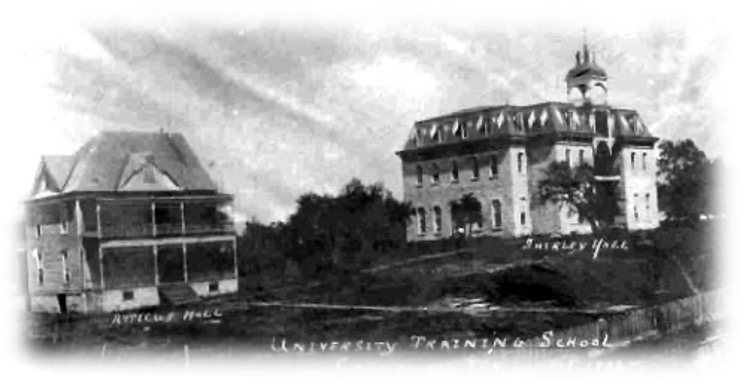
It may surprise many to learn that Granbury College and Training School, as it was known, existed at all. Even more surprising to some would be its location! Literally – far above the Brazos River on one of the highest points in the city of Granbury now stands – the Granbury Cemetery. Near the location of the middle of the current cemetery, where a water tower now stands adjacent to the oldest part of this hallowed site once stood the proud limestone structure of Granbury College. Believe it or not the college eventually was housed in a building that stood three stories high and measured 62’ by 80’. This was by comparison almost as tall as the current courthouse building minus the clock tower, and similar in size at ground level to the Nutt House Hotel building on the downtown square which measures roughly 50’ by 80’. It must have been an imposing sight up there on that hill above the town, and even more impressive is the fact that in an era when secondary education was still an opportunity often only offered to males, for its entire history – from 1873 to 1912 – the Granbury College was a co-educational institution!

In the summer of 1873, the District meeting of the Weatherford Methodist Conference was held in Acton. At that meeting, Rev. James Jones was the presiding elder. Many of the officials from throughout the conference recognized a need for an educational facility in this area of the state. Many expected it would be placed at Weatherford as that was the largest town in the area at the time. A strong presentation and proposal was made by the folks from the Granbury area, and it was decided that a District High School would be opened in Granbury instead.

Records indicate that the school opened that very fall in 1873, housed temporarily in a rock structure on the southeast corner of the square. The exact location and ownership of that building has been lost to the mists of time, but surely a debt of gratitude is owed to those unknown owners who lent their building to Granbury’s first institution of higher learning. A frame building was built on land given for the school to the north of town up on what is now the eastern most end of the Granbury Cemetery. The first headmaster of the school was Rev. W. P. Wilson and teachers were hired to teach students from grade school through what we would now consider community college level classes.

The school grew so much in the first two years that by 1875 it was a fully chartered and accredited school. It was originally intended that it would be a feeder school for the four-year Southwestern University in Georgetown, Texas. A few more terms and expansion of building space was needed. The citizens of Granbury recognized the value of having this institution of higher learning right here at home, and they rallied to the expansion needs, and in 1880-81 raised the money and built a three-story rock building measuring 42’ by 60’ on the land just west of the frame building. That building came into use in the fall of 1881. The elementary department covered grades one through seven, with an advanced eighth grade which is what we would consider high school today. The college department offered a two-year co-educational program offering a variety of courses including English, Latin, literature, mathematics, history, foreign language, music and art.

By 1883, the school had a total enrollment of 313 pupils and eight diplomas were granted in 1886. Rates were listed as board (including room), $10 to $12 a month with “washing” $1.00 per month. The school enjoyed several prosperous years until tragedy struck. The building and all of its contents were completely destroyed on January 9, 1887. Students had just returned from their Christmas holidays. D. S. Switzer (one of the college’s presidents) wrote of the distress of both faculty and students in the immediate aftermath of the fire. That despair quickly turned to hope as once more the town rallied around the school. Switzer wrote, “before the sun had set on the following day, a demoralized body of boarding pupils was pacified and ready to carry on their work. The Methodist and Baptist churches and Gordon Hall were engaged to provide classroom space and money sufficient to insure a better building was promised.”

The building that followed within the year was bigger and better with dimensions of 62’ by 80’, but with it came the huge debt. That debt along with the following years of drought and other problems brought the downfall of the college.

A 1909 Granbury College catalog lists expanded subject offerings including history, English, mathematics, Latin, science, Greek, German, a course in Bible and church methods, and a commercial course which included bookkeeping, penmanship, typewriting, et cetera. The school had a fine arts department, art department, and an athletics program which included tennis and baseball. There were two collegiate societies, the Phaino, a literary group, and the Aldelphian. Enrollment for that year was 124 and the cost for board, fuel, light and tuition was about $220 for the full term.

In the 1890s there was a terrible drought in the area. It was so bad that even the larger ranching operations were hard hit. An example is Jacob Nutt, who had a ranch out by Paluxy with over 2,500 acres. He had been running over 250 head of cattle on that land. In 1901 he was forced to sell off all but fifty head. The financial impact of the drought hit the families of many students hard. The resulting economic downturn had a disastrous impact on the school. Also, more and more communities were moving toward publicly funded schools located in each community and paid for through taxes.

The hard times for both local and far away student families caused enrollment to drop precipitously. After D. S. Switzer left as president at the end of the spring 1901 term, the school, over the next several years, offered fewer and fewer college level classes, as older students who chose to stay on finished their courses of study. It is thought the college formally closed its doors in 1912 and that some part of it went on to become (or already had become) part of Weatherford Junior College. Its effects like those of the other local college, Add-Ran, were great upon the local population and many enjoyed the quality education provided. The community at large also benefited greatly from the fine arts presentations made through the years by both faculty and students. The younger students continued their studies in newly constructed more centrally located public schools incorporated in Granbury and the various surrounding communities.
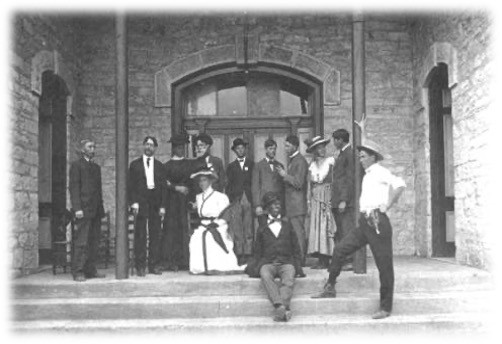
Granbury College Drama Production in 1880's
Granbury College Drama Production in 1880’s
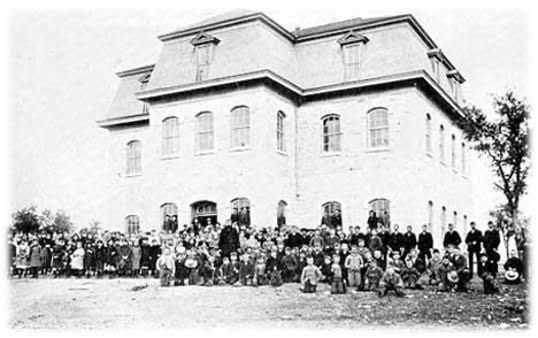
First Limestone Structure built in 1881 that burned in January 1887.
Original Frame Building built in 1875 that was later the Girls Dormitory and the second larger limestone Granbury College Building built in 1887 after First Limestone Building burned.

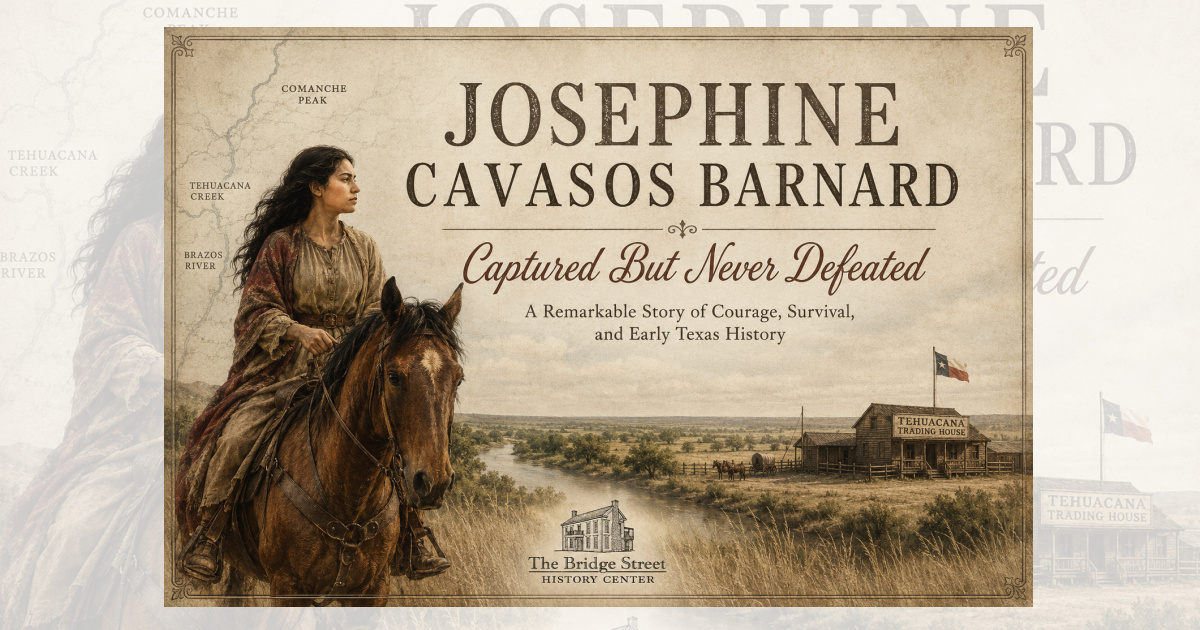
Captured But Never Defeated: The Incredible Story of Josephine Cavasos Barnard

Josephine Cavasos Barnard on horseback, a survivor of Comanche captivity who became a pioneering settler in Hood County, Texas.


Josephine Cavasos Barnard – Captured But Never Defeated – PART ONE

This is the story of Josephine Cavasos Barnard, who was wrenched from all she knew and suffered abuse and great trauma, before being rescued – by the man she would go on to build a life with. Josephine (or Juana, as she was called by many) and her husband Charles Barnard were among the earliest settlers in the area that now straddles the line between Hood and Somervell Counties. .Many don’t know that area was within the original boundaries of Hood County when it was established in 1866. But Juana’s story begins many years before… in a time long before Texas was even a State.

Josephine Maria Cavasos was born June 24, 1824, in the Canary Islands of Spanish-Italian ancestry. Her parents, Juan Jose and his wife, migrated from there to Matamoros, Mexico because his father, Don Narciso Cavasos, had received l06 leagues of land or 601,657 acres from the King of Spain. This was the largest land grant ever made in the New World and later part of it became part of what is now northern Mexico and south Texas.

In August 1842 Josephine was 18 years old. Texas was still part of Mexico then and friends and relatives passed freely back and forth across the Rio Grande. Josephine was great friends with a girl named Mary Alice whose family lived on the north side of that great river. As was the custom in those days, visits lasted days or even weeks. So, Josephine went to spend a few days visiting with her friend. While she was there, a band of Comanche attacked the house. Chaos ensued. Josephine ran from the house as the thunder of hoof beats filled the air. She hid in the woods nearby, but was found by a young Indian brave, who grabbed her by the hair and slung her across the horse in front of him. Over the course of the next few hours she saw him kill a mother and baby with his tomahawk and endured many miles of travel over rough terrain. Every moment she feared a downswing of the tomahawk that would end her life. Finally, they stopped at a dry creek, where she was thrown to the ground and tied to a tree. As night fell, Josephine heard sobs and cries from nearby. She recognized the voice as that of her friend, Mary Alice. She struggled against her bonds and called out to her friend. She received a fist in the face for her trouble.

This was the beginning of a harrowing nightmare of years of captivity. The band of Comanche first stayed in the area of south Texas and tortured the girls, trying to get them to tell them the location of the largest horse ranches in the area. Fearing for their fellow settlers, the girls at first refused, but later, in desperation, concocted a story hoping to lead the Indians astray. The raiding party returned, empty handed and furious. The girls were badly beaten. Mary Alice cried and begged for mercy and Josephine was made to watch as she was brutally killed.

In defiance, Josephine glared through her tears as a brave approached her, knife at ready. “Go ahead, do it!” she hissed.

Startled by her courage, he stopped, placed his hand over her heart, and said, “Brave, like Comanche! No kill!”

Alone now, Josephine was determined to survive and escape. As the Indian band turned north, she was tied each day to the horse she rode but was allowed to swim when water was available. She had experienced and seen horrific brutality, yet she was never brutalized again. She was befriended by one of the old women of the tribe and from her learned to live as the Indians did. She learned to cook and eat their food and how to soften skins for clothing. Other women joined in to teach her about herbal medicine, how to speak Comanche, and how to wash with soapwort.

Winter that year was spent on the Guadalupe River. A family trying to pass through was captured. The family was killed, except for a small boy. The Indians entertained themselves by holding the child’s bare feet in the flames. Josephine, unable to stand it, burst past the laughing Indians and snatched the boy. The Old One who had befriended her motioned that she come and bring the boy to her teepee. She not only dressed the child’s feet but salvaged some food for them. She told Josephine that she had insulted the Indians and she and the child were to be abandoned to starve. The next morning all the other Indians were gone and Josephine and the child were alone. After some period of days, the Indians returned; but the child was dead and Josephine was near death. Again, the Old One adopted her and nursed her back to health.

For most of the next two years Josephine lived with the Comanche. She was expected to work hard, but was allowed freedom to swim, shoot, and ride wild mustangs. She became so skillful at breaking horses that some of the braves became jealous. Because she understood Comanche, she learned of a trading post on Tehuacana Creek that treated the white man and red man the same.

George Barnard had established trading posts near Marlin Falls and Tehuacana. His brother, Charles, had come from New York to join him in the venture in Texas. They had made friends with Sam Houston and were well known for their business and trade with both Indians and white settlers at all their establishments. It was said by 1845 that relations with the Indians were so bad that settlers hardly slept except in the areas where the Barnards and their associates, the Torreys, had established a relationship with the Comanche.

On February 7, 1846, at Comanche Peak, the federal agents had called for a powwow. The Indians accepted many gifts and exchanged some polite talk, but the treaty with the Indians did not materialize. Instead, another meeting in May at Tehuacana Trading House was set.

By April, Indians were gathering on Tehuacana and Trading House creeks. All the Indians, including the women and children, attended, but Josephine was left in a canyon 20 miles away to tend The Old One — the woman who had protected her. Despite Josephine’s best effort, she died. When this happened, Josephine was taken to join the others. One of the activities was a sort of rodeo with each tribe entering its best riders. The ponies were wild; but one in particular had never been ridden. On the second day, Josephine leaped past her watchers and ran to the wild one. Grabbing its hackamore, she leaped aboard and rode the wild mustang until it was exhausted.

Charles Barnard was watching. He realized that this was not an Indian. As she leaped from the tamed horse, the tribe circled round Josephine, preventing anyone from approaching her. But she had seen Charles. As she was led away she was able to send a look which was unmistakably a cry for help.

End of PART ONE.

Josephine Cavasos Barnard – Captured But Never Defeated – PART TWO

This is the story of Josephine Cavasos Barnard, who was wrenched from all she knew and suffered abuse and great trauma, before being rescued – by the man she would go on to build a life with. Josephine (or Juana, as she was called by many) and her husband Charles Barnard were among the earliest settlers in the area that now straddles the line between Hood and Somervell Counties. .Many don’t know that area was within the original boundaries of Hood County when it was established in 1866. But Juana’s story begins many years before… in a time long before Texas was even a State.

Charles and George Barnard quickly came up with a plan and tried to bargain for the girl they had seen with the Indians at their Trading Post, but at that time she was not for ransom. A treaty was signed May 16, 1846, for a definite line some distance west of the westernmost settlements. Indians were to stay west; settlers were to stay east. During these negotiations, Josephine was nowhere to be seen. Just as the Indians were preparing to leave, she was taken to the trading house. There Charles and George Barnard were behind the counter with the chief and tribal leaders on the other side. The counter was covered with piles of blankets, knives, beads, flour, and sugar. Negotiations began. George was the bargainer. The Indians were very demanding. Each time the Chief would shake his head, George would nod and Charles would add to the pile. At last the chief grunted and left with his men carrying the bounty, leaving Josephine free for the first time in over three years.

Josephine was placed under the care of an Irish lady named Katy. Charles Barnard became a regular visitor at Katy’s home, and romance quickly blossomed between Josephine and her rescuer. But the decision to marry him was made difficult because of the life he had planned. He wanted her to go with him to establish a new trading post far up the Brazos River to the north in the shadow of the mesa called Comanche Peak where the tribes had gathered the year before. She would be the only white woman in the remote area. In 1847, Charles left to go start building the new post, while Josephine pondered her decision.

Love won out over fear and she and Charles were married in October of 1848. While the construction of the post continued, Josephine and Charles began married life with his traveling between his new post on the Brazos, and George’s post in central Texas. In August,1849, their daughter Maria was born. Shortly afterward, she and her mother joined her father on the Texas frontier. Josephine and Charles began their long life together in the log and limestone house on the banks of the Brazos in what is now southern Hood County. Their second child, John, was born the next year. He was the first child born to white settlers in the area. Throughout their marriage, Charles and Josephine were devoted to each other. He always allowed her the freedom to indulge her need for open spaces and ride fast horses. She bore him fourteen children, but in the way of those days – only four lived to adulthood.

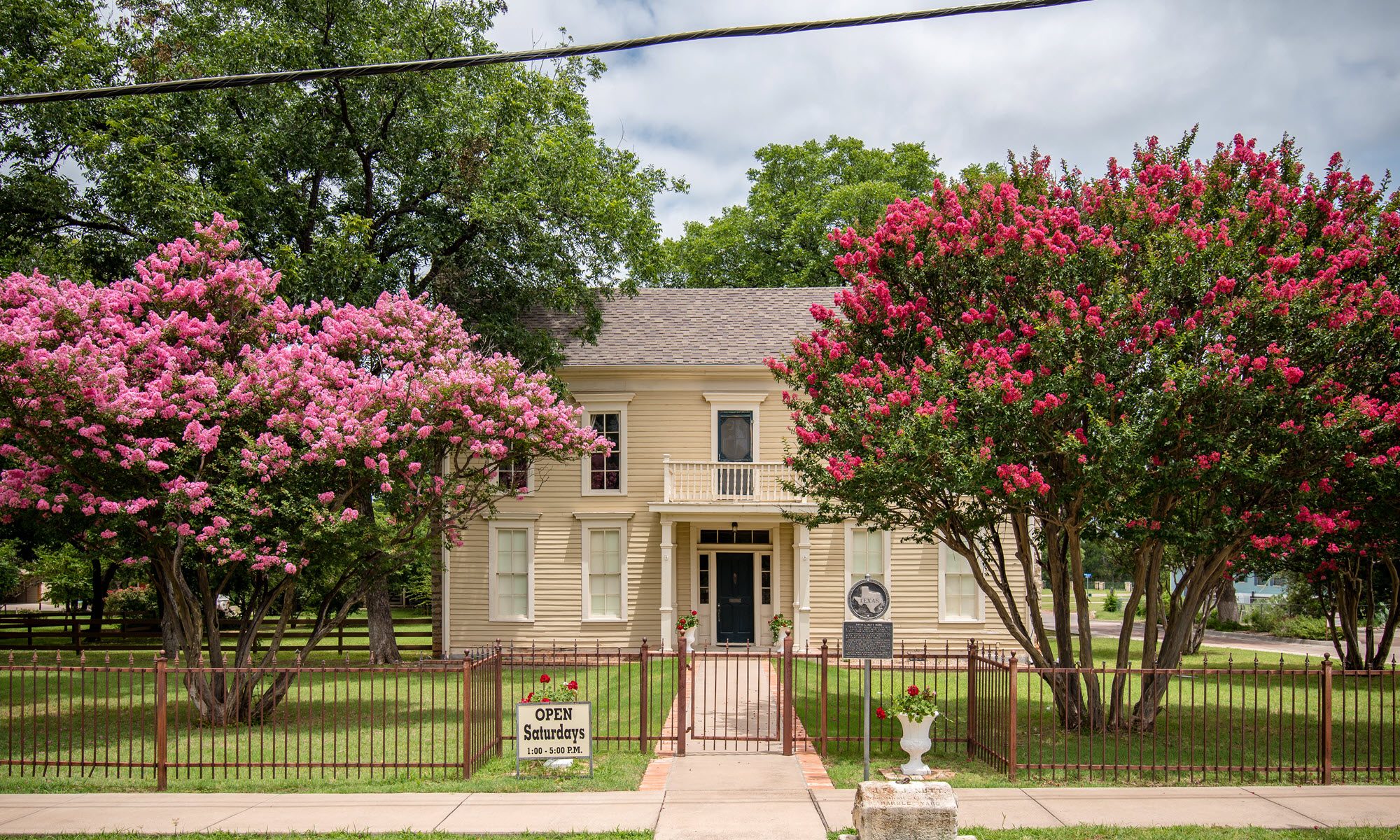
In 1851, friendly Indians settled in a village across the creek from the trading post. They farmed, hunted, and were peaceful and enjoyed horse racing gatherings with Charles and Josephine and other folks passing through. There were no schools in the territory, so Charles (a Harvard graduate) tutored the Indian children right along with his own. Later they attended the Acton Institute and then Baylor College in Waco. The Acton Institute was housed on the ground floor of the 19 Acton Masonic Lodge, of which Charles was a charter member. That building also doubled as a church meeting house for the various denominations in the Acton community. After many years of neglect, it was restored in the 1970s and is now the chapel of Good Shepherd Anglican Church.

In 1854 the Indians were removed to the reservation at Fort Belknap. Prior to that time it was common for the Commanche to come to Josephine for medical help, as her skills in that realm were remembered by their people. At one point, three Comanche brought a sick child to Josephine. She recognized him as a Mexican child, deathly sick with pneumonia. After nursing him back to health, she and Charles raised Ambrosio Hernandez and treated him as their own for the rest of his life.

At the age of 37, with his work with the Indians finished, Charles built a mill on the Paluxy River. Known as Barnard’s Mill, it took four years to build and cost $30,000.00. One winter afternoon at the mill, Josephine recognized the voice of Capt. Sullivan Ross, a friend who was a Texas Ranger. He and his men had captured a white woman with a baby who was a captive of the Comanche. The only thing they could learn from her was that she was Peta Nacona’s widow. Cynthia Ann Parker finally allowed herself and the baby to be bathed and accepted some clean clothing. When she left, she told Josephine, speaking for the first time in English, “You are kind, and I thank you.”

The mill was sold some years later to T. C. Jordan who changed the name to Glen Rose.

Near the trading post there was a shallow, stone-paved crossing on the Brazos where thousands crossed on the Chisholm Trail. In 1870, a large herd came from South Texas on the way to Fort Dodge, Kansas. The trail boss learned that the Brazos was on the rise and did not want to lose even a day. After the river became fordable, he went across to the trading post to thank Charles for giving them permission to camp. When Charles went out to greet the trail boss, Josephine heard him speak and recognized the voice of her twin brother. She screamed, “That’s Juan! That’s my brother!” At that Juan leaped for the porch and a 28-year-long separation had ended. In 1872, he bought land from Charles and came to live nearby.

During her many years in what is now southern Hood County and northern Somervell County Juana became known for her excellent midwifing skills. Taught her skills by the women of the Comanche, she saved the lives of many women and children across the area, continuing to travel on horseback to care for women in childbirth. She was respected and treated with admiration for her skills, even by many of the medical doctors in the area.

Charles died June 23,1900 and is buried in the Barnard Cemetery which is now in the middle of land long used as a peanut field.

Josephine lived on and spent part of each day riding her horse, Pigeon. On February 1, 1906, Pigeon was led to the mounting block so that she could visit two of her sick friends. When she arrived home before sunset, she sat a moment on Pigeon looking across the fields toward the river she loved. About midnight she was heard moving around. When asked what was wrong, she replied that she needed to rub some white liniment on her head because it was hurting. As she was talking, Josephine stiffened and fell backward and was gone. She had met death as she had lived life — never giving up, never backing down — with the same bravery and determination that her Indian captors had seen in her all those years ago.