March 12, 2026
By Melinda Jo Ray
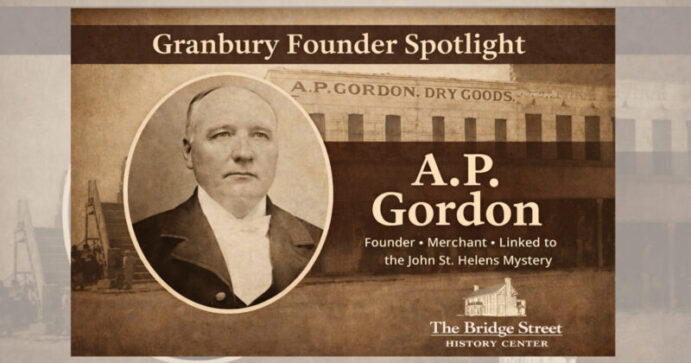
Granbury Founder A. P. Gordon: Merchant, Civic Leader, and Landlord to the Mysterious John St. Helen (aka John Wilkes Booth)
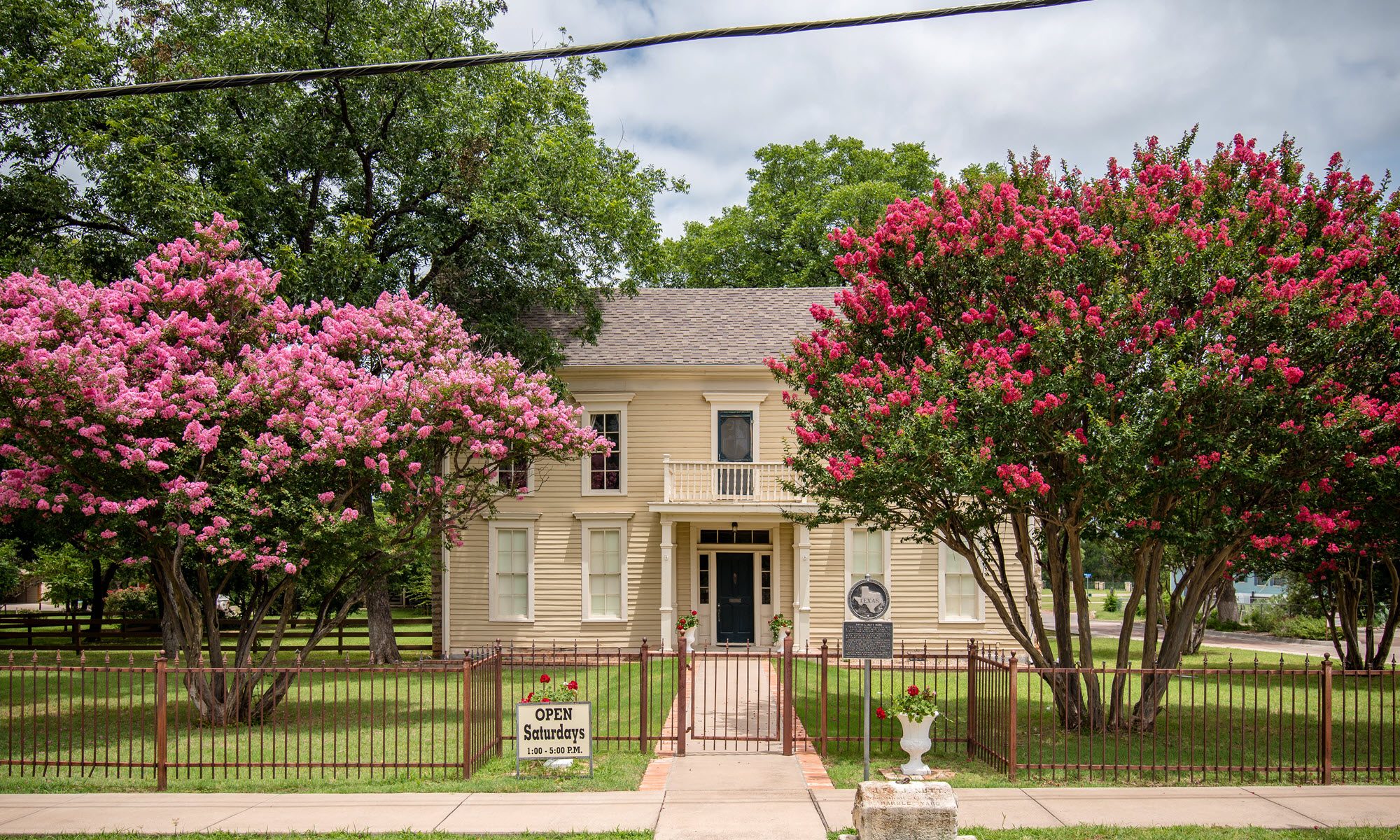
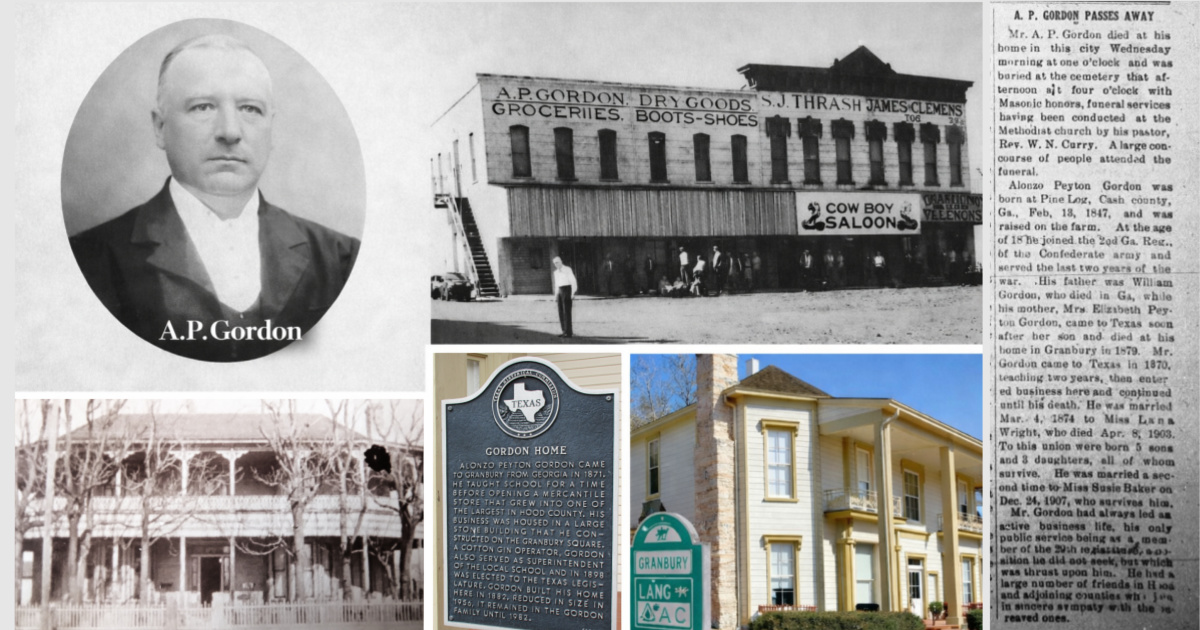
What do the Langdon Center Property, the building on the southeast corner of the Granbury Square that now houses a candle shop, and John St. Helen (aka John Wilkes Booth) all have in common? They are all connected to one man – Alonzo Peyton Gordon. Most folks who have been around Granbury very long have heard the name A. P. Gordon. His name is now on the historical markers located at his house, which now is headquarter of the Dora Lee Langdon Cultural Center, and the limestone building on the southeast corner of the Granbury Square began its existence as Gordon’s mercantile store! Gordon was also member of several early Granbury city councils and also figures prominently in local legend as the owner of at least one local saloon and landlord of the mysterious John St. Helen, the drifter who claimed to be Booth, the assassin of President Abraham Lincoln.
But Alonzo Gordon was much more than just an old-time saloon owner and landlord to a shady character. Indeed, Mr. Gordon was one of the “movers and shakers” in the town of Granbury almost from the moment of his arrival in 1871. Hailing from Georgia and a veteran of the Confederate Army, Gordon spent the first years after the war teaching school. A frugal young man, he steadfastly saved his meager salary, watching his nest egg grow, and dreaming of a more prosperous life as a businessman in some new and growing town “out west”. Finally, in 1870, he took his tidy sum of savings and headed westward to the little newly declared county seat of Hood County, Texas – Granbury.
Taking a teaching job quickly to pay room and board, Gordon used his funds to purchase two lots on the southeast corner of the brand-new Granbury town square. Like most during this time period he soon learned of the title dispute associated with the town lands, and chose, for the time being, to erect buildings using wood not stone, because of the cost. He also acquired the land east of the square where the Langdon Center is now, and homesteaded it, building a log cabin where he lived until his marriage. In 1873, contemplating marriage, Gordon added a living-quarters to his store building. He lived either behind or above the business for several years with his wife, Lana, until they built the large home on the property east of the square that is now the Langdon Center headquarters.
As one of the first business owners in Granbury and a well-educated man, Gordon took an active role in the city and county politics, serving on several early city councils in various capacities. He was also active in the local Masonic Lodge, and other area organizations throughout his life. Around the time of his marriage, sometime in 1873, a stranger new to town came to Gordon to inquire about renting his vacant log cabin. Sober, well-spoken, standoffish, and hot-tempered are all words that were used to describe John St. Helen, the mysterious fellow Southerner who Gordon signed on as tenant from 1874 to early 1875. St. Helen had found employment as bartender and later manager of two local saloons. The man had a policy of never indulging in the liquids he sold, “Saint” — as he was called — only got drunk (according to local lore) only once during his tenure — on April 14th in 1874. Tales were told later of him standing drunkenly on a table reciting lines from Shakespeare. It is said that after Saint was involved in a fight with a local man that spilled from the saloon to the street and across the square into the Nutt brothers store, where Saint actually pulled a knife and stabbed the man, that Gordon considered evicting St. Helen. Alas, he never had the chance, as St. Helen took ill a short time later, made his famous “deathbed” confession to Finis Bates, recovered, and disappeared in the middle of the night, leaving behind most of his belongings. Gordon family lore says that during his illness, St. Helen revealed, in his delirium, his true identity as John Wilkes Booth. As soon as he recovered, he fled, leaving behind a note to Alonzo Gordon, and one of two used derringer pistols used by Booth the night of the Lincoln assassination. That gun is still owned by A. P. Gordon’s descendants.
One can wonder if all the hoopla surrounding St. Helen was part of what inspired A. P. to scale or sell his interests in the saloon and focus on his grocery and dry goods store, and his shares in a local prosperous cotton gin enterprise. His wife was Lana Wright, whose father A. J. Wright was Hood County sheriff at the time of the marriage in 1874. He and Lana enjoyed many years of a good marriage together and had eight children. They were founding and long-time members of the Granbury First Methodist Church. Indeed, one of the stained-glass windows in the old Mission Style church that used to stand where Granbury Square Plaza is now was dedicated to their memory. After Lana died in 1903, A. P. married Susie Baker in 1907. They had 14 years together before his death in 1921.
In addition to his businesses and building the house and two buildings on the southeast corner of the square in the 1880’s, Gordon was also among the leaders who took bold steps to secure Granbury’s future during those formative years. He was among the group of businessmen who put up a total of $50,000.00 for the start-up of the First National Bank. In addition to his terms on the city council, also served as an early superintendent of schools, and as a local representative to the Texas Legislature for one term.
In the early years of Granbury, Alonzo Gordon was among the local men known for their prowess at hunting. Apparently, he and his fellows were not averse to travelling as far away as New Mexico in search of areas with plentiful game. Thomas Ewell tells the tale of one such trip in 1878 when Gordon and friends killed between them eighteen bears and literally 100’s of wild turkeys, 100 + by Gordon himself. Here’s hoping all of Granbury benefited from their efforts that year!
At the end of his days, according to accounts in the local papers, A. P. Gordon surely had one of the speediest funerals ever held anywhere. He died in his home early on the morning of November 9, 1921, and by four o’clock that afternoon he was in the ground at the local cemetery. His obituary notes that his funeral was held at the Methodist church, and burial with full Masonic honors was immediately after at 4 p.m. with a large number of family and friends in attendance. In spite of his speedy interment, his contribution to the fabric of Granbury has certainly been long lasting, as the home and buildings he built continue to be a vital and vibrant part of our community.