
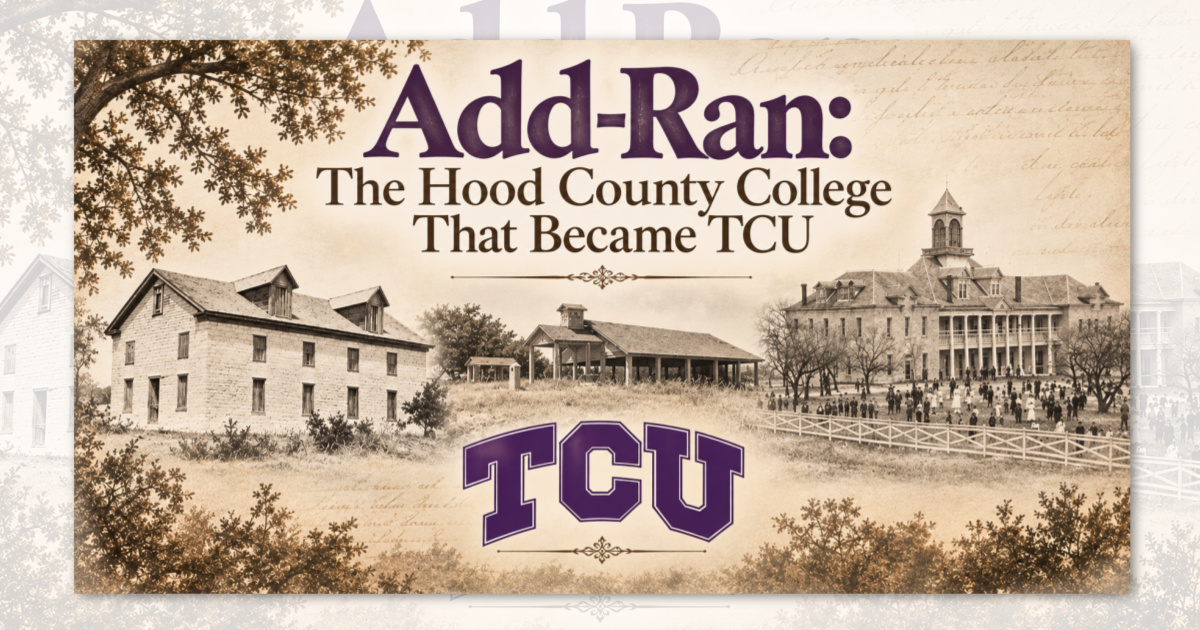
Sometimes “History” really does have something to teach us. And sometimes that “something” is not what we expect. Such was the case a while back, when a group of local history folk gathered to hear more about an erstwhile local educational institution known as Add-Ran College. Called together by leadership from a local history society, the group heard the story of the establishment of the school, how it came to be in Hood County, tales of its successes and failures and controversies, and in the end they went to visit the empty field where the buildings of the college once stood.
The saying goes that “a House divided against itself cannot stand,” and standing there in that empty field, in a small town set adrift by the demise of the institution that once stood there, it is easy to look at this story as a case study of the truth of that statement. Certainly, it must have seemed so on that day, over a century ago, when the decision was made to close that Add-Ran campus — when economics, religious controversy, and plain old human stubbornness combined to end the dream of Pleasant Thorp, members of the Clark family, and the whole Thorp Springs community of a great university in western Hood County, Texas.
Add-Ran College began in the area now known as the Fort Worth Stockyards as a tiny school started in a rented building by preacher/teacher Joshua Clark. Clark and his two sons, Addison and Randolph, like the rest of their family were Christians of what was then called the Campbellite persuasion, a sect of the Disciples of Christ denomination. When the frontier town of Fort Worth began to morph from army outpost into frontier cattle boomtown after the Civil War, it became quickly apparent that the location was not appropriate for a school striving to instill a lifestyle of Christian virtue in its students. It became known to the Clarks that a group of settlers led by fellow Campbellite Christian, Pleasant Thorp, had established a community known as Thorp Springs west of the Brazos River in the new Hood County. Negotiations soon brought the school to Thorp Springs, where town founder Pleasant Thorp had built a school building and was looking for someone to occupy it.
The resulting school became known as Add-Ran College – and later University – after Addison and Randolph Clark, the sons of its founder in the early 1870s. For a time, both the town and the college prospered. Several larger, more commodious buildings dotted a sprawling campus, serving hundreds of students in the Texas wilderness. But trouble was brewing behind the scenes. Monetary and other disputes between the Clarks and the Thorps, as well as various religious theological differences reflecting issues also troubling the Disciples of Christ denomination as a whole, eventually took a heavy toll. Finally, in 1891, both the financial and doctrinal divisions came to a head and the Clarks and the majority of the faculty and about two-thirds of the students left the facility in Thorp Springs and moved the college operation to Waco.
The people who were left in Thorp Springs tried for many years to keep a school going in various forms. But hard economic times and a remote location combined to limit their success. Finally, around 1930, the deteriorating college buildings were abandoned for good.
Meanwhile, the school in Waco found suitable quarters in a large building and prospered briefly. It was renamed Texas Christian University in 1902. Soon the hard times of the late 1890s and a devastating fire in 1910 wiped-out the success of the school in Waco. After the fire, a location and buildings just south of downtown Fort Worth brought the school full circle, back to its roots and to its destiny. But all these events and the decisions that followed them set in motion a chain of events none of the people at the time could have foreseen.
In spite of the turmoil, in spite of the hard feelings, in spite of the divisions, there remained a core of people who continued to believe in the need for a strong church affiliated institution of higher learning located in the western part of north central Texas. So those stalwart folk persevered, and tried again, first in Waco, and then later just south of central Fort Worth where it all began, to re-establish and grow such a school. They didn’t give up. They kept reinventing the concept. They kept searching for the right place — the right combination of answers. In the end that perseverance paid off. In the end that Divine Providence so often referred to in our historic documents held true. In the end, the little school that moved from old rough and ready wild west Fort Worth to the pastoral settings of Thorp Springs, to the rural fields near Waco, and finally back to a new central downtown city of Fort Worth, three decades later, found fertile soil back in the place of its beginnings. Relocated for the final time, Texas Christian University has grown over the past century to become one of the premiere institutions of higher learning in the state of Texas.
Those who tell the story of those early years often focus on the turmoil, the issues being fought over, or which group was “in power.” But it is the lesson of the long view that is the Truth this tale is telling us. It is not “just” a tale of various groups fighting for control of an institution. The lesson of history is bigger that. The vision of history is grander than that. The lesson and vision of History, with its long arc toward Justice and Truth, is that the real tale is in the striving—the striving of good people with diverse views and differing visions to truly Hear one another, to See a way forward, to work together to find a Better Way. In the end, the Add-Ran / TCU story is just one of an infinite number of examples History holds up before us, a tale of a “failure” that proved a steppingstone toward a greater good. It is a tale that says to us that even in the darkest of nights, in the most tumultuous of times, in the most strife ridden of situations, we who inhabit History must never stop striving to hear each other – to see and share ideas and visions that beckon toward a shared goal or the common good. Even when it means going places we don’t want to go and working with those we don’t fully understand or agree with, we must go. For in doing so we may be laying the cornerstones of a future that far exceeds all of our most grand expectations – as we follow Divine Providence up that grand arc of hopes and dreams and vision and legacy we call History.