Next Tuesday night, April 14, 2026, at about 9:15 in the evening, Granbury citizens might want to pause to
remember that it was at that hour 161 years ago that the man many consider to be one of America’s greatest presidents, Abraham Lincoln, was shot and killed by the stage actor, John Wilkes Booth. Many believe that man became one of Granbury’s most notorious residents – John St. Helen. Many believe he was the stage actor, John Wilkes Booth, and was the principal player of a story that before, during and after that tragic event is still, 161 years later, shrouded in mystery, conspiracy, inuendo, and enough plot twists to make it one of history’s most convoluted and tragic whodunits.
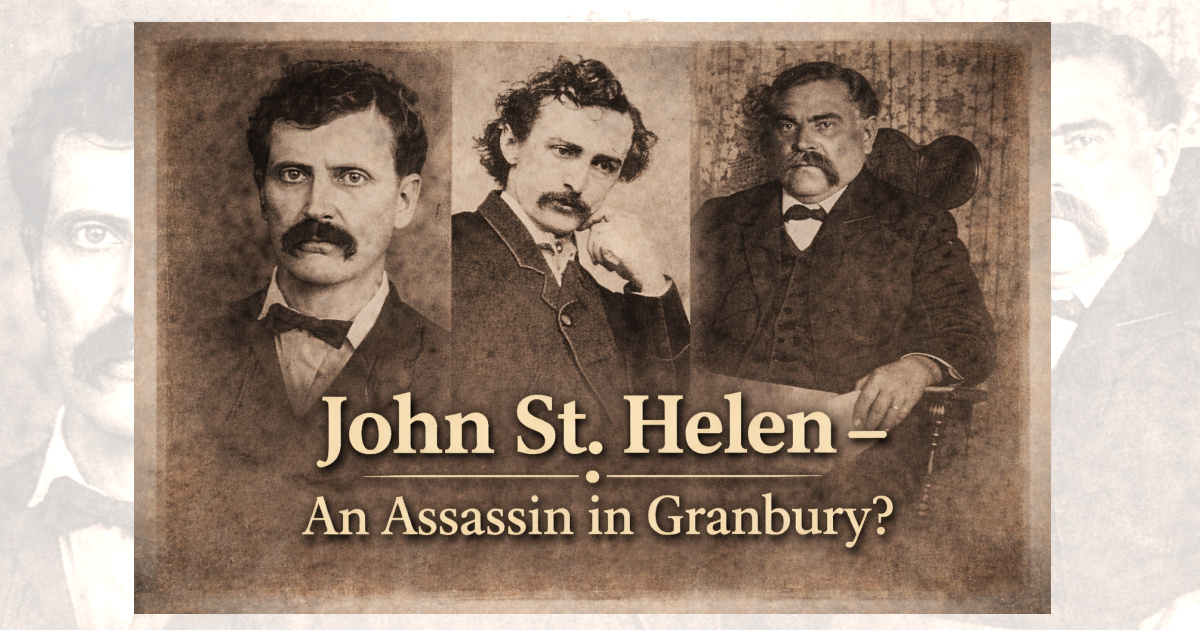
John St. Helen – An Assassin in Granbury?
Part One
A shot fired. The President dead as a nation mourns.
The manhunt begins, and ends, in a smoky blaze of fire. In Tennessee, a wife with infant child wait – abandoned.
In far-away Texas, a young girl stores memories – of the well-dressed stranger who lives with her family briefly on a farm near tiny Glenrose Mills. In frontier Granbury, a young lawyer befriends that stranger – who becomes the cultured teacher in whose temporary courthouse classroom Granbury College began and whose pupils performed a costumed, Shakespearean drama. Come summer, the stranger becomes the volatile, Shakespeare quoting bartender and saloonkeeper who drank only once a year, on the eve of the ides of April.
Decades pass, and relatives tell of the assassin believed dead – met on San Francisco’s streets, seen in a western mining camp… And finally, news of the death by suicide of an elderly Oklahoma man in in 1903, and a final call to that former Granbury lawyer, Finis Bates. Then – a human body – identified, mummified, displayed, disappeared. Bones held in secret, unopened graves shielded by federal courts. Fifty years on, federal agents are deployed – taking the sworn affidavits from 25 of Granbury’s most prominent citizens, collecting tales of a stabbing in his family’s shop…, of a deathbed confession…, of an empty bed – found after the sound of hoof-beats in the night.
And still today, a Nation wonders, awaiting the final act in the crime that shaped its fate – the play’s ending, perhaps forever – unknown. These are the elements, the bare bones – if you will – of a story that has spanned over 161 years, and still has no ending – no certain reality to finally close the book on the story of that greatest of American tragedies: the Civil War. For that is what this is. The assassination of Abraham Lincoln was the final ambush of one brother citizen against another in the nineteenth century war whose divisions our nation still grapples with today. The fact that the true fate of the assassin that waged that last attack is still shrouded in mystery is surely one of the great question marks of the American story.
At the center of this tale is the less than three-year glimpse of a man, that mysterious stranger, John St. Helen. In the spring of 1873 he appeared, arriving from the deep South, to linger here in the valley of the Brazos River on the frontier of Texas. He was alone, yet not alone – one of many immigrants to the area from what had once been the heart of the Confederate States of America. As such he should have felt himself among friends, and perhaps he was, as he soon made a deal for room and board with the family of farmer William McDonald, whose land was on the west side of the river near what is now Glen Rose in Somervell county. Or perhaps it was the cash he always paid with that made him welcome since, by all accounts, St. Helen was – at best – what my grandmother would have called “an odd duck.”
To say he did not blend in with the majority of the locals would have been an understatement. His ready cash was an anomaly in a culture where seasonal crops and or livestock were the primary sources of income. William McDonald’s daughter, Sadie McDonald Rylee, described him in recollections made almost seventy years later: “He was well-educated, and had fine manners, and he always wore the finest kind of clothes,
broadcloth and linen and silk. We would get mail only about every two or three weeks, and he would get lots of mail each time, and some of it would be fine clothing, and we were sure, though we didn’t know, that he got money through the mail. When we and other people of the community would have parties and entertainments, we would get St. Helen to read for us, which he did wonderfully. He was always poised, and he seemed to know Shakespeare by heart. Unless he were hiding out, it would seem strange for a man like him to be in a rough frontier country.”
Who was this cultured, dark-haired stranger; so suddenly appeared, so silent about his origins? Over the last sixteen or so decades a partial answer, most of it supported by some form of actual evidence, has been found. But the final answer, the one that matters, still eludes us. To put flesh on the bones of that story described in the summary above is to give substance to ghostly mystery, for the man called St. Helen appears then disappears again from history like a paranormal wraith in the night. Our only certainty is in the beginning — we know the event from which this man himself claimed John St. Helen sprang.
On April 14, 1865, several years before St. Helen’s arrival in northeast Texas, U.S. President Abraham Lincoln was shot and killed by a derringer wielding assassin as he attended a performance in Ford’s Theater in Washington, D.C. The assassin was a Shakespearean stage actor named John Wilkes Booth. Booth was a member of the then famous Booth family acting dynasty and was one of the most prominent and famous actors of the day. He was also a known Confederate sympathizer. Once Booth leaps from the Presidential box to the stage, and flees into the night, the mystery begins. We know he had accomplices; we know other murders were planned and attempted that night. We know Booth had a well-planned escape route. We know he had knowledge of a people across the Potomac in Southern territory ready to help him vanish. We know he had his broken leg tended by Dr. Samuel Mudd, and we think we know that, at least for a time, he hid in a barn owned by a farmer named Garrett. We know federal troops surrounded the barn. We know they fired multiple shots into the barn. We know the barn caught fire, either set or from a broken lantern, and partially burned. We know there was a body found in the barn afterward.
From there forward are myths and mystery. The myriad versions of the story of how government troops knew of Booth’s supposed presence in the barn, how long he was there, and what exactly transpired that evening do little to assure history of the veracity of the official government version of the tale. Even more staggering are the wildly divergent descriptions from many supposedly reliable sources as to the description and identity of the man who died there that day. But for the purposes of our story, let it suffice to say that descriptions vary from sworn statements that the body
matched the detailed description of John Wilkes Booth who clearly had dark hair and olive skin, to descriptions from supposed eyewitnesses who later swore the body they saw had reddish hair and fair, freckled skin.
From the Virginia confines of the barn on the Garrett’s farm, Booth fled, according to our tale. Heading first south and later west. For the next five plus years he wandered in the shadows, from “safe house” to “safe house,” moving often, and avoiding places where law enforcement or federal troops gathered. Finally, around 1871, he appears in the area of Franklin County, Tennessee, using the name John St. Helen. At this point he apparently decided enough time had passed that he could risk staying put for a while.
Louisa J. Payne was a Confederate Civil War widow. Her first husband, Confederate soldier C. Z. Payne, died in 1865 toward the end of the war. Louisa was left to care for her young son McCager (or Cage). Louisa worked as a seamstress for the recently opened The University of the South in Sewanee, Tennessee. In 1871 Louisa met a man named Jack Booth who claimed he was a distant cousin to John Wilkes Booth. Louisa fell in love and she married Jack in February 1872. However, after the wedding, Jack told Louisa that he had a past, and his name was not really Jack. He confessed that he was actually John Wilkes Booth, the assassin of the Republican President. Louisa, a devout Christian and southern Democrat, could forgive her husband for his war actions and personal deceptions to her, but she insisted that he sign their marriage certificate with his God-given name. And so, on February 24, 1872, a new certificate was signed in the presence of Rev. C. C. Rose, listing the marriage of John Wilkes Booth and Louisa Payne.
The late historiographer for The University of the South, Dr. Arthur Ben Chitty, did extensive research into Louisa Payne and her marriage to the man claiming to be John Wilkes Booth. Dr. Chitty eventually discovered the marriage certificate itself, located in the Franklin County Courthouse in Winchester, Tennessee. Dr. Chitty archived at The University of the South several audio tape interviews of men who personally knew McCager Payne, who in 1872 became John Wilkes Booth’s stepson. Dr. Chitty discovered that McCager had intimate knowledge while a youth that his stepfather was actually John Wilkes Booth.
As a newly married couple Louisa and John Wilkes Booth moved to Memphis, Tennessee, because, as Louisa would later say, “my husband had been told he would be paid a large sum of money owed him for his official work on behalf of the Confederacy.” While in Memphis, Louisa overheard some men on the street discussing her husband and pointing out where the “skunk” was now living. Louisa informed John that the men knew who he was, and his life was in danger. John told Louisa that it would be better if they separated for a season. He would go to Texas, and she should go back to Winchester, Tennessee, until things cooled off. John promised Louisa that he would return to Tennessee after things settled down.
Louisa went back east to Payne’s Cove, Tennessee, and the man claiming to be John Wilkes Booth headed south. Unbeknown to the couple at the time, Louisa was pregnant with John’s child. Louisa Payne would give birth to Laura Ida Elizabeth Booth, named after one of John Wilkes Booth’s sisters, while living alone in Tennessee in early 1873. Her second husband, the man who claimed to be “John Wilkes Booth” had gone to Hood County, Texas, and would change his name to John St. Helen.
Back in Tennessee, during 1873 Louisa Booth received financial help from the family of her deceased first husband. She went to work caring for her son, McCager, and her newborn infant girl. Louisa kept hope that her husband would return to her from Texas, but she never heard from him again. In 1879, 36-year-old Louisa Payne was burning leaves in her front yard when her dress accidentally caught fire. Louisa ran to a nearby creek to douse the flames, but her burns proved fatal. Before she died, Louisa called her six-year-old daughter Laura Ida Booth, and her fourteen-year-old son, McCager Payne, to her bedside. The mother informed her children that Ida’s father was John Wilkes Booth.
McCager Payne would later tell friends that he already knew John Wilkes Booth was his stepfather because of conversations he had overheard between his mother and the man when he was a boy. Caught once listening by his stepfather, McCager recalled being threatened by the man. If he told anyone his stepfather was Booth, the man told the boy, “I will kill you”.
Stay tuned to PART 2 coming Tuesday April 14th.
NOTE FROM THE AUTHOR MELINDA RAY
Some may question the veracity of the information mentioned in this tale of the man those in the Granbury and Glenrose area knew as John St. Helen between 1873 and 1875. I have spent almost twenty years exploring the tales of early Granbury and Hood County and their inhabitants. I began my investigations into the St. Helen tale as an avowed skeptic. After reading Finis L. Bates recounting of the tale, published in 1908 as the book The Escape and Suicide of John Wilkes Booth, I was intrigued. Bates had spent the thirty years between 1875 and 1905 working as a reputable attorney, who dealt on a daily basis with issues of truth and the law. For someone who had spent his life that way to put their reputation on the line by going public with what was sure to be dismissed by many and even by the government as at best a tall tale…got my attention. So, I proceeded to follow in the steps of those who had searched before me, and what I found blew me away.
I found the record of and photos of Booth and Louisa Payne’s marriage certificate from February of 1872 in the courthouse in Franklin County, Tennessee. I also found the tale of their marriage as told by both Louisa’s son, McCager Payne and his half-sister, who lived her entire life as Laura Ida Elizabeth Booth. And then I learned that the federal government of the United States sent 2 Secret Service agents to Hood and Somervell counties in the 1920’s to interview anyone who was still alive who had known St. Helen. There are 25 sworn affadavits from those folks were taken, all signed by a Texas notary. Here are just a few of the names on the list – Ashley Crockett, B. M. Estes, D. C. Cogdell, David Lee Nutt, Katherine Doyle and Sadie McDonald Rylee. The affadavit transcripts and other documentation can be found in two places- the originals are housed in the archives at Georgetown University, and certified copies are held here in Texas, in the collection of the library at San Angelo State University, alma mater of the attorney daughters of Texas native and Federal Judge E.H. Swaim who was involved in the investigation into the case.